
Tarot and Rituals
Astrology and Tarot Together
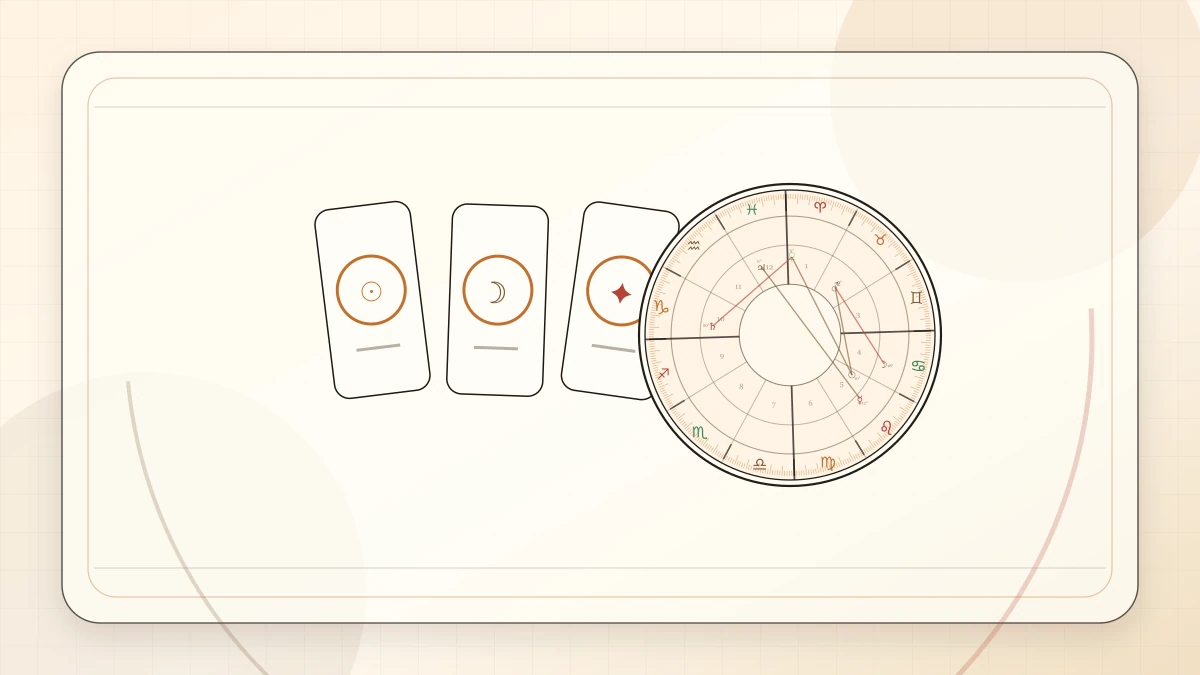
You can combine astrology and tarot through symbolic pairings, such as The Chariot with Cancer, used as reflection prompts. Keep what the chart says and what the card shows on separate lines.
Table of contents
- Example or practical exercise
- What a correspondence is, and where tarot and astrology meet
- Well-known Major Arcana and astrology pairs
- What about the other 56 cards?
- Why the correspondence systems differ
- Keeping the two systems separate in your notes
- A constructed example: Rae, the Moon in Cancer and The Chariot
- How to use the pairs as reflection prompts
- Questions readers ask about combining the two
- A second example: starting from the card and finding it in a chart
- What this does and does not establish
Example or practical exercise
With the Moon at 12 degrees Cancer, Rae draws The Chariot, notes the echo and asks where she is pushing ahead while looking after what she relies on, then decides to finish one task and call a relative.
What a correspondence is, and where tarot and astrology meet
A correspondence is a symbolic link: you pair one thing with another because they share a theme. Tarot and astrology are separate practices, one built on drawn images and the other on positions in the sky, but readers have long paired them. The best-known scheme comes from the Golden Dawn, a late nineteenth-century occult order, which linked the Major Arcana to planets and signs.
These pairs are associations made by people, not discoveries about the cards or the sky. Treat them as a shared vocabulary. When two symbols point at a similar theme, you get two ways of looking at one question.
Well-known Major Arcana and astrology pairs
These are the pairs most often cited. Systems differ, and some authors and decks change a few of them, so no table can be treated as final. Check the book or deck you follow, and use the third column as a prompt and not a rule.
| Major Arcana card | Astrological pair | Shared theme to reflect on |
|---|---|---|
| The Magician | Mercury | Skill, communication and using the tools you have |
| The High Priestess | The Moon | Intuition, cycles and what stays unspoken |
| The Empress | Venus | Nurture, pleasure and what you value |
| The Emperor | Aries | Initiative, structure and will |
| The Lovers | Gemini | Choice, dialogue and two sides of a question |
| The Chariot | Cancer | Moving ahead while protecting what matters |
| Strength | Leo | Warm, patient courage |
| Justice | Libra | Fairness, balance and weighing |
| The Tower | Mars | Sudden force, disruption and cutting through |
| The Star | Aquarius | Hope, shared ideals and a longer view |
| The Moon | Pisces | Imagination, dreams and uncertainty |
| The Sun | The Sun | Clarity, vitality and warmth |
What about the other 56 cards?
The Minor Arcana connect to astrology more loosely. The suits are matched with the elements, Wands with fire, Cups with water, Swords with air and Pentacles with earth, which ties each suit to the three signs of its element. The Golden Dawn also assigned the numbered cards from 2 to 10 to the 36 ten-degree decans of the zodiac. Those assignments are more specialized and vary more between schools, so they are not listed here.
Why the correspondence systems differ
No single authority fixed the pairings. Later writers and deck designers reworked the Golden Dawn scheme, and each had reasons: a different reading of a card's picture, a different tradition about a planet's nature, or a wish to match a deck's own numbering. That is why two respected books can disagree about the same card.
For a beginner the practical lesson is to pick one source and stay with it for a while. Mixing pairings from several sources in the same notebook makes your own patterns harder to see. If you later switch, note the change and the date.
Keeping the two systems separate in your notes
Astrology supplies chart factors that can be computed, such as a Moon sign or an aspect. Tarot supplies a drawn image. Write what the chart says on one line and what the card shows on another, so you always know which came from where.
When the two agree, that is a pleasant echo and not independent confirmation, because the pairings are human associations built to line up. When they disagree, you have two prompts instead of one, which is useful in its own way. Neither one predicts an outcome.
A constructed example: Rae, the Moon in Cancer and The Chariot
Rae is invented. On a given evening a chart calculator puts the Moon at 12 degrees Cancer. Rae asks, “What does this week ask of me?” and draws one card, The Chariot. She writes two separate lines. Astrology: the Moon in Cancer is traditionally linked with home, feeling and protection. Tarot: a charioteer in armor stands under a canopy of stars, with two sphinxes resting before the chariot.
The Chariot and Cancer are a pair in the table, so Rae notices an echo and turns it into a question: where am I pushing ahead while still looking after the people and places I rely on? She decides to finish one task and call a relative. She does not claim that the card or the Moon made anything happen, and she will look back at the end of the week to see whether the question helped.
How to use the pairs as reflection prompts
The routine below takes about ten minutes and needs a deck, a notebook and a chart or Moon sign from any calculator.
- Draw one card and note its name and image before looking up any pairing.
- Find the paired planet or sign in the table and write one word for its theme.
- Ask where the card's picture and the astrological theme agree, and where they differ.
- Turn the overlap into a question about your own week.
- Write one small thing to notice or try, then stop. The practice is for reflection and not for forecasting.
Questions readers ask about combining the two
Do I need to know my chart to use the pairings? No. The table works from the card side: draw a card, look up its pair and ask what that planet or sign means to you. A chart only adds a step if you want to compare the card with where that planet or sign sits in your own chart.
Does drawing The Emperor say something about my Aries placements? No. A card is a drawn image, and the pairing only records which astrological idea is associated with it by convention. Your Sun sign does not make a card more or less likely to appear, and a card says nothing about your chart.
Why are some planets and signs missing from the table? The table lists the commonly cited pairs, and schemes disagree about the rest. The original scheme was built mainly around the seven traditional planets and the elements, so writers who add the planets found later have made different choices. If your deck's guidebook gives a different pairing, follow it consistently.
A second example: starting from the card and finding it in a chart
Sam is invented and uses whole-sign houses with Gemini rising, which makes Aquarius the ninth house. Sam draws The Star, paired with Aquarius, and looks for Aquarius in the chart. It holds Venus, so Venus is in the ninth house, the area of travel, learning and belief.
Sam links the card's themes of hope and a longer view with Venus, the planet of what you value, in a house of learning, and asks: what do I value enough to study? The chart did not explain the card, and the card did not confirm the chart. Together they gave Sam one question to write down.
What this does and does not establish
When the card and the chart agree, it is a pleasant echo, not independent confirmation, because the pairings are human associations built to line up.
Related calculators
Use the matching tool when you want a direct chart or timing result after reading the guide.
Moon Ritual Calculator
Monthly Moon ritual planner that uses exact lunar dates and keeps the ritual layer explicitly symbolic.
Moon Ritual Timing Calculator
Live Moon-phase page that converts the current direction into clearer symbolic ritual-timing guidance.
Best Day for Meditation Calculator
Inspect unranked monthly Moon records and reported station intervals, with coverage limits and optional symbolic themes. Intraday elections remain uncalculated.
Related articles
Keep reading with nearby topics that deepen the same question from another angle.
Moon Phases Explained for Beginners
Moon phases show how much of the Moon's sunlit half we can see as it circles Earth. One 29.5-day cycle splits into eight phases of about 3.7 days, each starting at a multiple of 45 degrees.
6 min read
Full Moon Meaning and Emotional Release
A full Moon is the night the Moon sits opposite the Sun and shows its whole lit face. Emotional release here means a quiet review, such as dropping an expectation, not forcing strong feelings.
6 min read
New Moon Journaling Prompts
Good new Moon prompts ask what you want to begin, the smallest first step and when you will take it. Pick two or three and write for ten to fifteen minutes.
6 min read
A Simple Grounding Ritual After a Heavy Transit
After an hour of heavy transit reading, a ten-minute ritual closes the session: shut the source, write two lines, feel the floor and drink water. Then finish one small task.
6 min read
Keep exploring
Use the category page and the main hubs when you want the next layer of context.
Previous article
New Moon Journaling Prompts
Next article
A Simple Grounding Ritual After a Heavy Transit