
Moon Phases
Moon Phases Explained for Beginners
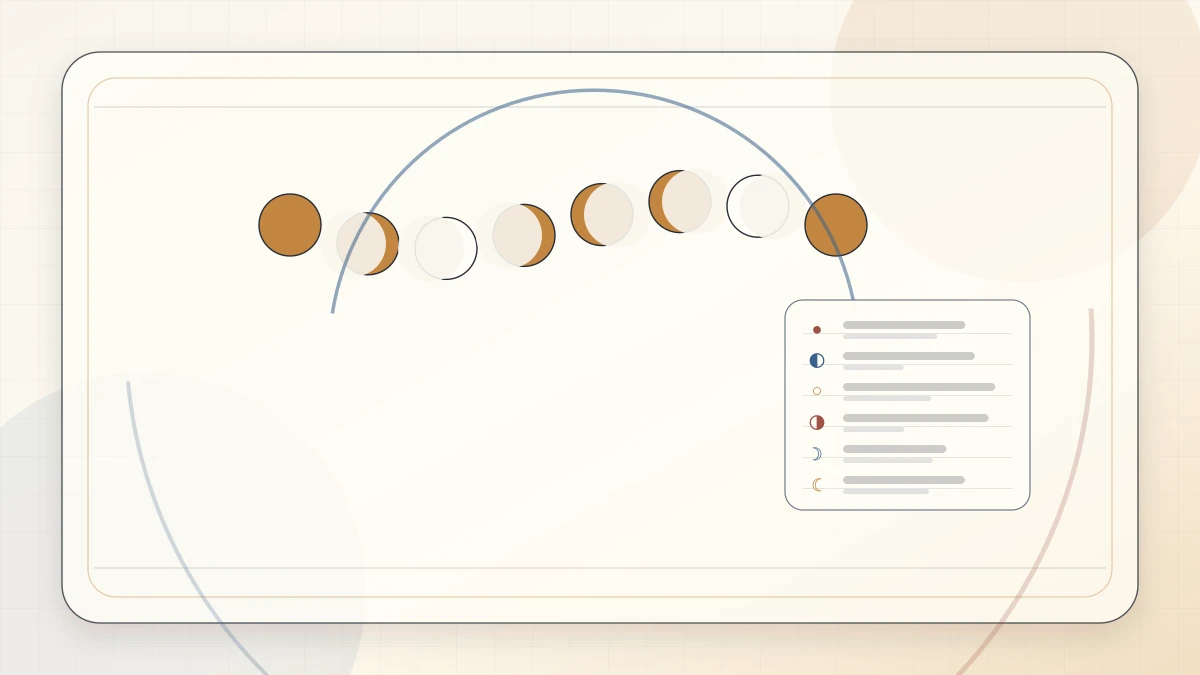
Moon phases show how much of the Moon's sunlit half we can see as it circles Earth. One 29.5-day cycle splits into eight phases of about 3.7 days, each starting at a multiple of 45 degrees.
Table of contents
- Example or practical exercise
- Why the Moon has phases
- The eight phases in order
- How to tell the phases apart in the sky
- How astrology uses the phases
- A simple way to follow one lunar month
- What the phases do and do not do
- A second example: finding the phase from two zodiac positions
- Questions readers ask about the phases
- What this does and does not establish
Example or practical exercise
With the Sun at 5 degrees Aries and the Moon at 20 degrees Leo, the Moon is 135 degrees ahead, exactly where the waxing gibbous band begins.
Why the Moon has phases
The Moon does not make its own light. Half of it is always lit by the Sun, and the phases are simply how much of that lit half we can see from Earth as the Moon travels around us.
When the Moon is between the Earth and the Sun, its lit side faces away and we see almost nothing: a new Moon. When the Earth is between the two, we see the whole lit face: a full Moon. Everything else is a stage between those two.
The phases are not caused by the Earth's shadow. That is a lunar eclipse, a separate and much rarer event.
The eight phases in order
One full cycle, from new Moon to new Moon, takes about 29.5 days. The eight-phase scheme used across this site divides it into eight phases of about 3.7 days each (29.5 divided by 8), each starting at a multiple of 45 degrees. The angle in the table is the band of distance between the Sun and Moon along the zodiac, with the Moon ahead of the Sun. The exact new Moon, quarters and full Moon are the instants at 0, 90, 180 and 270 degrees that open four of the bands.
| Phase | Sun–Moon angle | What you see | Traditional theme |
|---|---|---|---|
| New Moon | 0° to 45° | Little or nothing; the Moon is near the Sun | Beginnings, setting a direction |
| Waxing crescent | 45° to 90° | A crescent in the west after sunset | First steps, gathering what you need |
| First quarter | 90° to 135° | Half the disc or a little more, in the evening | Decisions, pushing past resistance |
| Waxing gibbous | 135° to 180° | More than half, growing | Refining, adjusting the plan |
| Full Moon | 180° to 225° | The whole disc or nearly, most of the night | Culmination, seeing clearly |
| Waning gibbous | 225° to 270° | More than half, shrinking | Sharing, taking stock |
| Last quarter | 270° to 315° | Half the disc or a little less, in the morning | Letting go, changing course |
| Balsamic or waning crescent | 315° to 360° | A thin sliver before dawn | Rest, closing the cycle |
How to tell the phases apart in the sky
“Waxing” means the lit part is growing and “waning” means it is shrinking. You can tell which by when the Moon is visible. A waxing Moon is in the evening sky. A waning Moon rises late and is still up in the morning.
In the Northern Hemisphere a waxing Moon is lit on its right side and a waning Moon on its left. In the Southern Hemisphere it is the other way round, because the Moon is seen the other way up.
The word “quarter” causes confusion. At first quarter you see half the disc lit. The name means the Moon is a quarter of the way around its orbit, not that a quarter of it is showing.
How astrology uses the phases
Astrology treats the lunar month as a small cycle of starting, building, completing and releasing. The waxing half, from new to full, is associated with beginning and adding. The waning half, from full to new, is associated with finishing and clearing away.
Each phase also happens in a zodiac sign. At a new Moon the Sun and Moon are in the same sign, so each month's new Moon carries the flavor of the current Sun sign. At a full Moon they are in opposite signs, which is why a full Moon is read as a balancing act between two opposite themes.
Your own chart records the phase you were born under as well. It is found from the angle between your natal Sun and Moon, and some astrologers read it as a note about temperament.
A simple way to follow one lunar month
The easiest way to learn the phases is to watch one cycle on purpose. You need a calendar that shows the dates of the new and full Moon and five minutes on a few evenings.
- At the new Moon, write down one thing you want to begin or pay attention to this month. Keep it small and specific.
- About a week later, at first quarter, look for the half Moon in the evening sky and note what has got in the way so far.
- At the full Moon, go outside at sunset and watch it rise. Write down what has become clear since you started.
- At last quarter, decide what to drop or finish.
- In the last few days before the next new Moon, do less. Review your notes before starting again.
What the phases do and do not do
The Moon's phase is a physical fact, and its pull does raise the tides. Claims that the full Moon changes human behavior, sleep or birth rates have been tested many times, with weak and inconsistent results.
The astrological use of the phases is best understood as a calendar for reflection: a regular reminder to start, review and let go. Used that way it asks nothing of the Moon except to keep time.
A second example: finding the phase from two zodiac positions
You can name a phase yourself from two positions. Count each position in degrees from the start of Aries, subtract the Sun from the Moon, and add 360 if the answer is negative. Then match the result to the angle column in the table.
Example one: the Sun is at 5 degrees Aries, which is 5, and the Moon is at 20 degrees Leo, which is 120 + 20 = 140. The difference is 135 degrees, exactly where the waxing gibbous band begins.
Example two, where the count wraps: the Sun is at 20 degrees Pisces, which is 330 + 20 = 350, and the Moon is at 5 degrees Taurus, which is 30 + 5 = 35. The Moon minus the Sun is 35 minus 350, or negative 315, and adding 360 gives 45 degrees, the start of the waxing crescent band. On the convention used here, a result of 40 degrees would still be in the new Moon band. Some astrologers center each phase on its multiple of 45 instead, which shifts every boundary by about 22 degrees, so note the convention beside any label that sits near a boundary.
Questions readers ask about the phases
How long is it from a new Moon to a full Moon? About 14 to 15 days, which is half of the 29.5-day cycle. The actual gap varies a little from month to month.
Why does my calendar show a different date from a friend's in another country? A phase is an instant, and the calendar date of that instant depends on the time zone. A full Moon late in the evening in one place can fall on the next date farther east.
Can I see the Moon in daylight? Yes. The Moon is above the horizon for part of the day in every phase, and it is easiest to spot in daylight in the days around the first and last quarters.
What this does and does not establish
The phases keep time and the Moon raises tides, but tests of claims that the full Moon changes behavior, sleep or birth rates show weak, inconsistent results.
Related calculators
Use the matching tool when you want a direct chart or timing result after reading the guide.
Current Moon Phase Calculator
reader-focused-friendly exact current Moon phase page for a selected city and live local timestamp.
New Moon Calculator
Exact monthly New Moon lookup page for reset and intention-planning readers.
Full Moon Calculator
Exact monthly Full Moon lookup page for release, visibility, and completion timing readers.
Calculation references
- NASA: Moon phases
Reference for illuminated phases and physical geometry; not evidence for personal or ritual interpretations.
Related articles
Keep reading with nearby topics that deepen the same question from another angle.
New Moon Journaling Prompts
Good new Moon prompts ask what you want to begin, the smallest first step and when you will take it. Pick two or three and write for ten to fifteen minutes.
6 min read
How to Use the Moon Phase Calendar
Mark the four main phase instants in your own time zone, then use them as short check-ins: begin at new Moon, check at first quarter, review at full Moon and tidy at last quarter.
7 min read
New Moon Meaning and How to Set Intentions
A new Moon is the monthly moment when the Sun and Moon share the same degree. To set an intention, write one small, specific goal you control and schedule its first step.
6 min read
Full Moon Meaning and Emotional Release
A full Moon is the night the Moon sits opposite the Sun and shows its whole lit face. Emotional release here means a quiet review, such as dropping an expectation, not forcing strong feelings.
6 min read
Keep exploring
Use the category page and the main hubs when you want the next layer of context.
Previous article
Karmic Relationship Astrology, Explained Carefully
Next article
New Moon Meaning and How to Set Intentions