
Moon Phases
How to Use the Moon Phase Calendar
Mark the four main phase instants in your own time zone, then use them as short check-ins: begin at new Moon, check at first quarter, review at full Moon and tidy at last quarter.
Table of contents
- Example or practical exercise
- What a Moon phase calendar actually shows
- What each column means
- Converting a full Moon time to your own date: a constructed example
- The void-of-course Moon, explained briefly
- How to build a simple monthly rhythm
- How much time each anchor point needs
- A constructed month on the calendar
- How to avoid over-scheduling
- Set up your calendar in ten minutes
- Questions readers ask about the dates on a calendar
- What this does and does not establish
Example or practical exercise
A constructed full Moon at 02:00 UTC on a Thursday falls at 21:00 on Wednesday for a reader at UTC minus 5, so that reader writes Wednesday in their own calendar.
What a Moon phase calendar actually shows
A Moon phase calendar lays out the lunar cycle against ordinary dates, and used well it gives you a light planning rhythm with four check-ins a month. Each day usually has a small image of the Moon, and some days carry a name or time. Using it well starts with knowing that there are two kinds of information on the page.
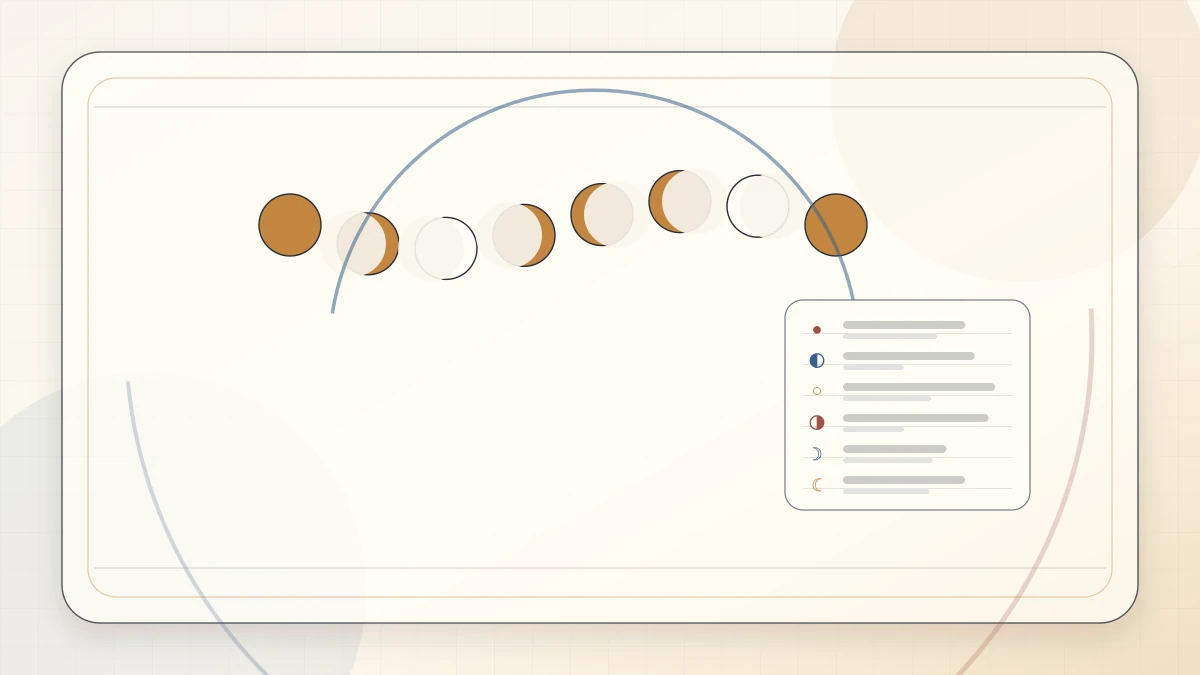
The four main phases (new Moon, first quarter, full Moon and last quarter) are instants, moments measured to the minute. Names such as waxing crescent or waning gibbous describe stretches of days between those instants. A day marked as a full Moon therefore usually means the exact instant falls on that civil date, not that the Moon is full for twenty-four hours.
Because the instants are tied to a clock, the same event can show a different date in a different time zone. Before you plan around a date, check that the calendar states its zone and that it matches yours. A worked conversion follows the table of columns below.
What each column means
Calendars differ in layout, but most include some combination of the columns below. Check which time zone the times use before you trust any of them.
| Column | What it tells you | How to use it |
|---|---|---|
| Date and time | When a phase instant happens | Convert to your own zone if needed |
| Time zone | The reference for the time shown | Look for it in the header or footnote |
| Phase name | The main event or the stage of the cycle | Separate events from stages |
| Moon sign | The sign the Moon is passing through | Optional; the Moon changes sign about every 2.3 days on average |
| Illumination | The share of the visible disk that is lit | Rises toward full, falls toward new |
| Void-of-course | A window with no further exact major aspects | Optional; explained after the conversion example |
Converting a full Moon time to your own date: a constructed example
This example is constructed, not a real event. A calendar lists a full Moon at 02:00 UTC, the world reference clock, on a Thursday. To convert, add your zone’s offset if you are ahead of UTC and subtract it if you are behind. If your zone uses daylight saving time, use the offset in force on that date.
The table below works it through for three readers. The instant is the same for all of them; only the date label changes. The reader at UTC minus 5 should copy Wednesday into their own calendar, because that is the evening the full Moon happens on their clock, not Thursday as the UTC list says. The reader at UTC plus 9 copies Thursday. Convert first, write the date second, and note the zone beside it.
| Zone | Arithmetic | Local time and date |
|---|---|---|
| UTC | The reference time, no change | 02:00 on Thursday |
| UTC minus 5 | 02:00 minus 5 hours goes 3 hours below midnight, so count back from 24:00 to 21:00 and step back one day | 21:00 on Wednesday evening |
| UTC plus 9 | 02:00 plus 9 hours is 11:00, still the same day | 11:00 on Thursday morning |
The void-of-course Moon, explained briefly
In traditional astrology the Moon is void of course from its last exact major aspect in a sign until it enters the next sign. That happens about once per sign, so a dozen or more times a month, and can last from minutes to more than a day. Traditions disagree on which planets and aspects count. It is a symbolic custom, not a tested effect, so leave the column out if it adds noise.
How to build a simple monthly rhythm
You do not need to track every day. Set the calendar up once, then use four anchor points, which are enough to make it useful.
- Mark the four main phase instants for the month in your own time zone.
- At the new Moon, choose one thing to begin and schedule its first step.
- At first quarter, check progress for ten minutes.
- At the full Moon, review the two weeks and decide what to keep.
- At last quarter, clear small loose ends so the next new Moon starts clean.
How much time each anchor point needs
A rhythm is only useful if you will keep it. Here is a modest time budget that fits into a normal week.
| Anchor point | Time | Task |
|---|---|---|
| New Moon | 20 minutes | Choose and schedule one intention |
| First quarter | 10 minutes | Check whether the first step happened |
| Full Moon | 20 minutes | Review and decide |
| Last quarter | 10 minutes | Close loose ends |
A constructed month on the calendar
Suppose a constructed new Moon falls on the 3rd of a month. A quarter of the cycle is about 7.4 days, so first quarter comes near the 10th (3 plus 7.4 is 10.4). The full Moon, 14.8 days after the new Moon, comes near the 18th. Last quarter, 22.1 days after, is near the 25th. The next new Moon, 29.5 days after the 3rd, is day 32.5 of the count, which lands around the 1st or 2nd of the following month after a 31-day month, and a day later after a 30-day month.
That month holds four short sessions and about an hour of calendar time. Everything else in the month is untouched.
How to avoid over-scheduling
A calendar with phases, signs and void windows can turn into a second job. These limits keep it manageable.
- Choose one layer, the phase, and add signs only if you enjoy them.
- Allow a day or two either side of every date. The exact instant rarely matters.
- Do not move real commitments, such as appointments, to fit a phase.
- Keep one blank week a quarter with no lunar tasks at all.
- If you miss a date, use the next convenient evening and carry on.
Set up your calendar in ten minutes
Pick a calendar that states its time zone, copy the four main phases for the coming month into your own calendar app, and add each to your usual reminder. Then give each a single line saying what you will do. If the month goes well, add one layer next month.
Questions readers ask about the dates on a calendar
Why are the gaps between phases not exactly 7.4 days? The Moon’s orbit is an ellipse, so it speeds up and slows down, and the time from one new Moon to the next ranges from roughly 29.3 to 29.8 days. The averages in the monthly example can put a phase half a day or so off its true date, which is why you copy the real instants from the calendar.
Can a month hold two full Moons? Yes. The cycle is about 29.5 days and most calendar months are 30 or 31 days, so a full Moon near the start of a month can be followed by another near its end. The second one is often called a blue Moon, and it comes roughly every two to three years. A year holds twelve or thirteen full Moons.
Do I need to convert every entry? Only the ones you act on. With the four anchor points that is four conversions a month, and the named stretches between them need none, because nobody plans around the exact start of a waxing crescent.
What this does and does not establish
A calendar times the phases but cannot make any date better for a task, so never move real appointments or commitments to fit a phase.
Related calculators
Use the matching tool when you want a direct chart or timing result after reading the guide.
Current Moon Phase Calculator
reader-focused-friendly exact current Moon phase page for a selected city and live local timestamp.
New Moon Calculator
Exact monthly New Moon lookup page for reset and intention-planning readers.
Full Moon Calculator
Exact monthly Full Moon lookup page for release, visibility, and completion timing readers.
Calculation references
- NASA: Moon phases
Reference for illuminated phases and physical geometry; not evidence for personal or ritual interpretations.
Related articles
Keep reading with nearby topics that deepen the same question from another angle.
New Moon Journaling Prompts
Good new Moon prompts ask what you want to begin, the smallest first step and when you will take it. Pick two or three and write for ten to fifteen minutes.
6 min read
Moon Phase Birthday Meaning
Your birth Moon phase is the angle between the Sun and Moon when you were born, and it stays fixed for life. The phase on each year's birthday changes and is just a calendar note.
6 min read
Void-of-Course Moon Explained
A void-of-course Moon is the stretch between the Moon's last major aspect in a sign and its entry into the next sign, which happens about every 2.3 days. It can last minutes or more than a day.
6 min read
Moon Phases Explained for Beginners
Moon phases show how much of the Moon's sunlit half we can see as it circles Earth. One 29.5-day cycle splits into eight phases of about 3.7 days, each starting at a multiple of 45 degrees.
6 min read
Keep exploring
Use the category page and the main hubs when you want the next layer of context.
Previous article
Moon Phase Birthday Meaning
Next article
Void-of-Course Moon Explained