
Career Astrology
Best Places for Career by Astrocartography? How to Read a Career Map
An astrocartography career map shows where planetary lines fall on the globe, not where jobs are. Treat a line near a place as a prompt for questions, then research the practical facts.
Table of contents
- Example or practical exercise
- What an astrocartography map actually shows
- The four line types, read for work
- How planets are popularly read on a career map
- How far from a line counts?
- Why most places sit near some line
- A constructed example: measuring one city against one line
- How to use a career map as a set of questions
- Common questions about career astrocartography
- A short reflection to write before you open any map
- What this does and does not establish
Example or practical exercise
Elena's invented Jupiter Midheaven line runs at 10 degrees east, and a city at 13.4 degrees east and 52 north lies about 145 miles away, which prompts questions about work, language, costs and permits.
What an astrocartography map actually shows
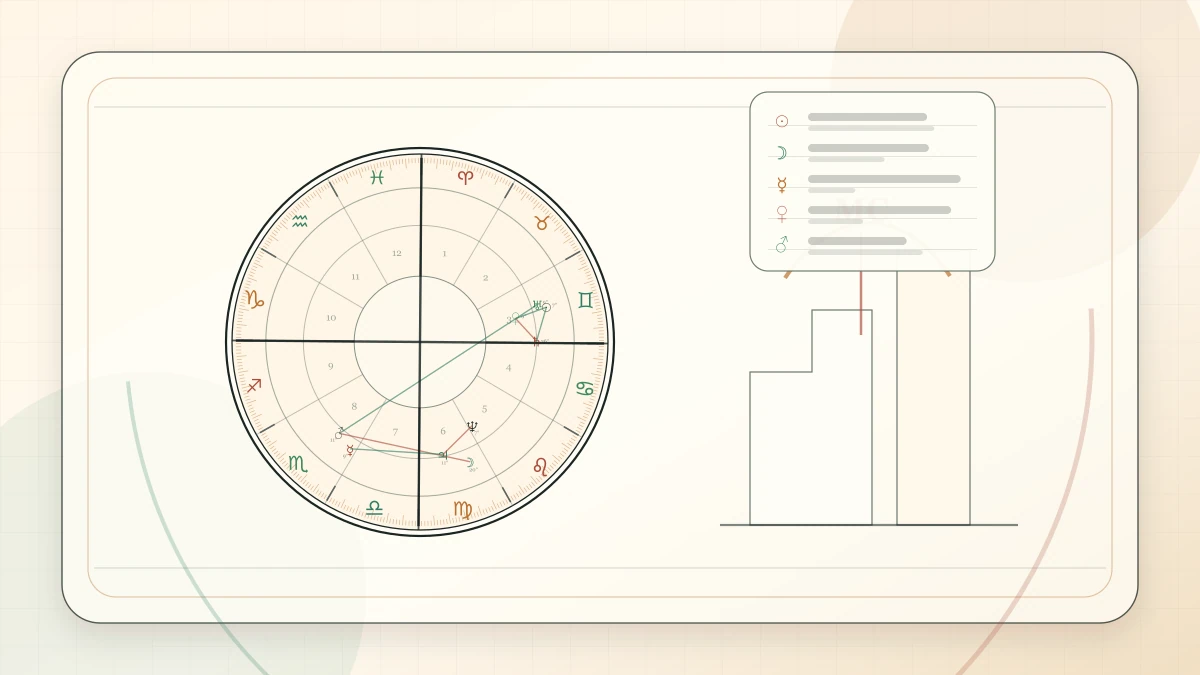
Astrocartography takes your birth chart and projects it onto a map of the world. For each planet it draws lines where that planet stood on one of the four chart angles at the moment you were born: the Ascendant (rising on the eastern horizon), the Descendant (setting in the west), the Midheaven (highest in the sky) or the Imum Coeli (lowest, opposite the Midheaven).
The lines describe geometry: where on Earth a planet would have been on an angle at your birth time, with a tradition of interpretation attached to each. They do not describe job markets, wages, visa rules or daily life, so no map can name the best place for your career. What a career map can do is raise questions about places you might like to work, and this guide shows how to read it that way.
The four line types, read for work
Each angle carries a different kind of theme, which is why a Midheaven line and an Imum Coeli line from the same planet are read quite differently.
| Line | Angle | Theme often attached | A question it can raise |
|---|---|---|---|
| Midheaven (MC) | Highest point | Public role, reputation and direction | Where would I like to be visible, and for what? |
| Imum Coeli (IC) | Lowest point | Home base, roots and private foundations | What kind of base do I need to work from? |
| Ascendant (AC) | Rising point | Self-presentation and how you begin things | In what setting do I feel most like myself at work? |
| Descendant (DC) | Setting point | Partnerships, clients and collaborators | Which working relationships do I want nearby? |
How planets are popularly read on a career map
Popular career readings often say that Sun and Jupiter lines suggest visibility and opportunity, Saturn lines effort and structure, Venus lines collaboration and taste, Mercury lines communication and learning, and Mars lines drive and friction. These are modern conventions rather than one agreed tradition, and astrocartographers disagree about them.
Read them as descriptions of atmospheres you might ask about, not as forecasts. A Saturn line is not a place where work is hard, and a Jupiter line is not a place where it is easy. Every line appears in people who live happy and unhappy working lives alike.
How far from a line counts?
There is no official distance. Astrocartographers commonly allow a band of a few hundred miles on either side of a line, and they disagree about how wide it should be. The size of that band in degrees depends on latitude, because a degree of longitude shrinks as you move away from the equator.
A degree of longitude is about 69 miles at the equator and about 49 miles at 45 degrees north or south (69 × 0.707). A band of 300 miles therefore spans about 300 ÷ 69 = 4.3 degrees of longitude at the equator, but about 300 ÷ 49 = 6.1 degrees at 45 degrees of latitude. Midheaven and Imum Coeli lines run straight north and south along a line of longitude, so this matters when you measure a city’s distance from one.
Why most places sit near some line
A typical map shows ten bodies with four lines each, forty lines in all. Spread across the inhabited world, forty bands a few hundred miles wide cover a great deal of it, so most cities sit within range of at least one line and many sit near two or three.
That means a map can be read as supportive of nearly any place if you choose the line you like and set the rest aside. It also means the lines are weak evidence for any single location. Their value lies in the questions they raise, not in picking winners.
A constructed example: measuring one city against one line
Elena is an invented person whose chart program draws a Jupiter Midheaven line at 10 degrees east longitude. A city she has been curious about sits at 13.4 degrees east and 52 degrees north. The difference is 13.4 − 10 = 3.4 degrees of longitude.
At 52 degrees north a degree of longitude is about 69 × 0.616 = 42.5 miles, so the city lies about 3.4 × 42.5 = 145 miles from the line, inside a 300-mile band. Her next step is not a decision about the city. It is a list of questions: what work exists there, what language is used, what the rules about working there require of her, what living there costs, and who she would know.
Notice what the arithmetic did and did not do. It told her that the city is close to a line on a map. It said nothing about whether jobs exist, whether she may legally work there, or whether she would be happy.
How to use a career map as a set of questions
If you want to explore a map, keep the practical world in charge. The sequence below puts the lines last.
- Write what you want from a work environment in plain words: pace, size of organization, language, climate and distance from family.
- Look at the lines near places you already have a practical reason to consider.
- For each line, read the theme and turn it into a question about what you would like.
- Compare the answers with what you can check: job listings, eligibility, costs, health care, safety and time zones.
- Talk with people who live and work in the place before taking any larger step, if it still interests you.
- Set the map aside whenever it conflicts with the facts you collected.
Common questions about career astrocartography
Does birth time matter? A great deal. The Earth turns one degree of longitude every four minutes, so a birth time that is off by 20 minutes moves Midheaven and Imum Coeli lines by 5 degrees of longitude, about 345 miles at the equator. Without a reliable birth time the map is not worth much.
Do the lines move if I do? No. They are fixed by your birth moment and are not updated by where you live. Astrologers who study timing add transits to them, but that is a separate and even less tested method.
Is there a best city for my career? No map or line can identify one. Moving is a big decision that depends on money, family, visas, language, law and health, and those facts outweigh any line. People work well and badly in every place.
Can I use the lines to decide on a move? No. Lines can start a conversation about environments you might like, but a relocation decision belongs with the facts and the people involved and, for visas and contracts, with qualified advisers.
A short reflection to write before you open any map
Most people open a map hoping it will name a place. A better start is to say what you want from a place. Write a few lines for each prompt below.
- What kind of daily environment helps me think clearly?
- Which people, languages and landscapes do I want within reach?
- What would I need to check before I could take any place seriously?
What this does and does not establish
No line can identify a best city for your career or show whether jobs exist or you may legally work there.
Related calculators
Use the matching tool when you want a direct chart or timing result after reading the guide.
Astrocartography Calculator
Advanced relocation analysis built from exact astrocartography line geometry and the current location set.
Astrocartography Map Calculator
chart-based map-overview page that groups exact astrocartography line families and the strongest matches from the current location set.
Best Places For Career Calculator
chart-based location list that orders cities by distance to the nearest planetary line, using exact astrocartography geometry; it does not rate any place for career.
Calculation references
- Swiss Ephemeris: positions, angles and house-system conventions
Technical reference for calculation conventions. It does not certify an interpretation or mean every live tool uses this engine.
Related articles
Keep reading with nearby topics that deepen the same question from another angle.
Midheaven Sign Meaning
Your Midheaven sign describes the public style you tend to show in your work and reputation, such as precise and helpful for Virgo. Its ruler and nearby planets add detail.
6 min read
Career Astrology for Beginners
Career astrology reads six layers: the tenth house and Midheaven for public role, the sixth for daily work, the second for resources, and the Sun, Saturn and Mars for purpose, discipline and drive.
6 min read
Work Burnout Patterns in Astrology, Carefully Framed
Astrology cannot diagnose burnout. Its symbols, such as the sixth house, Saturn, Mars and the Moon, can only sharpen questions about a work week you have already measured in hours, breaks and demands.
6 min read
Career Astrology Guide: A Reading Path
Read career astrology in six steps: the Midheaven, the tenth house and its ruler, the sixth house, the second house, Saturn and Jupiter, then the Sun, Moon and Rising signs.
6 min read
Keep exploring
Use the category page and the main hubs when you want the next layer of context.
Previous article
Work Burnout Patterns in Astrology, Carefully Framed
Next article
Life Path Number Guide: What the Number Can Help You Reflect On