
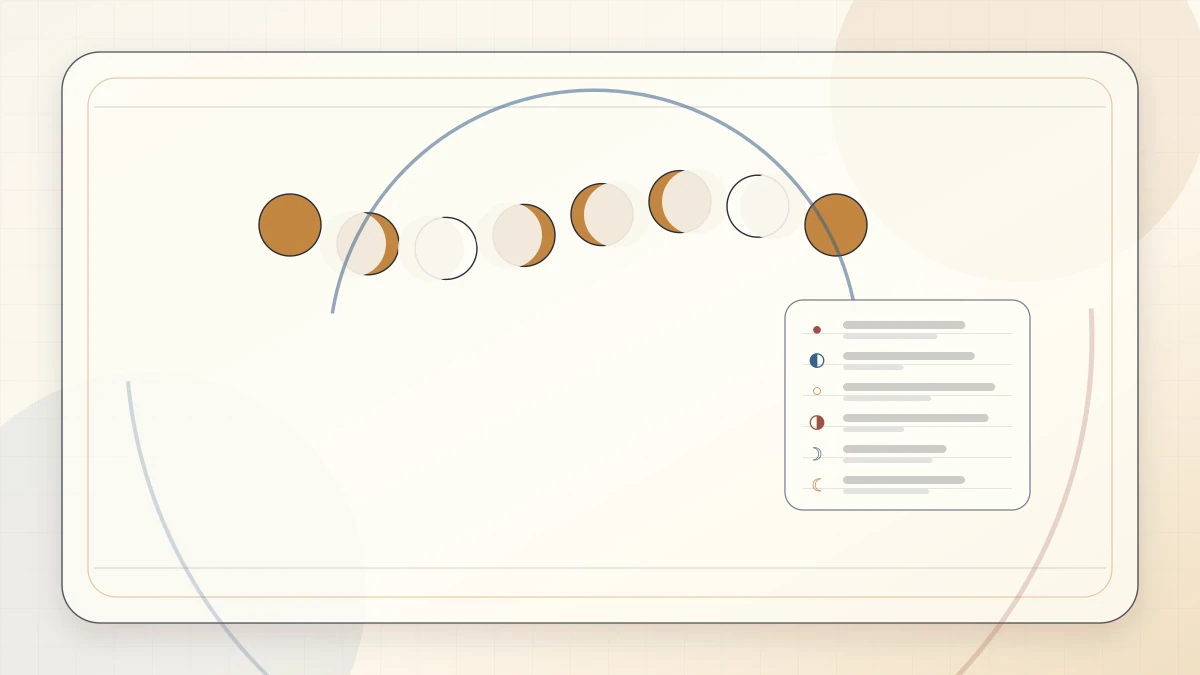
Moon Phases
How to Plan Around the Waning Crescent Moon
The waning crescent is the last stretch before the new Moon, about 3.7 days in the eight-phase scheme. Use it to finish small tasks, trim commitments and rest.
Table of contents
- Example or practical exercise
- How to tell you are in the waning crescent
- How to count the days left until the new Moon
- A late-cycle wind-down plan
- A constructed example: ten items on a list
- What to close, what to keep and what to reconsider
- A twenty-minute close-out session
- What the waning crescent is not a reason to delay
- Rest counts as planning too
- The nights just before the new Moon
- Hand off to the next cycle
- Common questions about planning in the waning crescent
- What this does and does not establish
Example or practical exercise
Priya starts the last week with ten to-do items, keeps two with hard deadlines, finishes three, drops two and asks a colleague about one, carrying five into the next cycle.
How to tell you are in the waning crescent
The waning crescent is the last stretch of the lunar cycle, after the last quarter and before the new Moon. In the Northern Hemisphere you see a thin crescent lit on the left, rising shortly before dawn. The Moon is shrinking, and the cycle is about to start again.
How long it lasts depends on how you count. If you use the final 45-degree slice of the Sun-Moon angle (315 to 360 degrees), it lasts about 3.7 days. If you count everything after the last quarter, it is about a week.
How to count the days left until the new Moon
The angle between the Moon and the Sun grows about 12 degrees a day, and the new Moon arrives when it reaches 360. So days remaining is the gap to 360 divided by about 12.
At an angle of 330 degrees, the gap is 30 degrees, which is about 2.5 days. At 300 degrees it is 60 degrees, about 5 days. A moon calendar or the current Moon phase calculator on this site shows the angle or the date.
A late-cycle wind-down plan
This table spreads the work over the last week. Shrink or skip any row.
| Stage | Focus | About how long |
|---|---|---|
| Last quarter to early crescent | List what is unfinished and mark what is truly due | 15 minutes |
| Mid crescent | Finish one small task and close one open loop | 30 minutes |
| Late crescent | Reduce one commitment or tidy one space | 20 minutes |
| Final nights before the new Moon | Rest, look back, then draft next cycle's first step | 10 minutes |
A constructed example: ten items on a list
Priya, a made-up person, has ten items on her to-do list at the start of the last week. Two have hard deadlines, so they stay where they are. She finishes three small tasks, drops two that no longer matter, and asks a colleague about a fourth.
That leaves five of the ten items to carry into the next cycle, two of them with fixed deadlines, which is a manageable number. Nothing about the Moon cleared the list; the pause to sort it did.
What to close, what to keep and what to reconsider
A quick way to sort the list is to ask what each item really needs from you, and the answer usually puts it into one of these groups.
- Close: small tasks that take under ten minutes and have been nagging at you.
- Keep: anything with a real deadline or that someone else is relying on.
- Reconsider: commitments you took on out of habit, which you could shrink, delegate or decline.
- Drop: tasks that no longer serve the goal they were attached to.
A twenty-minute close-out session
This works on any evening during the waning crescent.
- Write every unfinished task and commitment on one page, five minutes.
- Mark real deadlines, and set those aside because they stay where they are.
- Pick one item to finish, one to drop and one to reconsider.
- Do the quick one now if it takes under ten minutes.
- Write one sentence about what you want next cycle to hold, and stop.
What the waning crescent is not a reason to delay
A thin Moon is not a reason to put off necessary work, bills, appointments or care for other people. Late-cycle planning is about finishing and trimming, so do not use it to avoid starting something that is genuinely due. Decisions about health, money, law or safety belong with qualified people.
If low energy or a flat mood is a regular pattern for you, a diary can show whether it follows the Moon, and there is no good evidence that it reliably does. If tiredness or low mood persists, speak with a doctor or a qualified professional.
Rest counts as planning too
A cycle that ends in rest tends to start better than one that ends in a scramble. Many people use the waning crescent to simplify: an earlier night, fewer new obligations, a slower evening. There is no good evidence that the Moon has anything to do with it, but the habit of ending a cycle gently is useful on its own terms.
If you work shifts, care for others or cannot slow down, take the idea in a smaller form. Ten quiet minutes and one dropped task is a perfectly good version.
The nights just before the new Moon
In the last one to three nights, the Moon is usually too thin to see before it disappears. Some people call this the dark Moon, though others use that word for the new Moon itself, so there is no single meaning.
It is a natural time to stop planning and simply rest. A short review of the past cycle, written in a few lines, makes a good handoff to the next one.
Hand off to the next cycle
On the last evening, copy the items you are carrying forward onto a fresh page and add the single most important step for the new Moon. This keeps the end of one cycle tied to the start of the next without turning either into a big event.
If you keep a journal, write what you finished, what you let go of and what you learned. Five lines is plenty.
Over several cycles these notes become a record you can read back. You may notice that the same tasks keep landing on the list, which tells you something real about what to change, whatever phase the Moon is in.
Common questions about planning in the waning crescent
Is the waning crescent a bad time to start things? No. It is a traditional time to finish and release, but nothing prevents you from starting what is ready.
How is this different from the balsamic phase? In many systems they are the same stretch. The word balsamic refers to the last 45 degrees, and waning crescent is the more familiar sky name.
Can I plan by the Moon sign too? You can note it, but the phase alone is enough for most people.
What if I feel energetic in this phase? Then use the energy. A traditional theme is a suggestion, and your own experience comes first.
What this does and does not establish
A thin Moon is never a reason to put off necessary work, bills, appointments or care for others, and the Moon itself clears nothing from the list.
Related calculators
Use the matching tool when you want a direct chart or timing result after reading the guide.
Current Moon Phase Calculator
reader-focused-friendly exact current Moon phase page for a selected city and live local timestamp.
New Moon Calculator
Exact monthly New Moon lookup page for reset and intention-planning readers.
Full Moon Calculator
Exact monthly Full Moon lookup page for release, visibility, and completion timing readers.
Calculation references
- NASA: Moon phases
Reference for illuminated phases and physical geometry; not evidence for personal or ritual interpretations.
Related articles
Keep reading with nearby topics that deepen the same question from another angle.
Moon Calendar Basics for Beginners
A Moon calendar lists phases, sign changes, moonrise and moonset, and sometimes void-of-course windows. Phases and sign changes are shared instants, while moonrise depends on where you are.
7 min read
What to Do During the Waxing Crescent Moon
Use the waxing crescent, the band about 3.7 to 7.4 days after the new Moon, to take one small first step you can finish in a single sitting and review at first quarter.
6 min read
Moon Phases Explained for Beginners
Moon phases show how much of the Moon's sunlit half we can see as it circles Earth. One 29.5-day cycle splits into eight phases of about 3.7 days, each starting at a multiple of 45 degrees.
6 min read
New Moon Meaning and How to Set Intentions
A new Moon is the monthly moment when the Sun and Moon share the same degree. To set an intention, write one small, specific goal you control and schedule its first step.
6 min read
Keep exploring
Use the category page and the main hubs when you want the next layer of context.
Previous article
Moon Calendar Basics for Beginners
Next article
What to Do During the Waxing Crescent Moon