
Love Compatibility
How to Read Attraction vs Long-Term Compatibility
Read attraction and long-term compatibility as two separate columns: Venus and Mars contacts for the pull, and Sun, Moon and Saturn contacts for steadiness. One never answers the other.
Table of contents
- Example or practical exercise
- Attraction and long-term compatibility describe different things
- What astrologers associate with each, in a table
- Why the two can point in different directions
- A constructed pair, with two columns
- Reading the columns without turning them into a verdict
- When one column is strong and the other is quiet
- How to keep the two apart when you read your own pair
- The evidence that belongs next to the chart
- Common questions about attraction and long-term fit
- Neither a chart nor chemistry decides the outcome
- What this does and does not establish
Example or practical exercise
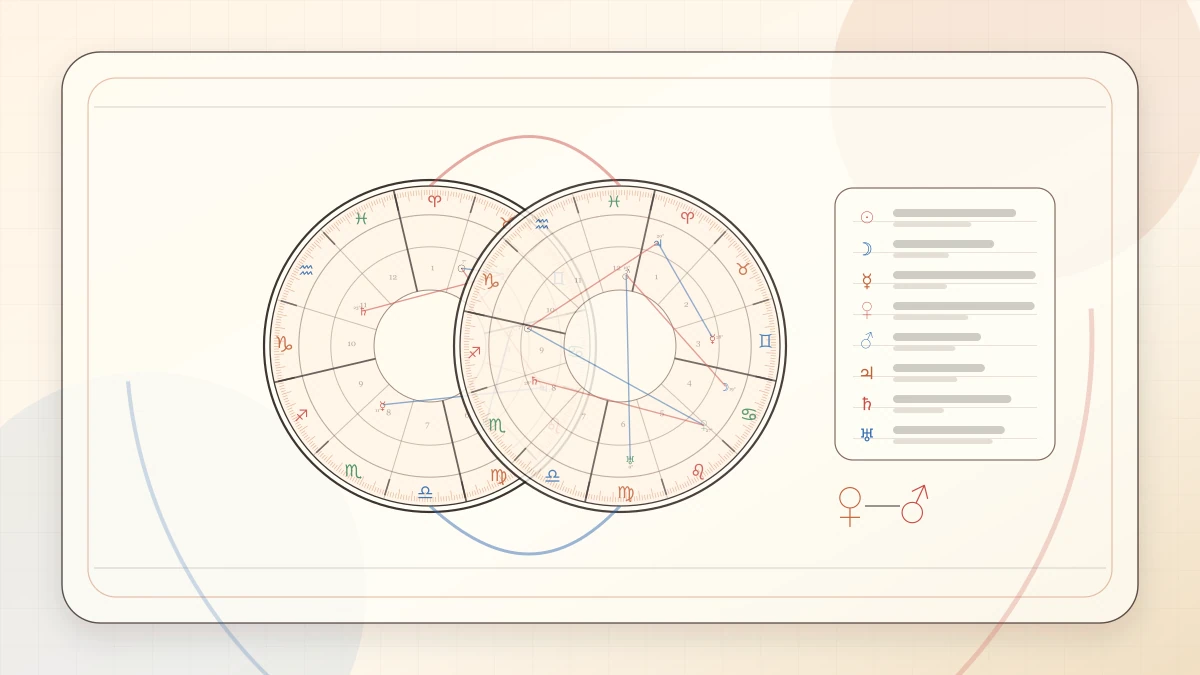
P's Venus squares Q's Mars in the attraction column, while their earth Moons form a trine and P's Sun conjoins Q's Saturn in the stability column.
Attraction and long-term compatibility describe different things
Attraction is the pull: curiosity, chemistry, the wish to be near someone. Long-term compatibility is about how two people function across ordinary weeks: how they handle plans, disagreement, rest and each other's families and friends. Most people have met someone with whom the first was strong and the second hard, or the reverse.
Astrologers read the two with somewhat different parts of a comparison chart. The purpose of separating them is to keep one from standing in for the other. A strong pull is not evidence of fit, and a calm fit does not mean something is missing.
What astrologers associate with each, in a table
Synastry is the comparison of one person's planets with another's. The lists below are traditional associations and vary between astrologers.
| Question | Often read for attraction | Often read for stability |
|---|---|---|
| What draws you together? | Venus and Mars contacts; Mars to the Ascendant | Sun and Moon contacts |
| What keeps the spark? | Uranus or Pluto touching Venus, Mars or the Moon | Jupiter contacts to personal planets |
| What gives it weight? | Contacts that feel intense, such as a close Pluto aspect | Saturn contacts to the Sun, Moon or Venus |
| How do you talk? | Mercury and Mars: lively debate | Easy Mercury and Moon contacts |
| What shared ground is there? | Fifth house overlays: romance and play | Fourth and seventh house overlays: home and partnership |
Why the two can point in different directions
Difference creates charge. Squares and oppositions often feel exciting because the two people bring contrasting energy, and astrologers link this friction with chemistry. Sameness creates ease. Trines and shared elements tend to feel comfortable, and comfort can look quiet beside a strong pull.
Saturn is the classic example. Saturn contacts are traditionally linked with commitment and seriousness, which can feel heavy early and dependable later. A Pluto contact can feel intensely magnetic, and the same intensity can demand honest conversation about control and privacy. None of this means the exciting pair is doomed or the calm pair is safe. It means the two kinds of contact ask different questions.
A constructed pair, with two columns
Person P has Venus at 6 degrees Virgo, the Moon at 20 Capricorn and the Sun at 10 Libra. Person Q has Mars at 8 Sagittarius, the Moon at 18 Taurus and Saturn at 13 Libra. Both are constructed. Virgo starts at 150, Sagittarius at 240, Capricorn at 270, Taurus at 30 and Libra at 180.
| Column | Contact | Positions | Gap | Aspect and orb |
|---|---|---|---|---|
| Attraction | P's Venus to Q's Mars | 156 and 248 | 92 | Square, orb 2 |
| Stability | P's Moon to Q's Moon | 290 and 48 | 242, so 118 | Trine, orb 2 |
| Stability | P's Sun to Q's Saturn | 190 and 193 | 3 | Conjunction, orb 3 |
Reading the columns without turning them into a verdict
The Venus-Mars square gives the pair a charged, friction-rich attraction column. The Moon trine in earth signs and the Sun-Saturn conjunction populate the stability column with themes of comfort and seriousness. A reader could say: there are prompts for both chemistry and steadiness. The Saturn contact may feel like responsibility, so the pair could talk about how Q's feedback lands on P.
It is just as important to say what the chart does not show. It does not show whether either person is kind, whether they want the same future or whether they keep their word. Those answers come from conduct over time.
When one column is strong and the other is quiet
A pair with many attraction contacts and few stability contacts is often described as intense early on and in need of deliberate structure later: agreed routines, clear plans and honest talk about expectations. A pair with the reverse pattern is often described as steady, and may want to add play, novelty and time set aside for each other.
Both descriptions are tendencies. People supply structure and play themselves, and a quiet column can be filled by choice as readily as a strong one can be neglected.
How to keep the two apart when you read your own pair
Follow this order so that chemistry does not quietly answer the stability question.
- Pick two columns: attraction and stability.
- Sort each contact within about 4 degrees into one column, using the table above.
- Record the real-world evidence first: what you enjoy together in one column and how you handle plans, disagreement and time in the other.
- Compare chart themes with the evidence only afterward, and note where they match and where they do not.
- Discuss any mismatch between the two columns as a question, not a diagnosis.
The evidence that belongs next to the chart
A chart reading works best when it sits next to observed behavior. The short list below is one way to collect it.
- Whether each person keeps small promises, such as turning up on time.
- How a disagreement ends: with a repair, a silence or a pattern that repeats.
- How each treats the other's friends, family and time.
- Whether each can say no, and be heard.
- How shared plans, such as a trip or a home, are discussed.
Common questions about attraction and long-term fit
Does strong attraction mean a relationship is meant to last? No. It means there is a pull. Whether the pair functions over years depends on communication, respect and shared goals.
Does a calm chart mean there will be no passion? Also no. Many couples with easy contacts feel plenty of chemistry, and many with tense ones feel little.
Can attraction grow over time? It often can, as trust and familiarity build. Interest can also fade, which is ordinary.
Which should I weigh more? Neither on its own. Ask what you need now and what you want to build, and use the chart only to organize the questions.
Neither a chart nor chemistry decides the outcome
Choices, effort and circumstances shape a relationship, and so does how each person treats the other. Strong attraction cannot make up for coercion, disrespect or goals that cannot be reconciled. If you feel pressured or unsafe, put your safety first and talk with someone you trust.
What this does and does not establish
A chart cannot show kindness, shared goals or kept promises, and strong attraction never makes up for coercion; if you feel unsafe, put your safety first.
Related calculators
Use the matching tool when you want a direct chart or timing result after reading the guide.
Birth Chart Compatibility Calculator
Higher-trust compatibility report built from two verified natal charts and exact synastry analysis.
Synastry Chart Calculator
Compare two birth charts for relationship patterns, emotional rhythm, attraction, and communication themes.
Zodiac Compatibility Calculator
Broad sign-to-sign compatibility page tuned for lifestyle readers.
Calculation references
- Swiss Ephemeris: positions, angles and house-system conventions
Technical reference for calculation conventions. It does not certify an interpretation or mean every live tool uses this engine.
Related articles
Keep reading with nearby topics that deepen the same question from another angle.
Can Opposite Zodiac Signs Work in Love
Opposite signs sit six signs apart and share a modality, so they are read as two ends of one theme. Whether a pair works depends on the two people, not the axis.
6 min read
Relationship Astrology for New Relationships
In a new relationship, use astrology to raise questions about pace, contact and comfort, then ask the person and listen. What they say and do tells you far more than a sign.
6 min read
Zodiac Compatibility: How to Read Love Matches
To read a zodiac match, compare the two signs' elements, then their modalities, then count how many signs apart they sit. The result is a first look, not a judgment on a relationship.
6 min read
Moon Sign Compatibility Explained
Moon sign compatibility compares how two people seek comfort and settle after a hard day, by element, modality and the exact angle between their Moons. It gives words for differences, not a ranking.
6 min read
Keep exploring
Use the category page and the main hubs when you want the next layer of context.
Previous article
Can Opposite Zodiac Signs Work in Love
Next article
Relationship Astrology for New Relationships