
Career Astrology
How to Read Career Themes in a Birth Chart
Read career themes as a weave of three houses: the tenth for public role, the sixth for daily work and the second for resources. Follow each house ruler and its aspects, and phrase every finding as a question.
Table of contents
- Example or practical exercise
- Career themes are a weave, not a job title
- The three houses and the question each one asks
- Five steps for reading your own chart
- A constructed chart: Capricorn Rising with whole-sign houses
- What the constructed chart suggests, as questions
- Where Saturn and Jupiter fit
- How to weigh clues that point in different directions
- What if a house is empty?
- What this reading cannot tell you
- Common questions about career themes
- What this does and does not establish
Example or practical exercise
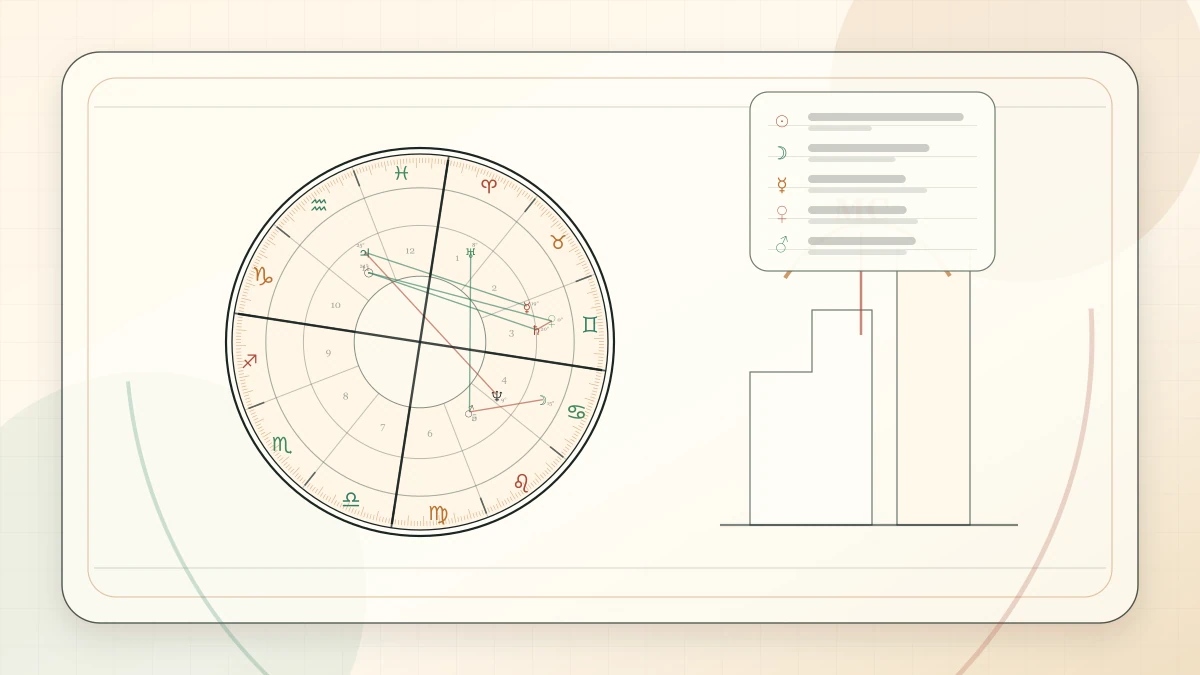
In a constructed Capricorn-rising chart, Venus, ruler of the Libra tenth, sits in the eleventh, and Mercury, ruler of the Gemini sixth, sits in the twelfth, raising questions about visibility in groups and quiet daily work.
Career themes are a weave, not a job title
A birth chart does not say what job you should hold, and no sign or placement belongs to one occupation. Every sign and every house appears among doctors, teachers, mechanics and artists. What a chart offers is vocabulary for thinking about three related questions: how you are seen at work, how you handle daily tasks, and what you value in return for effort.
Astrologers usually read those questions through three houses. The tenth is the public role, the sixth is daily work and routine, and the second is resources and values. Each house has a ruler, and where that ruler sits ties the houses together. This guide is the reading procedure: the order of steps, a worked chart and a way to weigh clues that disagree. If you want each layer explained from the beginning, start with our guide Career Astrology for Beginners.
The three houses and the question each one asks
Houses need a birth time, because they depend on the Ascendant. Planets in signs do not, so a reading without a time is partial.
| House | Traditional topic | Reflection question |
|---|---|---|
| Second | Resources, possessions and values | What do I want my effort to give me or others? |
| Sixth | Daily work, routines and service | What does a good working day look like? |
| Tenth | Public role and responsibilities | What do I want to be known for or responsible for? |
Five steps for reading your own chart
Take about twenty minutes and write brief notes at each step.
- Note the sign on the cusp of each house, or the sign that fills it if your chart uses whole signs.
- Find the traditional ruler of each of those signs and note its sign and house.
- List any planets inside each house.
- Look for close aspects among the rulers and any planets inside the houses.
- Turn each finding into a question, not a conclusion.
A constructed chart: Capricorn Rising with whole-sign houses
This chart is invented for the procedure. With Capricorn rising in whole-sign houses, Aquarius is the second house, Gemini the sixth and Libra the tenth. The traditional rulers are Saturn for Aquarius (modern readers add Uranus; this reading uses Saturn), Mercury for Gemini and Venus for Libra.
Put Venus at 12 degrees of Scorpio (210 + 12 = 222 on the zodiac wheel) in the eleventh house, Saturn at 10 degrees of Leo (120 + 10 = 130) in the eighth, and Mercury at 8 degrees of Sagittarius (240 + 8 = 248) in the twelfth. These are made-up placements chosen for the arithmetic.
What the constructed chart suggests, as questions
Venus, ruler of the tenth, in the eleventh house links the public role to groups and networks. A reader might ask what kind of team or community the person wants to be visible in.
Mercury, ruler of the sixth, in the twelfth house, the traditional house of retreat, places daily work out of sight. The question becomes how much of an ordinary day this person wants to spend in quiet, unobserved work. Saturn, ruler of the second, in the eighth ties personal resources to shared arrangements, so the question is how values meet joint commitments.
The aspects add detail. Venus at 222 and Saturn at 130 are 92 degrees apart, a square 2 degrees from exact. Mercury at 248 is 118 degrees from Saturn, a trine also 2 degrees from exact. Mercury and Venus are 26 degrees apart, which is no major aspect, so the reader does not invent a link between them. That leaves two conversations: where visibility in a group meets caution about shared commitments, and how structure supports quiet daily work.
Where Saturn and Jupiter fit
Saturn is traditionally the planet of limits, structure and effort, and Jupiter of growth and opportunity. In a career reading, note the house and sign of each, and whether either touches the rulers of your second, sixth or tenth houses. A reader might ask where discipline comes most naturally and where it feels heavy, and where learning or generosity tends to open doors.
These are questions, not forecasts. Jupiter does not promise luck and Saturn does not promise hardship. Both appear in the charts of people in every kind of work.
How to weigh clues that point in different directions
When clues pile up, a fixed order keeps the most dramatic one from taking over. One common convention reads planets inside a house first, then the placement of its ruler, then close aspects, then the sign. Other astrologers put the ruler first. Neither order is established; pick one, write it at the top of your notes and keep it.
When two clues pull apart, do not choose between them. Join them in one question. In the constructed chart, Venus in the eleventh points outward to groups while Mercury in the twelfth points inward to private work, so the combined question is how much of the work this person wants seen and how much done quietly. Your own work history, not the chart, answers it.
What if a house is empty?
A typical chart has several houses with no planets, so an empty house is common and not a gap. Go straight to the ruler of the sign on the cusp and read its sign, house and aspects. A tenth house with no planets still has a public-role theme, and its ruler says where it is expressed.
House systems also differ. A birth chart calculator can show your chart in whole-sign or a quadrant system such as Placidus, and the two can give different house placements near boundaries. State which one you used.
What this reading cannot tell you
It cannot name a profession, forecast promotions, or say whether you are suited to a job. It cannot replace advice on money, taxes, contracts or business decisions, and for those please talk to a qualified adviser. Use the themes to prepare questions for yourself, for a mentor or for a career counselor.
A useful test is to compare your notes with what you actually enjoy and are good at, and with feedback from people who have seen you work. Where they disagree with the chart, trust the evidence.
Common questions about career themes
Do I need a birth time? For houses, yes. Without it you can still read the Sun, Mercury, Venus, Mars and Saturn by sign and aspect, but the house layer is missing.
Which planet matters most? There is no single answer. Many astrologers weigh the ruler of the tenth house and the planets inside it first.
Can I read other people's charts this way? Only with their consent, and only as questions you ask them rather than conclusions you hand down.
What if my chart does not match the work I do? That is common and not a problem. People work where circumstances, training, money and interest take them, and the chart is a mirror for reflection, not a plan you failed to follow.
What this does and does not establish
A career reading cannot name a profession, forecast promotions or judge whether you suit a job, and where it disagrees with your evidence, trust the evidence.
Related calculators
Use the matching tool when you want a direct chart or timing result after reading the guide.
Career Astrology Calculator
Saved-chart practical career page built from Midheaven, Sun, Saturn, and tenth-house structure.
Midheaven / MC Sign Calculator
Exact Midheaven sign verification from full birth-chart math for practical career and visibility questions.
Money Astrology Calculator
Saved-chart money-style page built from second-house, eighth-house, Venus, and Jupiter patterns.
Calculation references
- Swiss Ephemeris: positions, angles and house-system conventions
Technical reference for calculation conventions. It does not certify an interpretation or mean every live tool uses this engine.
Related articles
Keep reading with nearby topics that deepen the same question from another angle.
Work Style by Rising Sign
Your Rising sign describes how you begin tasks and come across while working, and your chart ruler shows where that approach is steered. It is one vocabulary for work style, not a job guide.
6 min read
Astrology for Freelancers and Self-Employment
Astrology can offer a vocabulary for reflecting on how you work for yourself, but the practical side comes first: planned hours, real capacity, support and a monthly review of what actually happened.
6 min read
Career Astrology for Beginners
Career astrology reads six layers: the tenth house and Midheaven for public role, the sixth for daily work, the second for resources, and the Sun, Saturn and Mars for purpose, discipline and drive.
6 min read
Midheaven Sign Meaning
Your Midheaven sign describes the public style you tend to show in your work and reputation, such as precise and helpful for Virgo. Its ruler and nearby planets add detail.
6 min read
Keep exploring
Use the category page and the main hubs when you want the next layer of context.
Previous article
Work Style by Rising Sign
Next article
Astrology for Freelancers and Self-Employment