
Career Astrology
How to Read Entrepreneurship Patterns in a Chart
Reduce entrepreneurship to four questions: how you begin, how you keep going, how you exchange value and who you rely on. Tally the chart clues for each and start with the busiest question.
Table of contents
- Example or practical exercise
- What an entrepreneurship pattern is, and what it is not
- Four working questions and the clues behind each
- The tally in five steps
- A constructed chart: Sagittarius rising, tallied
- Adding context: element and modality spread
- Where entrepreneurship readings go wrong
- Questions people ask about entrepreneurship in a chart
- A small step you can take with the tally
- What this does and does not establish
Example or practical exercise
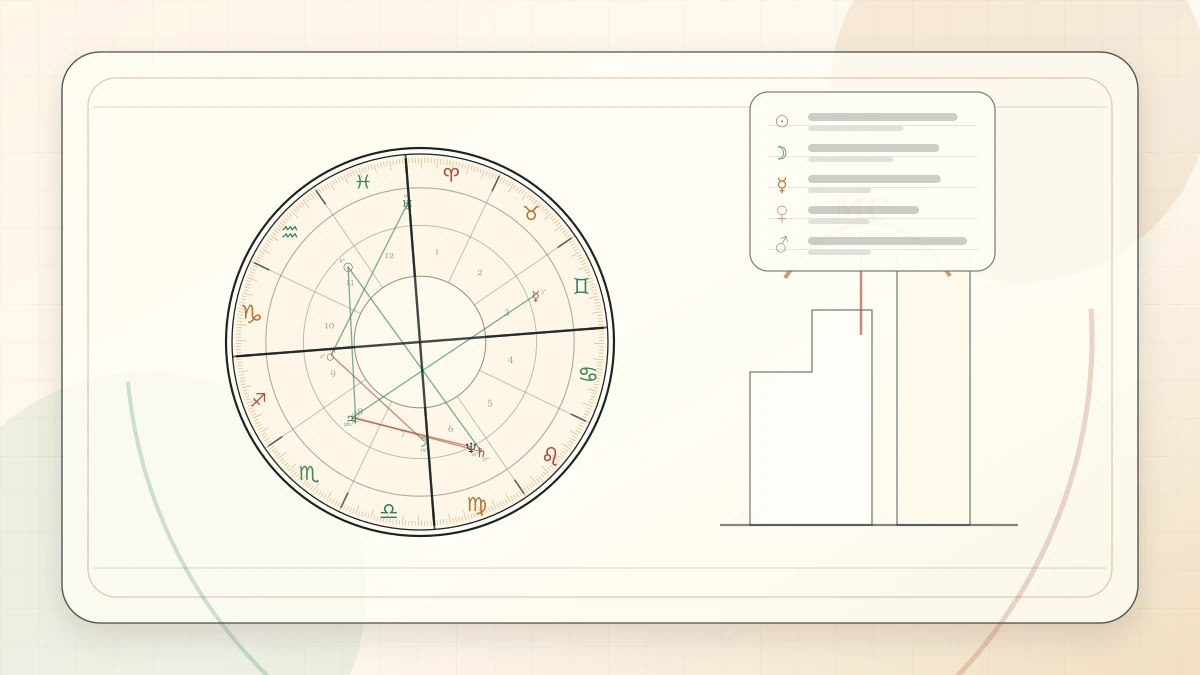
A constructed Sagittarius-rising chart tallies 4 clues for beginning things, 3 for keeping going, 2 for exchanging value and 1 for relying on others, so the first question is what slows a start.
What an entrepreneurship pattern is, and what it is not
A pattern in a chart is a repeated emphasis: several clues pointing at the same area of life. Reading entrepreneurship patterns means noticing which working questions your chart raises most often, such as how you begin, how you continue and how you deal with others. It does not mean finding a verdict on whether you would succeed in business, because no pattern can.
The method below uses a simple tally. It is a way to see where your questions cluster, not a score. Every sign and placement appears among people who work for themselves and people who do not. The themes themselves, and what electional astrology claims about start dates, are covered in our guide Entrepreneurship in Astrology; this guide is the counting method.
Four working questions and the clues behind each
Reduce the topic to four questions that a person working on their own tends to meet. Each has traditional clues, listed here.
| Working question | Chart clues | What the clues ask |
|---|---|---|
| How do I begin things? | Mars, cardinal signs, first and third houses | How do I get started, and what slows me? |
| How do I keep going? | Saturn, fixed signs, the sixth house | What routines and limits hold up my effort? |
| How do I exchange value? | Venus, Mercury, second and seventh houses | How do I think about what I offer and what it is worth? |
| Who do I rely on? | Jupiter, eighth and eleventh houses | Who supports me, and what do we share? |
The tally in five steps
A tally keeps you from leaning on a single striking placement.
- Pick one house system and write it down.
- For each question, count how many of its clues are present in your chart: a planet in a matching sign, a planet in a matching house, or a close aspect involving that planet.
- A clue may count under more than one question, and that is fine.
- Write the counts without adding them into a total or judging them.
- Turn the highest count into your first question, and the lowest into your last, since a low count is a quieter topic and not a weakness.
A constructed chart: Sagittarius rising, tallied
Take an invented chart read in whole signs. Sagittarius rising puts Capricorn in the second house, Aquarius in the third, Aries in the fifth, Taurus in the sixth and Gemini in the seventh. Say Mars is at 8 degrees of Aries, Saturn at 6 degrees of Taurus, Venus in Capricorn, Mercury at 3 degrees of Aquarius and Jupiter at 9 degrees of Gemini.
Count by question, using the rule in step two. For beginning: Mars in a cardinal sign, Venus in the cardinal sign Capricorn, Mercury in the third house and a Mars–Jupiter sextile (Mars at 8 and Jupiter at 69 on the wheel, a gap of 61 degrees, so 1 degree from exact) make 4. For keeping going: Saturn in a fixed sign, Mercury in the fixed sign Aquarius and Saturn in the sixth house make 3. For exchanging value: Venus in the second house and Jupiter in the seventh make 2. For relying on others: no planet sits in the eighth or eleventh house, and the sextile is the only clue that involves Jupiter, so that question makes 1. The counts are 4, 3, 2 and 1, and they are kept separate, not added up.
The question that gathers most clues is how this person begins things. The reading is therefore: ask what slows a start, and what small step would test an assumption before it is large. The low count for relying on others only means that question has fewer voices behind it.
Adding context: element and modality spread
Once the tally is done, look at the chart’s wider balance as context. Count how many of the ten planets fall in each modality. A chart with many planets in cardinal signs (Aries, Cancer, Libra, Capricorn) repeats the theme of starting. Many in fixed signs (Taurus, Leo, Scorpio, Aquarius) repeats holding steady, and many in mutable signs (Gemini, Virgo, Sagittarius, Pisces) repeats adapting.
Elements work similarly as texture: fire for energy, earth for practicality, air for ideas and water for feeling. These are descriptions of emphasis, not abilities. A person with no fire can be energetic, and a person with no earth can run a tidy operation.
Where entrepreneurship readings go wrong
Three mistakes appear repeatedly. The first is reading a tally as a score, as in “my chart is entrepreneurial.” The second is picking the one dramatic clue and ignoring the rest. The third is treating tradition as evidence: astrology has no reliable record of predicting business outcomes, and many successful self-employed people have charts that would not be flagged by any list.
Check any pattern against your own history. Think of the times you started something, kept something going or worked with others, and see whether the chart questions describe you or not.
Questions people ask about entrepreneurship in a chart
Do I need an exact birth time for the tally? For the houses, yes, since house clues depend on it. If you lack a birth time, count only the planet and sign clues, and treat the house columns as unknown instead of guessing at them.
What orb should the aspect clue use? Pick one before you count and keep it. A tight orb of 2 or 3 degrees gives fewer clues; a wide one of 6 to 8 gives more. The constructed chart above used a sextile only 1 degree from exact, which counts under almost any orb.
Should the Ascendant or Midheaven count as clues? You can add them, but say so and add them under every question where they fit, so one question is not padded while the others are not.
Can a chart tell me whether to quit my job? No. That decision involves income, obligations and risk, and it belongs with you and, for money matters, a qualified financial or business adviser.
What if my tally is nearly empty? That happens, and it carries no meaning about your prospects. It means the chart offers few clues for these four questions, and your own experience is the better guide.
A small step you can take with the tally
Choose the question with the most clues and write one concrete observation from your own life that matches it, and one that does not. Then decide on one small, low-cost way to learn something, such as talking with someone who works for themselves. Keep any serious step, such as spending money or leaving a job, for conversations with qualified people.
What this does and does not establish
A tally carries no meaning about your prospects, and a pattern is never evidence that a venture will succeed.
Related calculators
Use the matching tool when you want a direct chart or timing result after reading the guide.
Career Astrology Calculator
Saved-chart practical career page built from Midheaven, Sun, Saturn, and tenth-house structure.
Midheaven / MC Sign Calculator
Exact Midheaven sign verification from full birth-chart math for practical career and visibility questions.
Money Astrology Calculator
Saved-chart money-style page built from second-house, eighth-house, Venus, and Jupiter patterns.
Calculation references
- Swiss Ephemeris: positions, angles and house-system conventions
Technical reference for calculation conventions. It does not certify an interpretation or mean every live tool uses this engine.
Related articles
Keep reading with nearby topics that deepen the same question from another angle.
Leadership Style in Astrology
Astrology treats leadership as several qualities, such as initiative, communication and accountability, rather than one score. Write chart prompts for each, then test them against feedback from the people you lead.
5 min read
Using Transits for Career Planning Carefully
Use one or two transits as review checkpoints you choose, never as a schedule for applying, asking, resigning or launching. Deadlines, openings and your own readiness set the real timing.
6 min read
Career Astrology for Beginners
Career astrology reads six layers: the tenth house and Midheaven for public role, the sixth for daily work, the second for resources, and the Sun, Saturn and Mars for purpose, discipline and drive.
6 min read
Midheaven Sign Meaning
Your Midheaven sign describes the public style you tend to show in your work and reputation, such as precise and helpful for Virgo. Its ruler and nearby planets add detail.
6 min read
Keep exploring
Use the category page and the main hubs when you want the next layer of context.
Previous article
Leadership Style in Astrology
Next article
Using Transits for Career Planning Carefully