
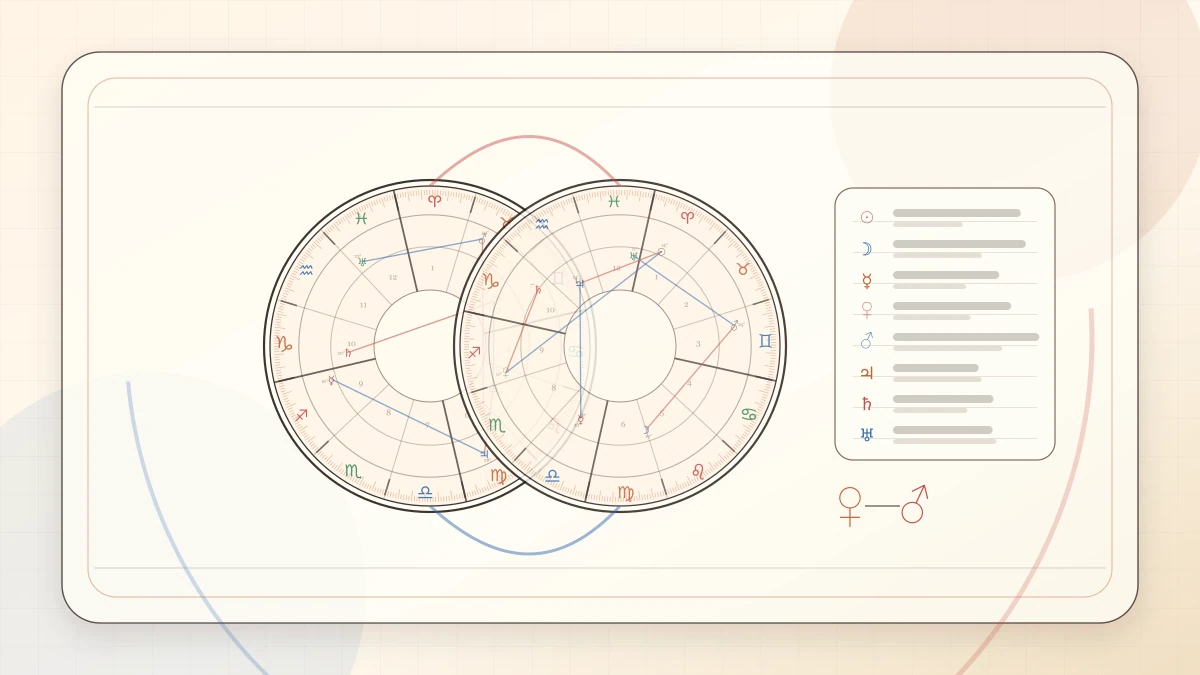
Love Compatibility
How to Read Long-Term Compatibility in Astrology
Read long-term compatibility topic by topic, such as affection, emotional safety, communication, conflict and commitment, instead of one total score. Each chart factor speaks to one topic at most.
Table of contents
- Example or practical exercise
- Long-term compatibility is several questions, not one
- Which chart factors speak to which long-term topic
- Why one total score hides the useful part
- A worked example: two Saturn-flavored contacts
- What the sheet might look like for a constructed pair
- A method with columns you can fill in
- Why a long-term reading has a date on it
- Common questions about long-term compatibility
- A review conversation to schedule
- What this does and does not establish
Example or practical exercise
Sam's Venus at 12 Capricorn conjoins Lee's Saturn and Sam's Saturn squares Lee's Moon, and their sheet lists shared goals, recurring disagreements and a screen-free evening each week.
Long-term compatibility is several questions, not one
Compatibility is often presented as one number or one verdict, which hides almost everything useful. A long relationship contains affection, emotional safety, communication, handling of conflict, commitments and shared plans, and two people can fit well on one and need work on another.
Reading for the long term therefore means breaking the question apart. Each piece of a synastry chart, the comparison of two people's planet positions, speaks to one topic at most, and many speak to none.
Which chart factors speak to which long-term topic
Astrologers use these associations as conventions. The right column turns each into a question a couple can discuss.
| Topic | Factors usually consulted | A question to discuss |
|---|---|---|
| Affection | Venus contacts between the two charts | How do we each show care, and does it land? |
| Emotional safety | Moon contacts and the fourth house | What helps each of us feel at home with the other? |
| Communication | Mercury contacts | How do we talk when something is hard? |
| Conflict and drive | Mars contacts | How do we argue, and how do we recover? |
| Commitment and structure | Saturn contacts and the seventh house | What do we expect of each other over time? |
| Growth and change | Jupiter and the outer planets | What do we want to learn and try together? |
Why one total score hides the useful part
Suppose a tool counts ten aspects between two charts and calls six of them easy. That produces a score of 6 out of 10, or 60 percent. The figure says nothing about which six were easy. If the four hard ones are all about commitment and the six easy ones are all about attraction, the score hides exactly the thing a long-term reader would care about.
Reading topic by topic costs more time, and it keeps the information that the score throws away. A single hard Saturn contact tells you what to discuss, and does not tell you that the relationship is poor.
A worked example: two Saturn-flavored contacts
This pair is constructed. Sam's Venus is at 12 degrees Capricorn, which is 270 + 12 = 282 degrees. Lee's Saturn is at 15 degrees Capricorn, which is 285 degrees. They are 3 degrees apart, a conjunction at an orb of 3, within the 3 to 5 degrees often used for personal planets. Lee's Moon is at 12 degrees Aries, 12 degrees, and Sam's Saturn is at 14 degrees Cancer, 90 + 14 = 104 degrees. The separation is 92 degrees, a square at a 2-degree orb.
A reader might note that Sam's affection meets Lee's sense of structure, which can feel steady or can feel heavy. Lee's emotional needs, meanwhile, meet Sam's sense of limits, which can feel like caution or like a restriction. Neither reading is a result. Each is a question to ask the pair: do you each feel your affection is welcome, and do you each feel your needs are heard?
What the sheet might look like for a constructed pair
Here is how Sam and Lee, the constructed pair above, might fill it in. Under shared goals, they both want to live near family within a few years. Under recurring disagreements, they list how quickly to answer messages and how to split weekends. Under explicit agreements, they have one evening a week kept free of screens and a monthly talk about plans.
The Saturn contacts now have somewhere to land. The structure that Lee values already appears in the agreements column, and the recurring disagreements show where affection and limits meet. The chart pointed to the area, and the sheet shows what the two of them have actually done about it.
A method with columns you can fill in
This order keeps the chart in a supporting role.
- List the topics above and note any contact from the two charts under each one.
- Add a column for shared goals you have actually discussed, such as where to live or how to spend time.
- Add a column for disagreements that have recurred, in plain words, without naming who is at fault.
- Add a column for agreements you have made explicitly, even small ones.
- Compare the columns. Where the chart prompt and a recurring disagreement meet, spend a conversation on it.
- Set a date to review the sheet together.
Why a long-term reading has a date on it
People change, and so do the circumstances around them. A reading is a snapshot of the questions that seem relevant now. Saturn, which takes about 29.5 years to go around the zodiac and about two and a half years to cross one sign, moves through about four signs in ten years, so the symbolic weather around a relationship shifts over a decade even when nothing in the two natal charts changes.
That is a reason to revisit a reading every year or so, as a prompt to check in, and not a reason to expect anything specific.
Common questions about long-term compatibility
Do hard aspects mean trouble? They mean the two charts have a tension that is worth discussing. Many couples work with such tensions, and many easy contacts do not remove the need for conversation.
Is a composite chart better for the long term? A composite chart builds one symbolic chart from the midpoints between two charts. It offers a different set of prompts, not a more reliable answer.
Can a chart certify fidelity or predict how long a relationship will last? No. Only behavior and mutual commitments can speak to those, and only the people involved can decide them.
A review conversation to schedule
Once or twice a year, sit down with your sheet. Ask which agreements are still working, which need updating, and which topics have been avoided. End with one change you can make in the next month. The point is to make the relationship easier to talk about, and the chart is only one tool for doing so.
What this does and does not establish
A chart cannot certify fidelity or predict how long a relationship lasts; only behavior and commitments made by the two people speak to those.
Related calculators
Use the matching tool when you want a direct chart or timing result after reading the guide.
Birth Chart Compatibility Calculator
Higher-trust compatibility report built from two verified natal charts and exact synastry analysis.
Synastry Chart Calculator
Compare two birth charts for relationship patterns, emotional rhythm, attraction, and communication themes.
Zodiac Compatibility Calculator
Broad sign-to-sign compatibility page tuned for lifestyle readers.
Calculation references
- Swiss Ephemeris: positions, angles and house-system conventions
Technical reference for calculation conventions. It does not certify an interpretation or mean every live tool uses this engine.
Related articles
Keep reading with nearby topics that deepen the same question from another angle.
Challenging Aspects in Synastry Explained
Challenging aspects in synastry are squares, oppositions and some conjunctions, where two people's planets want different things. They mark topics to talk through, not verdicts on the pair.
6 min read
Zodiac Compatibility: How to Read Love Matches
To read a zodiac match, compare the two signs' elements, then their modalities, then count how many signs apart they sit. The result is a first look, not a judgment on a relationship.
6 min read
Moon Sign Compatibility Explained
Moon sign compatibility compares how two people seek comfort and settle after a hard day, by element, modality and the exact angle between their Moons. It gives words for differences, not a ranking.
6 min read
Venus Sign Compatibility Explained
Venus sign compatibility compares what two people find pleasant and how they show and receive affection. Read it by element, modality and exact distance, never as a score.
6 min read
Keep exploring
Use the category page and the main hubs when you want the next layer of context.
Previous article
Challenging Aspects in Synastry Explained
Next article
Moon Phases and Sleep Carefully Explained