
Career Astrology
Money Houses in Astrology
Astrologers read money themes across five houses: the second for what you own, the eighth for what you share, the sixth and tenth for work, and the eleventh for groups and hopes.
Table of contents
- Example or practical exercise
- Which houses are called the money houses, and why more than one
- Own, earn, share, hope: five houses side by side
- Why the eighth house is more than other people’s money
- Second or eighth, sixth or tenth: telling neighboring money themes apart
- A constructed chart: Sagittarius rising with whole-sign houses
- What the constructed chart shows, and what it does not
- Common questions about money houses
- Fill in the facts before you read the symbols
- What this does and does not establish
Example or practical exercise
In a constructed Sagittarius-rising chart, Venus rules both the sixth and eleventh houses and sits in the tenth, so daily work, groups and public role all pass through one planet.
Which houses are called the money houses, and why more than one
No single house holds all of a chart’s money themes. Astrologers who write about resources usually point to several houses at once, because money has several sides: what you own, what you earn, what you share with other people, and what you hope to build. The houses are twelve divisions of the chart, each tied to an area of life, and a handful of them touch resources in different ways.
Some traditions name the second and eleventh houses as the wealth houses, and others add the sixth and tenth because earning comes through daily work and public role. Which list you pick is a matter of school, not fact. This guide uses a wider map of five houses so you can see how the questions differ, instead of treating one house as a verdict on income.
Why the eighth house is more than other people’s money
Traditional texts list shared money, debts and joint holdings under the eighth house, and older books add inheritance. Modern astrologers read it more broadly as the house of what is held in common and what must be settled, changed or ended between people. It also covers intimacy, so a money reading uses only one slice of it.
Read it as a symbol, never as a forecast. An eighth-house planet does not say that you will inherit, owe or lend anything. It only raises the question of how you handle what is jointly held, which you can answer far better by looking at your actual agreements.
Second or eighth, sixth or tenth: telling neighboring money themes apart
Most confusion about money houses comes from treating two of them as one. The table sets the commonly blurred pairs side by side, each with a plain test you can apply to a real situation.
Following one house’s ruler step by step is covered in our guide How to Read the Second House for Money Patterns. Here the rulers of all five houses are followed at once, in the constructed chart below, using the traditional rulers.
| Pair | How they differ | A plain test |
|---|---|---|
| Second and eighth | What is yours versus what is held with, or owed to, others | Could I change this on my own, without anyone else agreeing? |
| Sixth and tenth | The daily tasks of work versus the role you are known for | Would a stranger see this, or only the people I work beside? |
| Second and eleventh | What you value and keep versus what you hope for with a group | Is this mine to hold, or something we are building together? |
| Eighth and eleventh | Formal shared arrangements versus looser shared aims | Is there an agreement with terms, or only a common hope? |
| Sixth and second | The effort you put in versus what you treat as worth having | Is this about how I spend my days, or about what I keep? |
A constructed chart: Sagittarius rising with whole-sign houses
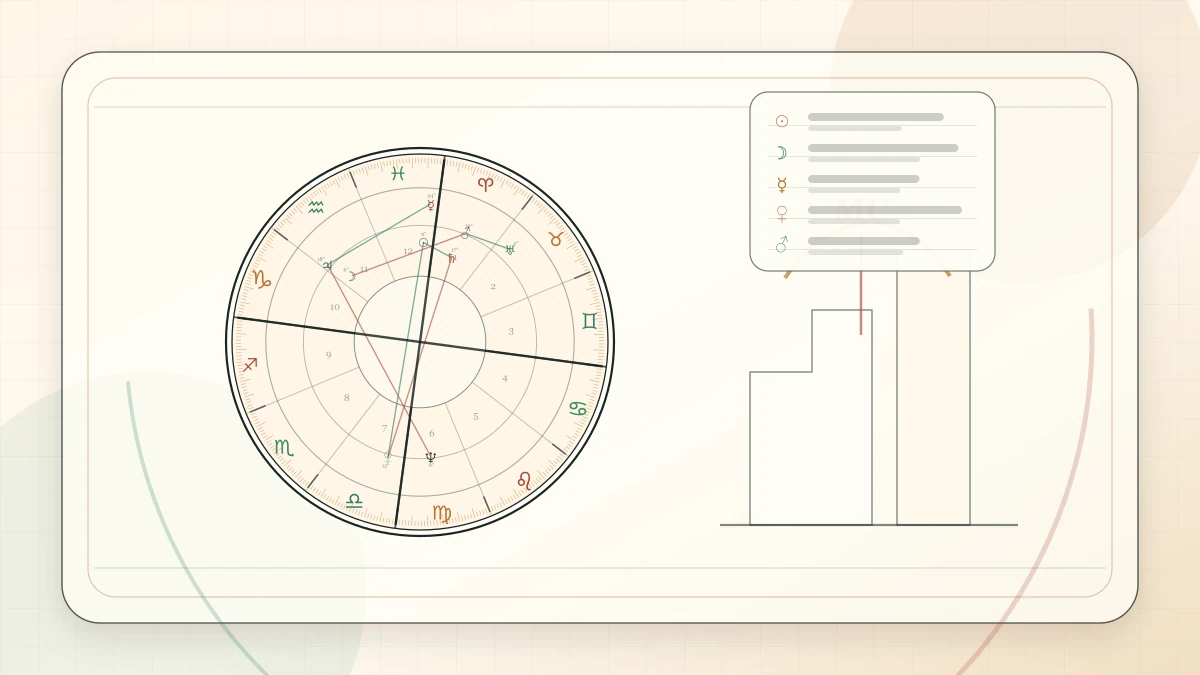
This chart is invented for teaching. With Sagittarius rising, whole-sign houses run Sagittarius (first), Capricorn (second), Aquarius, Pisces, Aries, Taurus (sixth), Gemini, Cancer (eighth), Leo, Virgo (tenth), Libra (eleventh), Scorpio. Place Saturn in Leo, the Moon in Taurus, Mercury in Libra and Venus in Virgo.
| House | Sign | Ruler sits in | Question it suggests |
|---|---|---|---|
| Second | Capricorn, ruled by Saturn | Leo, ninth house | How do my resources connect to study, travel or what I believe? |
| Sixth | Taurus, ruled by Venus | Virgo, tenth house | Is my daily work tied to my public role? |
| Eighth | Cancer, ruled by the Moon | Taurus, sixth house | Do shared obligations show up in my weekly routine? |
| Tenth | Virgo, ruled by Mercury | Libra, eleventh house | How does my public role connect to my groups? |
| Eleventh | Libra, ruled by Venus | Virgo, tenth house | Do my groups overlap with my public role? |
What the constructed chart shows, and what it does not
Venus rules both the sixth and eleventh houses here and sits in the tenth, so daily work, groups and public role all pass through one planet. An astrologer would call that a recurring theme. You would turn it into a question, such as whether the people you work beside are also the people who know your work.
None of this tells you how much anyone has or earns. People with every one of these placements live on every kind of income, and a chart cannot assess creditworthiness, investment fit or future wealth.
Common questions about money houses
Which money house matters most? None by rule. Some schools stress the second and eleventh, others the second and tenth. Reading all five as separate questions avoids loading everything onto one.
Where does the fourth house fit? Some astrologers link it with property and family resources. This map leaves it out to keep the comparison to five, but you can add it the same way, as one more question.
Does the house system matter? Somewhat. Whole-sign and quadrant systems can put the same planet in different houses, so record which one you used.
Where do Jupiter and Saturn fit? Jupiter is traditionally linked to growth and generosity, and Saturn to limits and effort. In any of the five houses, a planet is a symbol, not a deposit.
Fill in the facts before you read the symbols
A short worksheet keeps the symbolism honest. Write the plain facts first, then read the chart for questions. For anything involving debt, tax, contracts or investments, speak with a qualified financial or legal adviser; a chart is not a substitute.
- Second house: what you personally own or are responsible for.
- Sixth house: the tasks of a typical week of work.
- Eighth house: anything you hold jointly with someone else, and who decides what.
- Tenth house: how you would describe your work to a stranger.
- Eleventh house: the groups you actively take part in.
What this does and does not establish
No money house shows how much anyone has or earns, and a chart cannot assess creditworthiness, investment fit or future wealth.
Related calculators
Use the matching tool when you want a direct chart or timing result after reading the guide.
Career Astrology Calculator
Saved-chart practical career page built from Midheaven, Sun, Saturn, and tenth-house structure.
Midheaven / MC Sign Calculator
Exact Midheaven sign verification from full birth-chart math for practical career and visibility questions.
Money Astrology Calculator
Saved-chart money-style page built from second-house, eighth-house, Venus, and Jupiter patterns.
Calculation references
- Swiss Ephemeris: positions, angles and house-system conventions
Technical reference for calculation conventions. It does not certify an interpretation or mean every live tool uses this engine.
Related articles
Keep reading with nearby topics that deepen the same question from another angle.
Midheaven Sign Meaning
Your Midheaven sign describes the public style you tend to show in your work and reputation, such as precise and helpful for Virgo. Its ruler and nearby planets add detail.
6 min read
Career Astrology for Beginners
Career astrology reads six layers: the tenth house and Midheaven for public role, the sixth for daily work, the second for resources, and the Sun, Saturn and Mars for purpose, discipline and drive.
6 min read
How to Use Astrology for Career Reflection
Turn chart themes into questions about your own work, then check each one against your work history, feedback and the conditions you have enjoyed. The chart supplies prompts; your record supplies evidence.
6 min read
Second House Money Guide
The second house describes what you value and how you relate to your own resources, read through its sign, its ruler and any planets in it. It asks about values, not earnings.
6 min read
Keep exploring
Use the category page and the main hubs when you want the next layer of context.
Previous article
How to Use Astrology for Career Reflection
Next article
Second House Money Guide