
Love Compatibility
Synastry vs Composite Chart: What Is the Difference
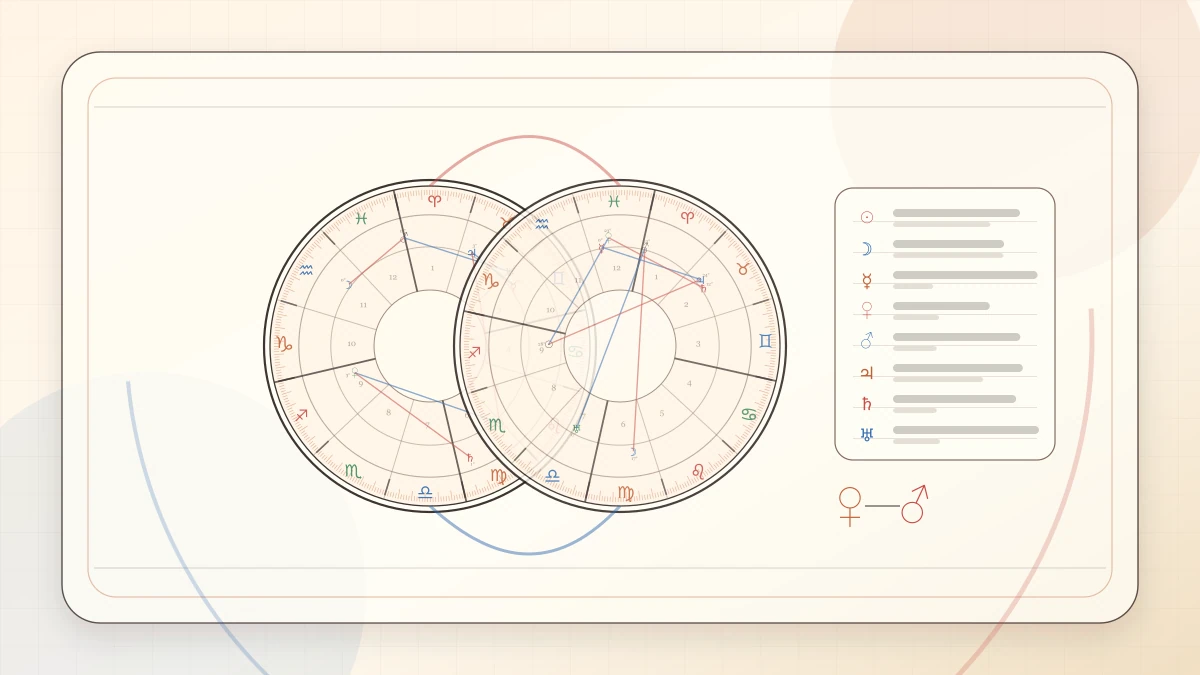
Synastry keeps two birth charts and reads the contacts between them; a composite merges them into one new chart built from midpoints. One shows interaction, the other the relationship as a whole.
Table of contents
- Example or practical exercise
- Two ways to bring two birth charts together
- Synastry and composite side by side
- How the midpoint is calculated
- Worked arithmetic, including the case where the naive average fails
- What each method answers, and what neither does
- Which one to use for which question
- A practical first step
- A third method: the Davison relationship chart
- Three mix-ups between the two methods
- What this does and does not establish
Example or practical exercise
Two Moons at 20 Sagittarius and 10 Gemini are 190 degrees apart, so the naive average of 15 Virgo is wrong and the short-arc composite Moon sits at 15 Pisces.
Two ways to bring two birth charts together
Synastry and the composite chart are the two main methods astrologers use to read a relationship from birth data. Both start from the same two charts. They treat them very differently, and mixing them up leads to readings that sound confident and describe nothing.
In synastry you keep two charts and look for aspects between a planet in one and a planet in the other. In a composite you merge the two charts into one new chart, built from the midpoint between each pair of matching planets. Synastry shows how two people affect each other; the composite describes the relationship as if it were a third thing.
Synastry and composite side by side
| Feature | Synastry | Composite chart |
|---|---|---|
| What you end up with | A list of contacts between two real charts | One new chart |
| Whose planets are they | Each belongs to one person | Neither person’s; they are midpoints |
| Question it answers | What does each of us stir up in the other? | What is the relationship’s own character? |
| Birth time needed | Helpful for houses and angles | Needed for the composite angles |
| Main risk | Counting dozens of aspects and reading none well | Treating the chart as if it were a real birth |
How the midpoint is calculated
The midpoint method is the most common way to build a composite, and it is plain arithmetic on positions measured around the zodiac circle. Each sign begins at a multiple of 30 degrees: Aries 0, Taurus 30, Gemini 60, and so on to Pisces 330.
- Convert each position to a number from 0 to 360 by adding the sign’s starting degree to the degrees inside the sign.
- Subtract the smaller number from the larger to find the gap.
- If the gap is 180 or less, add the two numbers and divide by 2.
- If the gap is more than 180, add 360 to the smaller number first, then add the two and divide by 2. If the answer reaches 360 or more, subtract 360.
- Turn the result back into a sign and degree.
Worked arithmetic, including the case where the naive average fails
Easy case, with two invented Suns: 10° Taurus is 30 plus 10, or 40; 20° Virgo is 150 plus 20, or 170. The gap is 130, which is under 180. Add them to get 210, halve it to get 105, and 105 is 90 plus 15, so the composite Sun is at 15° Cancer.
Wrap case, with two invented Moons: 20° Sagittarius is 240 plus 20, or 260; 10° Gemini is 60 plus 10, or 70. The gap is 190, which is over 180. The naive average is 260 plus 70, which is 330, halved to 165, or 15° Virgo. That point is on the long way around the circle.
The short-arc rule fixes it. Add 360 to the smaller number to get 430, then add 260 to get 690 and halve it to get 345. That is 330 plus 15, or 15° Pisces, exactly 180 degrees from the naive answer. It sits on the shorter path between the two Moons. If the gap is exactly 180, both candidate points are equally close, and software has to pick a convention.
What each method answers, and what neither does
Synastry answers questions about interaction. When one person’s Venus falls on the other’s Moon, you can ask what the first person’s affection does to the second person’s sense of comfort. Both people are still in the picture, with their own charts intact.
A composite answers questions about the shared story. A composite Moon in Virgo, for example, invites a question about what the relationship needs in order to feel secure. That is a metaphor about a pairing; it does not record where the Moon actually stood when the relationship began.
Neither method measures how well two people will do. Both give a structure for questions, and the answers come from how the two people behave.
Which one to use for which question
- Use synastry to understand why one person’s words or moods land in a particular way with the other person.
- Use the composite to describe the relationship’s overall priorities, such as whether it centers on adventure, security or friendship.
- Use synastry for the first reading, because it needs only the two birth charts you already have.
- Use the composite as a second layer, once the synastry contacts raise a question about what the pairing seems to be for.
- Keep the two lists separate in your notes, so a composite aspect is never mistaken for a contact between two real placements.
A practical first step
Start with the birth chart calculator on this site to get both charts, and check each birth time before you trust any angle or house. Then pick one question you actually have about the relationship, such as how you handle disagreements, and choose the method that fits it.
Write down one or two observations, not a verdict, and test them against what you notice over the following weeks.
A third method: the Davison relationship chart
The midpoint composite is the most common method, and it is not the only one. A Davison chart, named for the astrologer Ronald Davison, finds the midpoint in time and space instead. It takes the halfway date between the two birth dates, the halfway time between the two birth times and the halfway point between the two birthplaces, then casts an ordinary chart for that moment and location.
Because it is a real sky, every planet sits where it actually was at that moment. Two births exactly ten years apart on the same calendar date give a Davison date five years from each. The Sun in the two methods can land close together, and depending on the two birth dates it can also land on the opposite side of the zodiac. The Moon can differ a great deal, because it circles the zodiac many times between two birth dates.
Astrologers who prefer the Davison chart like that it is a real chart for a real moment, with real houses and angles. Those who prefer midpoints like that each planet is a direct blend of the two people’s own positions. There is no good evidence that either is better, so pick one, say which, and do not swap between them within one reading.
Three mix-ups between the two methods
| The mix-up | Why it happens | What to check instead |
|---|---|---|
| Calling a composite aspect a contact between the two of you | Both methods use the same aspect words | Whether the planets belong to two people (synastry) or are midpoints (composite) |
| Expecting the composite Sun to match either person’s Sun sign | It feels like an average of the two | That a midpoint can land in a sign neither person has |
| Using the composite to explain one person’s behavior | A composite planet is not anyone’s planet | Use synastry for what one person stirs in the other |
What this does and does not establish
Neither method measures how well two people will do, and a composite aspect is never a contact between two real placements.
Related calculators
Use the matching tool when you want a direct chart or timing result after reading the guide.
Birth Chart Compatibility Calculator
Higher-trust compatibility report built from two verified natal charts and exact synastry analysis.
Synastry Chart Calculator
Compare two birth charts for relationship patterns, emotional rhythm, attraction, and communication themes.
Zodiac Compatibility Calculator
Broad sign-to-sign compatibility page tuned for lifestyle readers.
Calculation references
- Swiss Ephemeris: positions, angles and house-system conventions
Technical reference for calculation conventions. It does not certify an interpretation or mean every live tool uses this engine.
Related articles
Keep reading with nearby topics that deepen the same question from another angle.
Venus Sign Compatibility vs Mars Sign Compatibility
Venus sign compatibility compares what two people enjoy and how they show care; Mars sign compatibility compares how fast they act, pursue and push back. A pair can match on one but not the other.
6 min read
What the Seventh House Says About Relationships
The seventh house describes how you approach partnership and agreements with others. Read the sign on it, that sign's ruling planet and any planets inside, not a single label.
6 min read
Zodiac Compatibility: How to Read Love Matches
To read a zodiac match, compare the two signs' elements, then their modalities, then count how many signs apart they sit. The result is a first look, not a judgment on a relationship.
6 min read
Moon Sign Compatibility Explained
Moon sign compatibility compares how two people seek comfort and settle after a hard day, by element, modality and the exact angle between their Moons. It gives words for differences, not a ranking.
6 min read
Keep exploring
Use the category page and the main hubs when you want the next layer of context.
Previous article
Venus Sign Compatibility vs Mars Sign Compatibility
Next article
What the Seventh House Says About Relationships