
Moon Phases
Waxing Moon vs Waning Moon
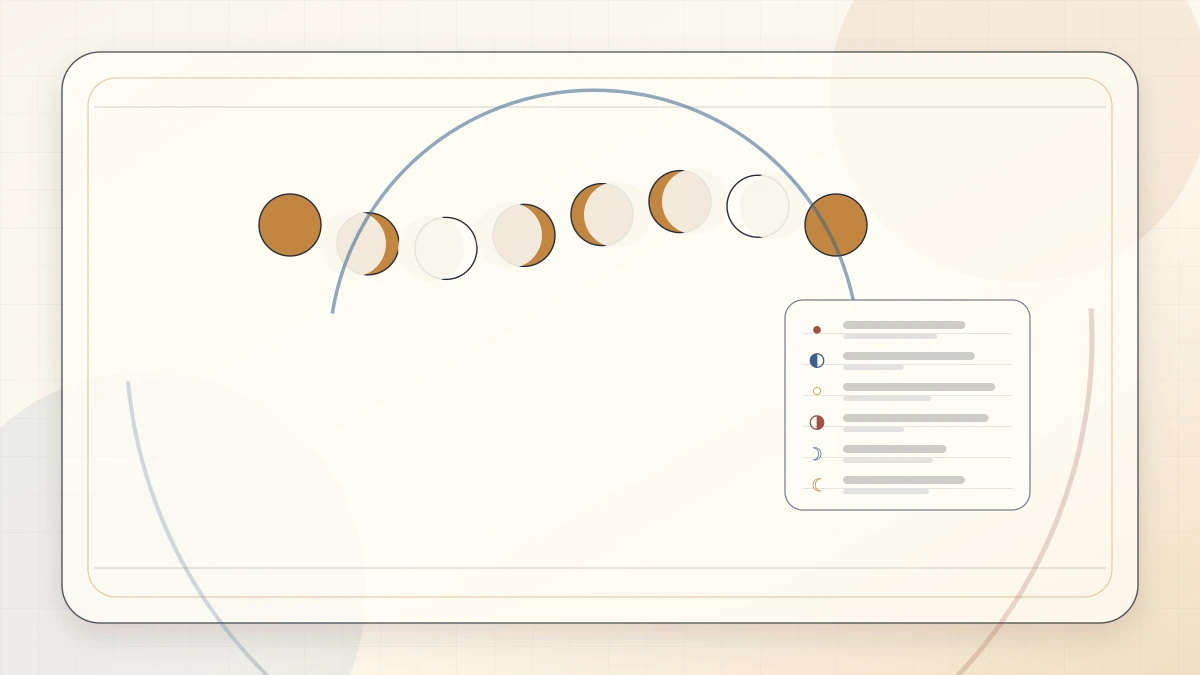
A waxing Moon is growing toward full, and a waning Moon is shrinking toward new. In the Northern Hemisphere a waxing Moon is lit on the right and seen in the evening.
Table of contents
- Example or practical exercise
- The quick rule: which side of the Moon is lit
- Telling them apart by time of day
- Waxing and waning side by side
- What each half is traditionally used for
- Why the distinction matters in practice
- A constructed month for one project
- Common mix-ups to avoid
- Check it yourself tonight
- Five practice observations to sort yourself
- Questions readers ask about waxing and waning
- What this does and does not establish
Example or practical exercise
With a new Moon on day 0, a person drafts a short report during the waxing half, up to the full Moon near day 15, then edits and sends it by day 30.
The quick rule: which side of the Moon is lit
A waxing Moon is growing: more of its visible face is lit each night, heading toward full. A waning Moon is shrinking, heading toward new. Each half of the cycle lasts about 14.8 days, and the rest of this article is about telling them apart on sight and deciding what, if anything, to do with the difference.
From the Northern Hemisphere, the waxing Moon is lit on its right side and the waning Moon is lit on its left. From the Southern Hemisphere the view is flipped, so a waxing Moon is lit on the left. Near the equator the Moon often appears tipped so a crescent looks like a bowl or a boat on its back, and the side rule is harder to use.
Telling them apart by time of day
The time the Moon is in the sky works in every hemisphere. A waxing Moon is in the afternoon and evening sky, and a waning Moon rises late and is still visible in the morning. Use this three-check test.
- Check the time. Visible in the evening after sunset: waxing. Visible in the early morning: waning.
- Check the lit side, remembering your hemisphere. In the Northern Hemisphere a lit right side means waxing, and in the Southern Hemisphere a lit left side means waxing.
- Check a calendar. If the next full Moon comes before the next new Moon, the Moon is waxing. If the next new Moon comes first, it is waning.
Waxing and waning side by side
The table pulls the main differences into one place. The timing in the last rows is approximate and follows from the Moon’s position relative to the Sun.
| Feature | Waxing Moon | Waning Moon |
|---|---|---|
| Direction | Lit portion grows toward full | Lit portion shrinks toward new |
| Phases in the half | Waxing crescent, first quarter, waxing gibbous | Waning gibbous, last quarter, waning crescent |
| Lit side, north | Right | Left |
| Lit side, south | Left | Right |
| Best seen | Evening, after sunset | Late night and morning |
| First quarter or last quarter | First quarter rises near noon, sets near midnight | Last quarter rises near midnight, sets near noon |
| Length | About 14.8 days | About 14.8 days |
What each half is traditionally used for
Astrological and ritual traditions give the two halves complementary jobs. The waxing half is associated with beginning, building, adding and learning, because the visible light is increasing. The waning half is associated with clearing, finishing, editing and resting, because it is decreasing.
These are symbolic assignments. The Moon’s light does not change how well you can start or finish a task. What the assignment offers is a division of labor: two weeks to build something, two weeks to tidy and complete it.
The full Moon and the new Moon sit at the hinges. The full Moon is the turning point from adding to subtracting, and the new Moon is the turning point back. Some people treat those two nights as review days, one looking at what to take on and the other at what to put down.
Why the distinction matters in practice
The first benefit is clear planning. Splitting a month in two reduces decisions: during the waxing half you take on, and during the waning half you review and close. Many people find that a simple rule helps them keep a rhythm.
The second benefit is avoiding mix-ups. A crescent at 30 percent lit could be waxing or waning, so the percentage alone does not tell you the direction. Use the lit side, the time of day or a calendar. The word gibbous is also easily confused with full: a gibbous Moon is more than half lit but not yet full.
A constructed month for one project
Say a new Moon falls on day 0. A quarter of the 29.5-day cycle is about 7.4 days, so first quarter is near day 7, the full Moon near day 15 (14.8 days), last quarter near day 22 (22.1 days) and the next new Moon near day 30.
A person writing a short report might build in the waxing half, drafting sections between day 0 and day 15. In the waning half they edit, cut and send it between day 15 and day 30. The Moon does not help the report; the two-part schedule does.
Common mix-ups to avoid
A few misunderstandings come up again and again.
- Assuming waning means bad. It is a half of the cycle, not a warning.
- Using the lit-side rule in the wrong hemisphere and reading waning as waxing.
- Treating the division as strict. Nothing prevents you from starting something during the waning half.
- Reading the percentage as the direction. Half lit can be first quarter or last quarter.
Check it yourself tonight
Step outside, note the time, and look at which side of the Moon is lit. Then open a Moon phase calculator and confirm whether it is waxing or waning. Do it for a few nights and the pattern becomes automatic.
Five practice observations to sort yourself
Try the three checks on these constructed observations before you go outside. The last row shows why a single clue is not enough.
| What you see | Verdict | Why |
|---|---|---|
| Northern Hemisphere, 7 pm: a thin crescent low in the west after sunset, lit on the right | Waxing | The evening sky and the right-hand side point the same way |
| Northern Hemisphere, 6 am: a crescent in the east before sunrise, lit on the left | Waning | A morning Moon is heading back toward the Sun, and the left side is lit |
| Southern Hemisphere, 9 pm: a half Moon lit on the left | Waxing, near first quarter | The lit sides are flipped in the south, and the evening sky agrees |
| Any hemisphere, mid-afternoon: a pale half Moon in the eastern sky in daylight | Waxing, near first quarter | A first quarter Moon rises around midday, so it is up in the afternoon |
| A calendar says the Moon is 30 percent lit | Cannot tell from that alone | Check the lit side, the time of day, or whether the next full Moon comes before the next new Moon |
Questions readers ask about waxing and waning
Why does the Moon rise later each night? It moves east against the stars by about 13 degrees a day, so it rises about 50 minutes later each day on average. That drift carries the waxing Moon from the afternoon sky into the late evening sky as the weeks pass.
Is there a quick way to remember the sides? In the Northern Hemisphere a lit right side looks like the curve of a D and a lit left side like the curve of a C. The letters D, O, C follow the order of the cycle: growing, full, shrinking. The trick fails in the Southern Hemisphere, where the lit sides are swapped.
Does waxing include the night of the full Moon? The full Moon is the turning point between the halves, so it belongs to neither. Waxing ends at the instant of full Moon and waning begins at once. The same is true of the new Moon in the other direction.
What this does and does not establish
The building and clearing jobs given to each half are symbolic, and a lit percentage alone cannot tell you which half you are in.
Related calculators
Use the matching tool when you want a direct chart or timing result after reading the guide.
Current Moon Phase Calculator
reader-focused-friendly exact current Moon phase page for a selected city and live local timestamp.
New Moon Calculator
Exact monthly New Moon lookup page for reset and intention-planning readers.
Full Moon Calculator
Exact monthly Full Moon lookup page for release, visibility, and completion timing readers.
Calculation references
- NASA: Moon phases
Reference for illuminated phases and physical geometry; not evidence for personal or ritual interpretations.
Related articles
Keep reading with nearby topics that deepen the same question from another angle.
New Moon Journaling Prompts
Good new Moon prompts ask what you want to begin, the smallest first step and when you will take it. Pick two or three and write for ten to fifteen minutes.
6 min read
How to Use the Moon Phase Calendar
Mark the four main phase instants in your own time zone, then use them as short check-ins: begin at new Moon, check at first quarter, review at full Moon and tidy at last quarter.
7 min read
Full Moon Meaning and Emotional Release
A full Moon is the night the Moon sits opposite the Sun and shows its whole lit face. Emotional release here means a quiet review, such as dropping an expectation, not forcing strong feelings.
6 min read
Moon Phase Birthday Meaning
Your birth Moon phase is the angle between the Sun and Moon when you were born, and it stays fixed for life. The phase on each year's birthday changes and is just a calendar note.
6 min read
Keep exploring
Use the category page and the main hubs when you want the next layer of context.
Previous article
Full Moon Meaning and Emotional Release
Next article
Moon Phase Birthday Meaning