
Timing Guides
Year Ahead Questions to Ask Your Solar Return
Ask your solar return open what, how or where questions tied to its Rising sign, the Sun's and Moon's houses, planets near angles and Saturn's and Jupiter's houses, and answer them yourself first.
Table of contents
- Example or practical exercise
- Why questions work better than predictions
- How to phrase a question the chart can help with
- Return chart features and a question for each
- How to turn the Sun’s house into a question of your own
- A constructed example: Nadia’s three questions
- Questions to leave out
- Common questions about working with return questions
- Carrying your questions through the year
- What this does and does not establish
Example or practical exercise
Nadia's return has Sagittarius rising, so the Sun in Libra falls in her eleventh house and the Moon in Gemini in her seventh; she asks about groups, partnerships and what keeps her steady.
Why questions work better than predictions
A solar return chart is cast for the moment the Sun returns to its natal degree, and astrologers read it as a symbolic frame for the year that begins at that moment. The most useful way to read it is to ask what it invites you to think about. “What will happen?” gets you a guess; “What does this ask me to consider?” gets you a plan.
The questions that follow are sorted by chart feature, so you can open the chart and pick the ones that fit. Choose about five, write your own answers first and compare afterward, so your thinking leads.
How to phrase a question the chart can help with
Good questions share a few habits. They begin with what, how or where, they point to something you control and they connect to a real part of your life.
- Ask open questions, not yes or no ones.
- Ask about your choices, and leave other people’s inner lives out of it.
- Tie each question to something concrete, such as a role, a routine or a relationship.
- Limit yourself to about five, and write your own answers before you compare with the chart.
Return chart features and a question for each
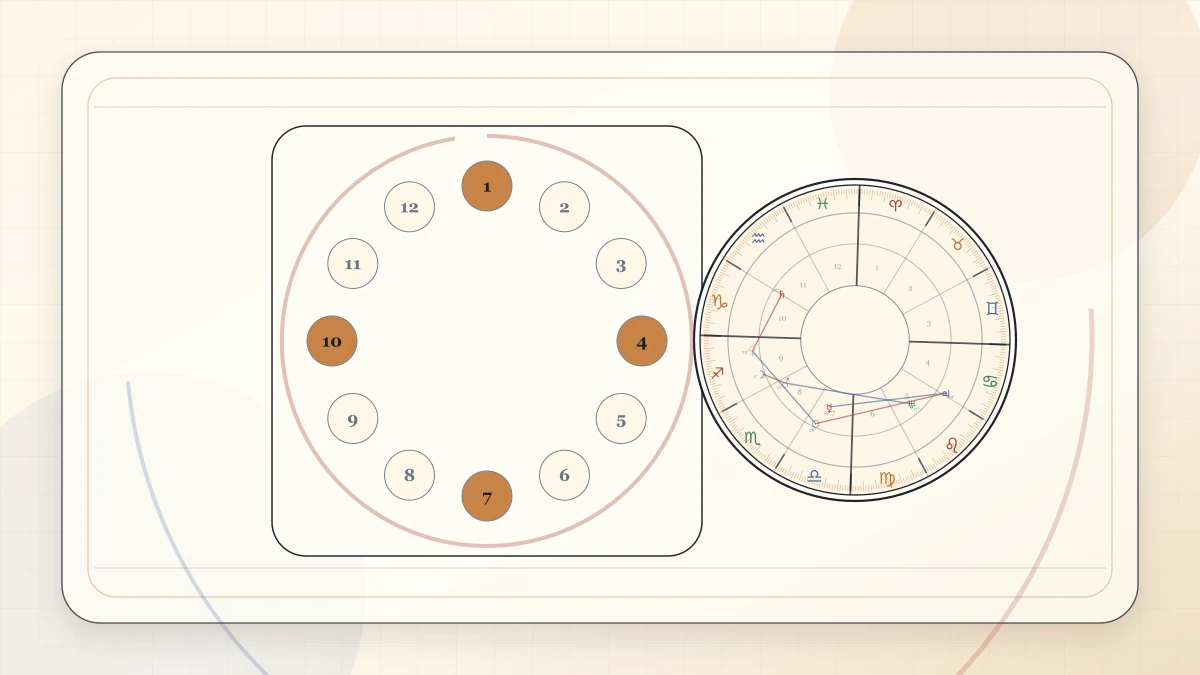
Angles are the four sensitive points of a chart, and the angular houses (the first, fourth, seventh and tenth) are the ones that traditionally carry the most emphasis.
| Feature | What it marks | A question to ask |
|---|---|---|
| Rising sign of the return | The tone with which the year is approached | How do I want to meet this year? |
| House holding the Sun | Where attention gathers | What deserves my best hours in this area? |
| Moon’s sign and house | Emotional needs and routines | What do I need to feel steady, and where? |
| A planet near an angle | Emphasis on that planet’s subject | What is this subject already asking of me? |
| Saturn’s house | Where effort and limits sit | Which responsibility here am I ready to take up or set down? |
| Jupiter’s house | Where there is room to expand | Where could I learn or give more? |
How to turn the Sun’s house into a question of your own
The house that holds the return Sun is the easiest place to start, because it is one fact you can find in seconds. A stock prompt for each of the twelve houses is in our solar return chart guide. The step that matters here comes next: turning that stock prompt into a question about your own life, so the answer can be checked later.
Questions that touch money, health or law can be shaped the same way, as long as the answer is a topic to bring to a qualified adviser and not a decision taken from the chart.
- Write the house and its broad area in plain words, such as “sixth house: daily routines and work habits”.
- Name one concrete thing in your life that belongs to that area right now.
- Ask an open what, how or where question about that thing, with you as the one who acts.
- Add a date, usually the start of the next season, when you will look at the question again.
| Sun’s house | Stock prompt | Personal version | What to look at next season |
|---|---|---|---|
| Second | What do I value? | How do I want to spend my free Saturday mornings? | Whether the mornings went where I said they would |
| Sixth | Which routines need tending? | What would let my workday start before my inbox does? | How many days began the new way |
| Ninth | What do I want to study? | Which one evening class would I actually attend? | Whether I enrolled, and why or why not |
A constructed example: Nadia’s three questions
Nadia is a constructed person whose return has Sagittarius rising, the Sun in Libra and the Moon in Gemini. Counting whole signs from Sagittarius as the first house gives Capricorn 2nd, Aquarius 3rd, Pisces 4th, Aries 5th, Taurus 6th, Gemini 7th, Cancer 8th, Leo 9th, Virgo 10th and Libra 11th. So the Sun is in her eleventh house and the Moon in her seventh.
She picks three questions: which groups and hopes deserve her time, what her closest partnerships ask of her and what she needs to feel steady. Before looking further she writes that she is stretched across three groups and wants more time with her sister. Comparing afterward, she sees that her answers agree with the chart on groups, and that the chart says nothing about her new job, which she decides to think about without it.
Questions to leave out
Some questions ask the chart for what it cannot hold. “Will I marry this year?”, “Will I get sick?” and “Will I earn more?” invite a forecast, and no placement answers them. Rewrite them as “What do I want from partnership?”, “How do I want to look after myself?” and “What do I value about my work?”
Decisions about health, money, law and safety belong with qualified people, such as a doctor, a financial adviser or a lawyer. A return chart can give you a topic to bring to them and cannot stand in for them.
Common questions about working with return questions
How many questions should I keep? About five is plenty. More than that turns the page into a to-do list, and you are less likely to reread it.
What if my own answers and the chart point different ways? Keep your answers. The chart is a prompt for thinking, and a mismatch tells you that the symbol is not where your year’s real attention lies.
Should I share the questions with someone? If a trusted friend helps you think, yes. Talking an answer through often sharpens it more than rereading the chart does.
What about location, house system and birth time? Each can change the house the Sun falls in, and our solar return chart guide explains all three. Here, write the location and house system at the top of your page so your questions stay tied to one chart.
Carrying your questions through the year
A return chart cannot promise events, and it does not replace a full search of your personal transits. Its job is to hand you a short set of questions. Put them on a single page and reread the page at the start of each season.
Choose five questions from the tables today, write your own answers and leave the chart for later. The answers are the part that belongs to you.
When the next season begins, reread your page and mark each question as still open, partly answered or no longer relevant. Retiring a question is as useful as answering one, and it keeps the list from turning into another source of pressure.
What this does and does not establish
A return chart cannot answer questions like whether you will marry, get sick or earn more, and it does not replace a full search of your transits.
Related calculators
Use the matching tool when you want a direct chart or timing result after reading the guide.
Current Transits Calculator
Exact current-sky snapshot for a selected city, built for repeat-use daily astrology readers.
Solar Return Calculator
Exact birthday-year return chart for a selected city and one verified natal chart.
Transit Opportunity Themes
Explore seven chronological local-noon samples and their computed sky contacts. Opportunity themes are interpretations; these samples do not establish a best day.
Calculation references
- Swiss Ephemeris: positions, angles and house-system conventions
Technical reference for calculation conventions. It does not certify an interpretation or mean every live tool uses this engine.
Related articles
Keep reading with nearby topics that deepen the same question from another angle.
Monthly Reset Ritual With Astrology Timing
A monthly reset is a half hour to look back, sort commitments into keep, change or end, clear one task and schedule one step, timed to a marker such as the new Moon or the first of the month.
6 min read
How to Use the Moon Cycle for Goal Tracking
Use the Moon's 29.5-day cycle as a tracking frame: set a countable goal at the new Moon, then check your numbers at about day 7, day 15 and day 22, and review at the next new Moon.
6 min read
Yearly Astrology Guide
A yearly astrology guide maps the cycles that run through any twelve months, from the monthly Sun and Moon to slow Saturn, and separates checkable dates from symbolic interpretation.
6 min read
Monthly Astrology Checklist
A monthly astrology checklist confirms your sign, time zone and dates first, gives each week one five-minute check, and keeps facts, themes, your calendar and month-end notes in separate lists.
6 min read
Keep exploring
Use the category page and the main hubs when you want the next layer of context.
Previous article
Monthly Reset Ritual With Astrology Timing
Next article
How to Use the Moon Cycle for Goal Tracking