
Moon Phases
Best Moon Phases for Reflection and Planning
No Moon phase is better for a task, but tradition pairs planning with the waxing half and reflection with the waning half. Four quarter check-ins fit most schedules well.
Table of contents
- Example or practical exercise
- Match the phase to the kind of task, not the other way around
- Which phase pairs with which kind of thinking
- Looking forward while the Moon grows, looking back while it shrinks
- A month in four blocks instead of eight phases
- A constructed example: one person, one goal, one cycle
- Test it yourself with a diary
- Fit the intervals to your real schedule
- When the phase should not decide
- Common questions about planning by Moon phase
- What this does and does not establish
Example or practical exercise
Jordan organizes a spare room with ten-minute sessions at the new Moon, first quarter, full Moon and last quarter, around days 0, 7, 15 and 22, for 40 minutes a cycle.
Match the phase to the kind of task, not the other way around
Asking which Moon phase is best usually hides a better question: what kind of thinking do I want to do? Beginning a plan, testing it, judging it and letting parts of it go are four different activities. Traditional lunar planning gives each one a phase as a reminder, and that mapping is useful as a calendar even though it has no demonstrated effect.
There is no good evidence that the Moon changes mood, motivation or productivity, so the value is the rhythm. A fixed monthly structure makes you stop and think at regular intervals, which is something people often skip.
Which phase pairs with which kind of thinking
Treat these pairings as one possible convention, not a rule.
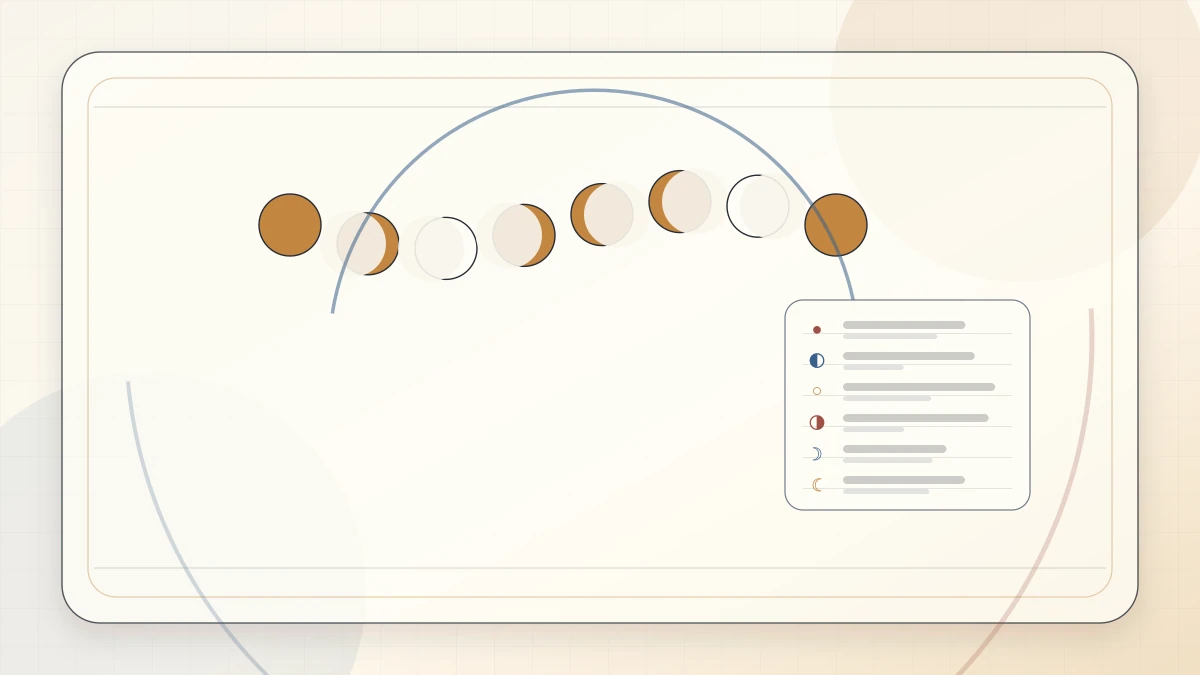
| Kind of thinking | Phase traditionally paired | A five-minute prompt |
|---|---|---|
| Starting something | New Moon | What do I want to begin this cycle? |
| Building momentum | Waxing crescent | What is one small step I can repeat? |
| Deciding and committing | First quarter | What is blocking this, and what choice is mine? |
| Refining | Waxing gibbous | What needs adjusting before I judge it? |
| Reviewing results | Full Moon | What is visible now that was not before? |
| Sharing and teaching | Waning gibbous | What have I learned that someone else could use? |
| Letting go | Last quarter | What can I stop carrying? |
| Resting and clearing | Balsamic | What would make the next cycle easier? |
Looking forward while the Moon grows, looking back while it shrinks
The simplest version of lunar planning uses two moods. While the Moon waxes (grows from new toward full), you look forward: choose, start, build. While it wanes (shrinks from full toward new), you look back: review, finish, release.
Reflection and planning are not opposites. A review gives you the information that the next plan needs, so the waning half is where you collect it and the waxing half is where you use it. Many people find it easier to keep one habit in each half than to follow all eight phases.
A month in four blocks instead of eight phases
The Moon takes about 29.5 days to go from one new Moon to the next, so quarter points arrive about 7.4 days apart. Rounded to calendar days, that gives check-ins around day 0, day 7, day 15 and day 22.
Four stops fit most schedules better than eight, and they pair with begin, check, review and release. If even that feels like a lot, pick two.
A constructed example: one person, one goal, one cycle
Jordan, a made-up person, wants to organize a spare room. At the new Moon (day 0) he spends ten minutes listing what the room should be used for. At first quarter (day 7) he checks what he has done and trims the list. At the full Moon (day 15) he reviews what worked, and near the last quarter (day 22) he donates what he has decided not to keep.
Total time: four sessions of ten minutes, or 40 minutes a cycle. Over a year of 12 to 13 cycles that is about 8 to 9 hours of deliberate planning. Whether he finishes the room depends on his schedule and his effort, not on the Moon.
What Jordan gains is structure. Without the four dates, he says, the project would have stayed a vague wish for months. With them, each session has a small, clear job, and he can see progress at a glance.
Test it yourself with a diary
If you want to know whether the rhythm helps you, a short experiment is better than a belief.
- For three cycles, which is about 88 days, note the Moon phase each day beside a one-line mood and energy rating.
- Mark the days you did your planned check-ins.
- At the end, compare. Did check-in days feel different? Did any phase stand out, or did it look like noise?
- Keep what is useful and drop the rest.
Fit the intervals to your real schedule
A cycle of 29.5 days does not match calendar months, work weeks or school terms. About 12 or 13 new Moons occur in a year, and some calendar months hold two full Moons. If your life runs on shifts, deadlines or a family timetable, anchor your check-ins to the nearest convenient day instead of the exact phase.
Reflection and planning only help if you can keep them, so pick a rhythm you will actually follow. A weekly check-in that happens to land near the right phase is worth more than a perfectly timed one you skip.
- Pick one question for the new Moon, such as what do I want to start?
- Pick one question for the full Moon, such as what is working and what is not?
- Set a recurring reminder on your phone for both dates.
- Keep each session under fifteen minutes so it stays easy to repeat.
When the phase should not decide
Real deadlines, appointments and care for other people come first. If a bill is due or a doctor's visit is scheduled, a waning Moon is not a reason to delay it. Decisions about health, money, law or safety belong with qualified people, not a calendar of phases.
Also be wary of using the Moon to avoid something. If every full Moon is a reason to put off a hard conversation, the pattern has stopped helping.
Common questions about planning by Moon phase
Is the new Moon really the best time to start? It is the traditional starting point because the cycle begins there. That makes it a convenient date, not a better one.
What if I miss a phase? Nothing is lost. Do the check-in on the next convenient day, because the rhythm works only when you can keep it.
Do I need to see the Moon? No. A moon calendar or the current Moon phase calculator on this site gives the phase, and it is the same everywhere in the world even though it looks mirrored in the Southern Hemisphere.
Should I use the Moon sign too? You can, but it is optional. The Moon spends about 2.3 days in each sign on average, and many people find the phase alone is plenty to track.
What this does and does not establish
There is no good evidence the Moon changes motivation or productivity, and real deadlines, appointments and care for others always come before a phase.
Related calculators
Use the matching tool when you want a direct chart or timing result after reading the guide.
Current Moon Phase Calculator
reader-focused-friendly exact current Moon phase page for a selected city and live local timestamp.
New Moon Calculator
Exact monthly New Moon lookup page for reset and intention-planning readers.
Full Moon Calculator
Exact monthly Full Moon lookup page for release, visibility, and completion timing readers.
Calculation references
- NASA: Moon phases
Reference for illuminated phases and physical geometry; not evidence for personal or ritual interpretations.
Related articles
Keep reading with nearby topics that deepen the same question from another angle.
New Moon Journaling Prompts
Good new Moon prompts ask what you want to begin, the smallest first step and when you will take it. Pick two or three and write for ten to fifteen minutes.
6 min read
How to Use the Moon Phase Calendar
Mark the four main phase instants in your own time zone, then use them as short check-ins: begin at new Moon, check at first quarter, review at full Moon and tidy at last quarter.
7 min read
Dark Moon vs New Moon
The new Moon is the exact instant the Moon and Sun share the same longitude. The dark Moon usually means the one to three nights before it when no Moon can be seen.
6 min read
Moon Phase Journaling Prompts
Moon phase journaling gives each of the eight phases one short question, so you write about every 3.7 days instead of daily. The Moon supplies the rhythm, not your feelings.
6 min read
Keep exploring
Use the category page and the main hubs when you want the next layer of context.
Previous article
Dark Moon vs New Moon
Next article
Moon Phase Journaling Prompts