
Moon Phases
Moon Phase Journaling Prompts
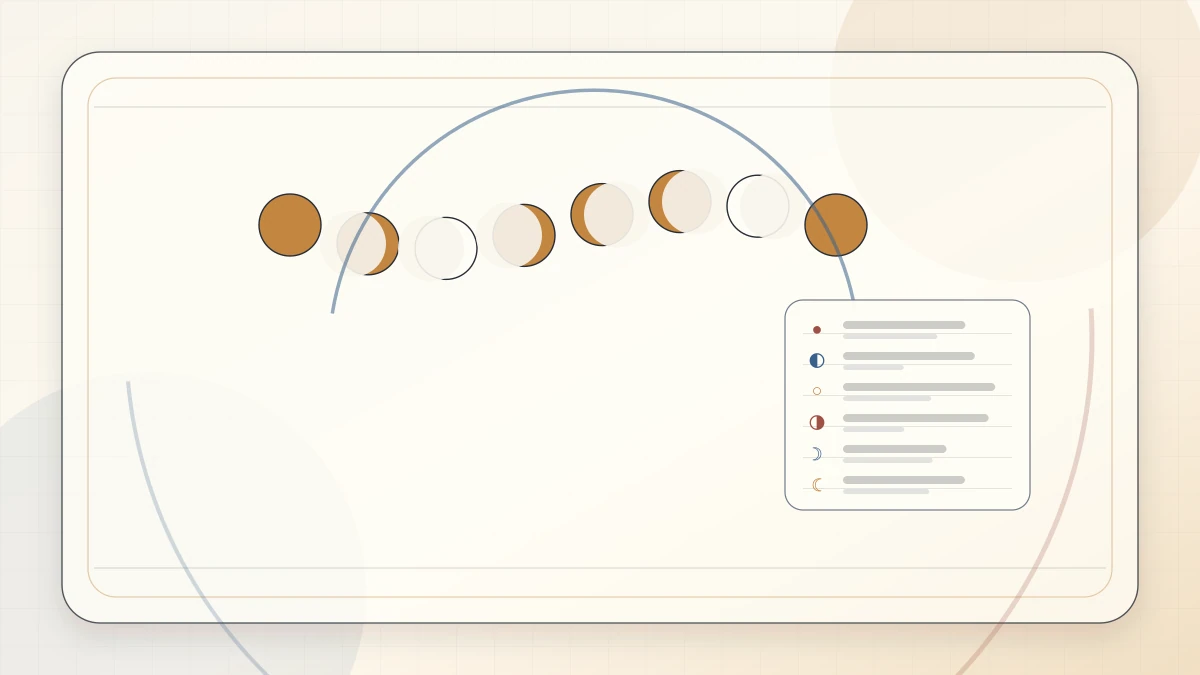
Moon phase journaling gives each of the eight phases one short question, so you write about every 3.7 days instead of daily. The Moon supplies the rhythm, not your feelings.
Table of contents
- Example or practical exercise
- How a phase prompt differs from a daily prompt
- Eight phases, eight prompts
- A four-line entry you can finish in five minutes
- A worked example: one first quarter entry
- Fallback prompts for days when nothing fits
- When a prompt brings up something painful
- How to adapt a prompt to your own goal
- Common questions about phase journals
- How to review the journal after three cycles
- What this does and does not establish
Example or practical exercise
Mara planned to paint on four evenings before first quarter and managed two; her entry names setup as the obstacle, so she decides to leave the paints out.
How a phase prompt differs from a daily prompt
Daily journaling asks you to write every day, and many people drop it by the second week. Phase journaling asks for an entry about every four days, because each of the eight named phases lasts about 3.7 days. That is roughly eight short entries in one 29.5-day cycle, which is a rhythm most people can keep.
The Moon does not change what you feel. The value is the repeating structure: a fixed moment to stop, look back and plan. Each prompt below is a question you could ask in any week, attached to a phase so you remember to ask it.
Eight phases, eight prompts
Each prompt is built to take about five minutes. Use the one for the phase you are in, and skip the others until their turn. The last column counts days from the exact new Moon, with each phase starting every 45 degrees of Sun-Moon separation, about every 3.7 days; a Moon calendar gives the real dates.
| Phase | Prompt | Begins about |
|---|---|---|
| New Moon | What small thing am I curious enough to try this cycle? | Day 0 |
| Waxing crescent | What is the first ten-minute step, and when exactly will I take it? | Day 3.7 |
| First quarter | What got in the way this week: a problem to solve or a plan to adjust? | Day 7.4 |
| Waxing gibbous | What needs refining before anyone else sees it? | Day 11.1 |
| Full Moon | What evidence has appeared, for or against what I set out to do? | Day 14.8 |
| Waning gibbous | What did I learn that someone else could use? | Day 18.4 |
| Last quarter | What am I still carrying out of habit that I could set down? | Day 22.1 |
| Balsamic Moon | What do I need to rest from, and what can wait until the next cycle? | Day 25.8 |
A four-line entry you can finish in five minutes
A prompt works best when the page it lands on is also small. This format keeps facts apart from interpretation, which makes the entries easier to reread honestly.
- Line one: the date and the phase.
- Line two: one fact from the past few days that you could prove to a stranger.
- Line three: your answer to the prompt, in two or three sentences.
- Line four: one thing that does not fit your answer.
A worked example: one first quarter entry
Here is a constructed entry by a writer called Mara, who set out at the new Moon to paint on four evenings before the first quarter. The fact line reads: painted on two of the four planned evenings. The prompt asks what got in the way, and she writes that both missed evenings were ones where she left clearing the table until late.
Her answer is that the obstacle was setup, not motivation, so she decides to leave the paints out. Line four, the thing that does not fit, reads: the evenings I did paint were also the two busiest days at work. Two of four is half, and the last line keeps her from concluding too much from it.
Over a full cycle, eight entries of five minutes come to forty minutes in all. That is the whole commitment.
Fallback prompts for days when nothing fits
Some phases arrive when you have nothing to say. Rather than skip, use a plain fallback and move on.
- What is one thing I noticed outdoors today?
- What did I do today that I would be glad to repeat?
- What is one small thing I have been putting off, and what is the first two minutes of it?
When a prompt brings up something painful
A good question can land on a sore spot. If writing an answer leaves you distressed, put the pen down, take a few breaths, and go do something ordinary. You do not have to finish an entry.
Journaling is a reflection habit, not therapy. If a topic keeps returning and feels heavy, talk with someone you trust or a qualified professional. Choose a different prompt from the table in the meantime.
How to adapt a prompt to your own goal
The eight prompts are generic on purpose. Rewrite each one once so that it names your own project, and it will stop sounding like someone else’s homework. Replace the word thing with the real subject, and keep the verb, since the verb is what makes each prompt work.
For a writing project the first quarter prompt becomes: what stopped me from writing this week, and is it a problem to solve or a plan to adjust? For a friendship it might ask what small contact I could make that I would be glad to repeat. For a household task it could ask what is the smallest version of this I could finish before the full Moon. The structure stays the same, and only the subject changes.
A good test is whether you can answer the prompt in under three sentences. If you cannot, the question is too big, and you should cut it down to a part of the project you can actually see.
Common questions about phase journals
Do I write at night? Write when you can. The phase lasts nearly four days, so any day inside it works, and the time of day is yours to choose.
What if I miss a phase? Pick up at the next one. A gap of four days does no harm, and a journal that forgives gaps is one you will keep.
Should I add the Moon’s sign? Not at first. The sign adds a second layer to track, and most beginners get more from the phase alone.
How soon will it show me anything? Give it three cycles, about three months. A pattern in a few entries is a hint, and a pattern across a quarter is worth a closer look.
How to review the journal after three cycles
After three cycles you have about 24 entries. Read them in order in one sitting and mark two things: which prompts produced answers you were glad to have written, and which produced only filler.
Keep the useful prompts, replace the others with your own, and pay special attention to line four of each entry. The things that did not fit are the honest part of the record, and they stop a neat story from hardening into a belief.
What this does and does not establish
A journal is a reflection habit, not therapy, and a heavy topic that keeps returning deserves a trusted person or a qualified professional.
Related calculators
Use the matching tool when you want a direct chart or timing result after reading the guide.
Current Moon Phase Calculator
reader-focused-friendly exact current Moon phase page for a selected city and live local timestamp.
New Moon Calculator
Exact monthly New Moon lookup page for reset and intention-planning readers.
Full Moon Calculator
Exact monthly Full Moon lookup page for release, visibility, and completion timing readers.
Calculation references
- NASA: Moon phases
Reference for illuminated phases and physical geometry; not evidence for personal or ritual interpretations.
Related articles
Keep reading with nearby topics that deepen the same question from another angle.
New Moon Journaling Prompts
Good new Moon prompts ask what you want to begin, the smallest first step and when you will take it. Pick two or three and write for ten to fifteen minutes.
6 min read
How to Use the Moon Phase Calendar
Mark the four main phase instants in your own time zone, then use them as short check-ins: begin at new Moon, check at first quarter, review at full Moon and tidy at last quarter.
7 min read
Best Moon Phases for Reflection and Planning
No Moon phase is better for a task, but tradition pairs planning with the waxing half and reflection with the waning half. Four quarter check-ins fit most schedules well.
6 min read
Moon Phases Explained for Beginners
Moon phases show how much of the Moon's sunlit half we can see as it circles Earth. One 29.5-day cycle splits into eight phases of about 3.7 days, each starting at a multiple of 45 degrees.
6 min read
Keep exploring
Use the category page and the main hubs when you want the next layer of context.
Previous article
Best Moon Phases for Reflection and Planning
Next article
Mercury Retrograde Meaning and a Practical Checklist