
Career Astrology
Best Work Environments by Zodiac Element: Questions to Ask
The elements give a vocabulary for workplace preferences: fire for energy, earth for steadiness, air for ideas and exchange, water for attunement. No element has a best workplace, so use them to ask questions.
Table of contents
- Example or practical exercise
- What an element can describe about a workplace, and what it cannot
- Element by element: conditions people often name as helpful
- Four dials: pace, structure, talk and support
- Modality adds a second layer
- Counting the elements in a constructed chart
- Reading the count as questions, not a verdict
- Using elements to talk about differences in a team
- Tasks have moods too
- Turn it into a two-week experiment
- Common questions about elements and workplaces
- What this does and does not establish
Example or practical exercise
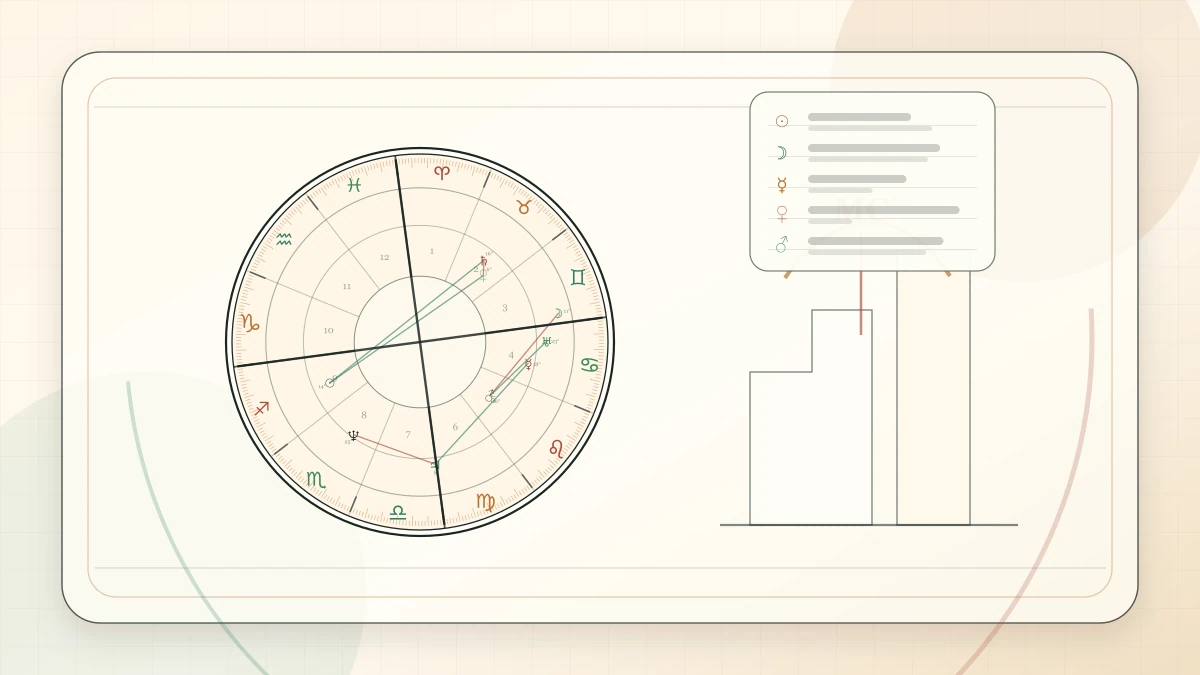
A constructed chart counts three fire, four earth, one air and two water placements, but Saturn, Uranus and Neptune share Capricorn for years, so only the Virgo Moon makes the earth emphasis personal.
What an element can describe about a workplace, and what it cannot
Workplaces differ in pace, structure, talk and support, and people differ in what helps them concentrate. The four elements, fire, earth, air and water, give a symbolic vocabulary for describing those differences. Fire is linked to energy and initiative, earth to practical steadiness, air to ideas and exchange, and water to feeling and attunement.
These are traditions, not measurements. Every element can work in every kind of environment, and no element makes anyone unsuited to any job, so there is no best workplace for an element. Use the vocabulary to ask questions about a preference you have already noticed, not to forecast one.
Element by element: conditions people often name as helpful
The table lists what tradition associates with each element, along with a friction to watch for. People with a strong emphasis on an element often recognize part of it, but plenty do not.
| Element | Signs | Conditions people often describe as helpful | Friction to watch |
|---|---|---|---|
| Fire | Aries, Leo, Sagittarius | Room to start things, visible goals, quick feedback | Slow approval chains may feel heavy |
| Earth | Taurus, Virgo, Capricorn | Clear tasks, steady routines, tangible results | Sudden changes of plan may feel unsettling |
| Air | Gemini, Libra, Aquarius | Conversation, variety, a chance to test ideas | Long solitary stretches may feel flat |
| Water | Cancer, Scorpio, Pisces | Trust, privacy, a team that notices how people feel | Constant noise or sharp criticism may drain focus |
Four dials: pace, structure, talk and support
Instead of asking which element you are, ask where you set each dial for a given task.
- Pace: do you work best with quick turns or with long stretches of deep work?
- Structure: do you want a clear list and rules, or room to improvise?
- Talk: does discussion sharpen your thinking or interrupt it?
- Support: do you want check-ins and encouragement, or to be left alone until you ask?
Modality adds a second layer
Each sign also has a modality. Cardinal signs begin things, fixed signs sustain them, and mutable signs adapt and close them. Tradition reads this as a question about the phase of work you favor.
| Modality | Signs | Prompt about work |
|---|---|---|
| Cardinal | Aries, Cancer, Libra, Capricorn | Do I like launching projects and setting direction? |
| Fixed | Taurus, Leo, Scorpio, Aquarius | Do I like staying with a task until it is done? |
| Mutable | Gemini, Virgo, Sagittarius, Pisces | Do I like adjusting plans and handling changes? |
Counting the elements in a constructed chart
A person has all four elements spread across the chart. This invented chart places the Sun in Aries, Moon in Virgo, Mercury in Pisces, Venus in Aries, Mars in Gemini, Jupiter in Sagittarius, Saturn, Uranus and Neptune in Capricorn, and Pluto in Scorpio.
That gives fire three (Sun, Venus, Jupiter), earth four (Moon, Saturn, Uranus, Neptune), air one (Mars) and water two (Mercury, Pluto), and 3 + 4 + 1 + 2 = 10. Astrologers count differently, some using only seven planets or adding the Ascendant, so state your method. Uranus, Neptune and Pluto stay in a sign for years, so they say little about an individual.
Reading the count as questions, not a verdict
Four earth placements might prompt a question about how much structure the person likes, although Saturn, Uranus and Neptune stay in Capricorn for years, so only the Moon’s placement is closer to personal. One air placement is not a shortage. It is a prompt to ask where conversation comes from, since Mars, the planet of action, sits in an air sign.
Nothing here says the person would do well or badly in any workplace. The counts only suggest what to observe.
Using elements to talk about differences in a team
Elements can give a team neutral names for differences in how people work. Picture four invented colleagues. Dev, a Leo Sun, likes to brainstorm out loud. Mia, a Taurus Sun, likes a written brief. Omar, a Libra Sun, wants a call before a decision. Lena, a Pisces Sun, wants time alone before she speaks.
Rather than ranking them, the team agrees on a short written brief a day ahead, a 20-minute call, and a day to reply in writing. That suits people of every sign. The elements only helped them find words for what each person already knew.
Tasks have moods too
A launch, a routine maintenance chore, a brainstorm and a hard customer call each ask for different conditions. Matching conditions to the task usually helps more than matching them to a sign, because the same person wants quiet for one task and company for another.
Turn it into a two-week experiment
A diary tells you more than an element count. Choose two kinds of work conditions, such as quiet solo time and group sessions, and rate your focus from 1 to 5 after each.
Suppose five quiet sessions score 4, 4, 3, 5 and 4, a total of 20, or an average of 4.0. Five group sessions score 3, 2, 4, 3 and 3, a total of 15, or an average of 3.0. That suggests quiet time helped, though the tasks may differ, so repeat it with similar tasks before drawing a conclusion.
Also note the time of day and the task, since an afternoon slump or a harder assignment can look like an environment effect. If the result is unclear after two weeks, that is a fine answer too: it means the setting may matter less to you than you expected.
Common questions about elements and workplaces
Is my element my Sun sign? Only one part of it. Your Moon, Rising sign and planets each bring an element too, and a Sun sign alone is one of many factors.
Which element suits remote work best? None. A remote setup can give quiet and flexibility, or isolation, depending on the person and the job.
What if I cannot change my workplace? Small adjustments often help: headphones, set times for messages or a short walk. These work for any chart.
Do opposite elements clash at work? Not by rule. Fire and water, or earth and air, are sometimes described as differing in pace and approach, but differences often complement each other, and clear working agreements matter more than elements.
Can I use this to choose a job? No. An element count is not evidence about any occupation or workplace, and every element appears in every line of work.
What this does and does not establish
An element count is not evidence about any job or workplace, and every element appears in every line of work.
Related calculators
Use the matching tool when you want a direct chart or timing result after reading the guide.
Career Astrology Calculator
Saved-chart practical career page built from Midheaven, Sun, Saturn, and tenth-house structure.
Midheaven / MC Sign Calculator
Exact Midheaven sign verification from full birth-chart math for practical career and visibility questions.
Money Astrology Calculator
Saved-chart money-style page built from second-house, eighth-house, Venus, and Jupiter patterns.
Calculation references
- Swiss Ephemeris: positions, angles and house-system conventions
Technical reference for calculation conventions. It does not certify an interpretation or mean every live tool uses this engine.
Related articles
Keep reading with nearby topics that deepen the same question from another angle.
How to Use Astrology for Work-Life Balance Reflection
Begin with your real week of 168 hours, then use chart axes such as the Midheaven and IC to ask questions about proportion. No placement tells you how much to work or rest.
6 min read
Career Change Astrology in Your 30s
Astrologers point to the Saturn return near 29.5, the Jupiter return near 35.7 and the Saturn square near 36.9 in your thirties. Treat them as reflection markers, not a rule about when to change careers.
6 min read
Career Astrology for Beginners
Career astrology reads six layers: the tenth house and Midheaven for public role, the sixth for daily work, the second for resources, and the Sun, Saturn and Mars for purpose, discipline and drive.
6 min read
Midheaven Sign Meaning
Your Midheaven sign describes the public style you tend to show in your work and reputation, such as precise and helpful for Virgo. Its ruler and nearby planets add detail.
6 min read
Keep exploring
Use the category page and the main hubs when you want the next layer of context.
Previous article
How to Use Astrology for Work-Life Balance Reflection
Next article
Career Change Astrology in Your 30s