
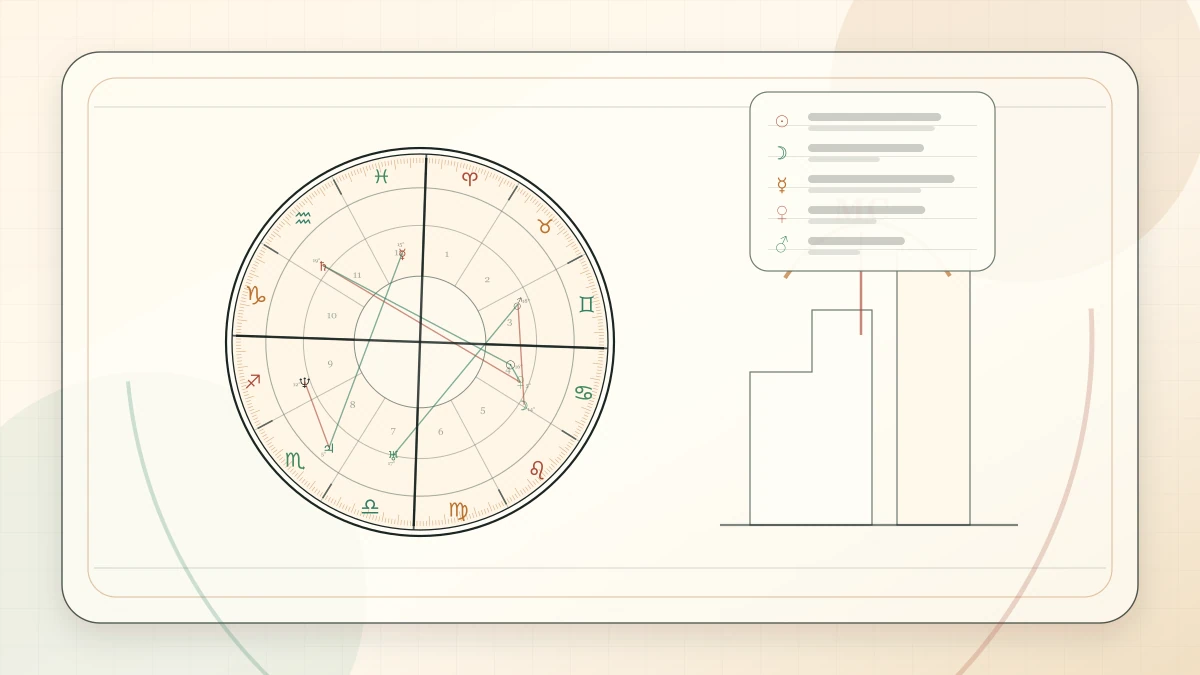
Career Astrology
How to Use Astrology for Work-Life Balance Reflection
Begin with your real week of 168 hours, then use chart axes such as the Midheaven and IC to ask questions about proportion. No placement tells you how much to work or rest.
Table of contents
- Example or practical exercise
- Balance starts with hours, not houses
- A constructed week of 168 hours
- Four chart axes that name a balance
- The Moon, Saturn and Mars as prompts
- A heavy tenth house does not mean you should work less
- Adding Marcus’s invented chart to the week
- Why the right proportions change over time
- A fifteen-minute weekly check-in
- When balance becomes a health matter
- Common questions about balance and the chart
- What this does and does not establish
Example or practical exercise
Marcus, invented, adds up 49 hours of sleep, 46 of paid work, 6 commuting, 14 of household tasks and 14 of meals, leaving 39 hours, most of them evenings and weekends easily eaten by errands.
Balance starts with hours, not houses
A week holds 168 hours, and balance questions are easiest to answer when you can see where they go. Astrology comes second. It offers a language for asking why a pattern feels heavy or light, but it cannot say how many hours of work are right for you.
This guide uses the chart to prompt reflection after you have the facts. If you are not sure what the facts are, start with the table in the next section.
A constructed week of 168 hours
Marcus is an invented person. He sleeps 7 hours a night, which is 49 a week, works 46 hours, spends 6 commuting, 14 on household tasks and 14 on meals. Those add up to 49 + 46 + 6 + 14 + 14 = 129 hours, leaving 168 - 129 = 39.
Marcus first thinks 39 hours is plenty. When he looks, most of them are evenings and weekends, the hours most easily taken by messages and errands. The number matters less than how the hours arrive.
| Category | Hours per week |
|---|---|
| Sleep | 49 |
| Paid work | 46 |
| Commuting | 6 |
| Household tasks | 14 |
| Meals | 14 |
| Left over | 39 |
Four chart axes that name a balance
Houses sit in opposite pairs, and each pair describes a tension that can be held rather than solved. These are traditional associations, offered as prompts.
| Axis | Houses | Balance it names | Prompt |
|---|---|---|---|
| Midheaven and Imum Coeli | Tenth and fourth | Public role and home | What does my home life need from my work schedule? |
| Work and retreat | Sixth and twelfth | Daily duty and rest | Where do I get real rest, not just time off? |
| Play and groups | Fifth and eleventh | Own projects and shared aims | When did I last do something for its own sake? |
| Self and others | First and seventh | My needs and other people’s | What do I say no to, and what do I say yes to? |
The Moon, Saturn and Mars as prompts
The Moon’s sign and house are traditionally read as what restores you. A question follows: what actually does that for you, and is it on the calendar?
Saturn stands for limits and structure, so its placement invites a question about the boundaries you keep. Mars stands for drive and energy, so its placement asks where your effort goes and what you do when it runs low. None of these shows how much work is healthy. They only help you word your own observations.
A heavy tenth house does not mean you should work less
The Midheaven and the Imum Coeli (the IC, the point opposite it) are always 180 degrees apart, so every chart contains both public life and private life. A chart with many planets in the tenth house is not a warning about overwork, and one with many in the fourth is not a call to stay home.
Treat the axis as a question about proportion. At different stages of life the right proportion changes, and no placement fixes it.
Adding Marcus’s invented chart to the week
Suppose Marcus’s chart has the Moon in the fourth house and Saturn in the tenth. The Moon prompt asks what restores him, and he realizes it is quiet evenings at home, which errands often take. The Saturn prompt asks what boundary surrounds his work, and he notices he answers messages until 10 p.m.
He tries one adjustment: no work messages after 8 p.m. That is 2 hours a night, or up to 10 hours across five weeknights, that were at least partly spent on work. After two weeks he checks whether evenings feel different. The chart supplied the questions, and his own record supplied the answers.
Why the right proportions change over time
Saturn takes about 29.5 years to circle the zodiac, and its returns, at about 28 to 30 and again at about 57 to 60, are traditionally read as times to review structures and commitments. Many people simply use those ages to take stock.
Many people notice nothing dramatic at these ages. The useful idea is the plain one: caring for children, studying, a new job or an aging parent each reshape a week, and a balance that fit last year may not fit this one.
A fifteen-minute weekly check-in
Choose a regular slot, such as Sunday evening. The Moon does not change outcomes. The value is the pause.
- Write down the hours you worked and slept this week.
- Name one thing that gave you energy and one that drained it.
- Pick one axis from the table and answer its prompt in a sentence.
- Decide on one small adjustment for the coming week, such as a fixed finishing time.
- Check whether last week’s adjustment helped.
When balance becomes a health matter
If long hours, poor sleep, constant worry or physical symptoms are affecting you, speak with a doctor or another qualified professional. A chart cannot judge healthy working hours, and reading your placements is no replacement for care.
Sometimes hours are fixed by a job, a family or money, and balance means small adjustments rather than a new life. That is still worth doing, and it is no failure to have limited choices.
Common questions about balance and the chart
Do fire signs overwork? That is a tendency attributed to the sign. Any sign can overwork, and circumstances matter more.
Does a stellium in the tenth house mean I am a workaholic? No. It means several planets share that area, which can prompt questions about focus there.
Is balance an equal split of time? No. It shifts with seasons of life, and the aim is to notice what you need.
Can a chart tell me I am burning out? No. Burnout is about how you feel and function. If you are exhausted, hopeless or unwell, a doctor or qualified professional is the right person to talk with.
What if my family sees the week differently? Sharing the hours table can start a conversation, and the axis prompts give you words for differences without blame.
What this does and does not establish
A chart cannot tell you that you are burning out or what healthy working hours are; exhaustion belongs with a doctor or qualified professional.
Related calculators
Use the matching tool when you want a direct chart or timing result after reading the guide.
Career Astrology Calculator
Saved-chart practical career page built from Midheaven, Sun, Saturn, and tenth-house structure.
Midheaven / MC Sign Calculator
Exact Midheaven sign verification from full birth-chart math for practical career and visibility questions.
Money Astrology Calculator
Saved-chart money-style page built from second-house, eighth-house, Venus, and Jupiter patterns.
Calculation references
- Swiss Ephemeris: positions, angles and house-system conventions
Technical reference for calculation conventions. It does not certify an interpretation or mean every live tool uses this engine.
Related articles
Keep reading with nearby topics that deepen the same question from another angle.
How to Read Public Reputation in a Birth Chart
Astrologers read reputation through the Midheaven, its ruler, planets near it or in the tenth house, and the Ascendant. Turn each into a question, then compare it with real feedback from people who know you.
6 min read
Best Work Environments by Zodiac Element: Questions to Ask
The elements give a vocabulary for workplace preferences: fire for energy, earth for steadiness, air for ideas and exchange, water for attunement. No element has a best workplace, so use them to ask questions.
6 min read
Career Astrology for Beginners
Career astrology reads six layers: the tenth house and Midheaven for public role, the sixth for daily work, the second for resources, and the Sun, Saturn and Mars for purpose, discipline and drive.
6 min read
Midheaven Sign Meaning
Your Midheaven sign describes the public style you tend to show in your work and reputation, such as precise and helpful for Virgo. Its ruler and nearby planets add detail.
6 min read
Keep exploring
Use the category page and the main hubs when you want the next layer of context.
Previous article
How to Read Public Reputation in a Birth Chart
Next article
Best Work Environments by Zodiac Element: Questions to Ask