
Houses, Aspects, and Planets
Conjunction, Square, Trine, and Opposition Explained
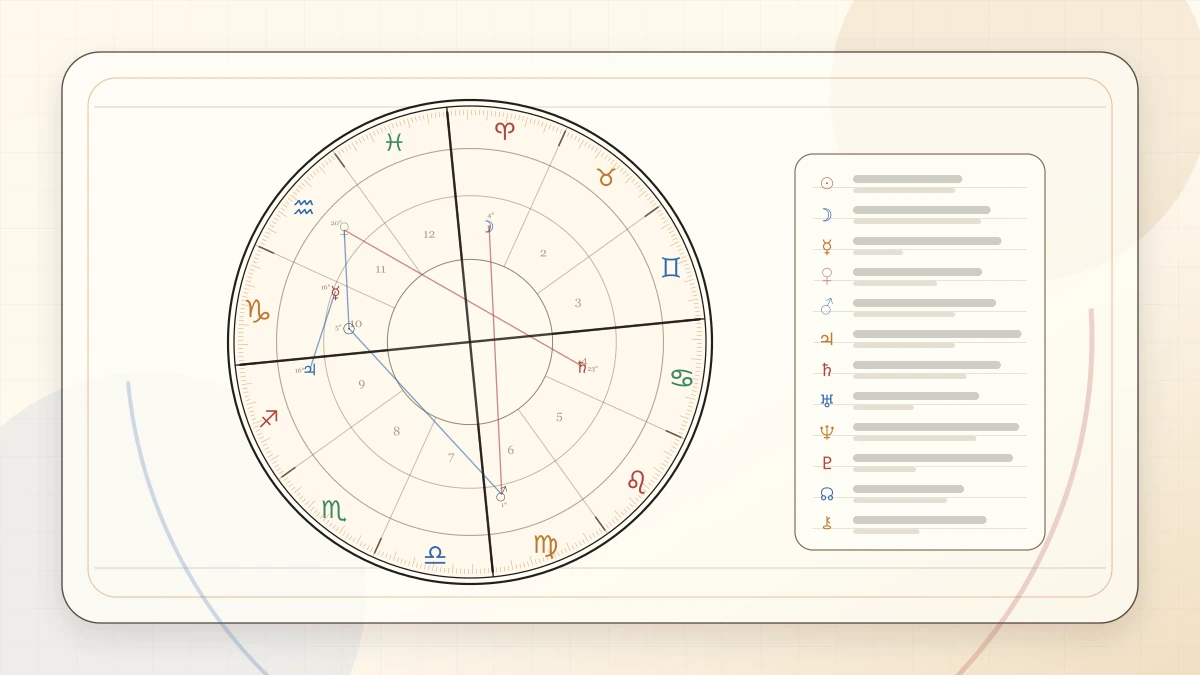
The major aspects are angles between two planets: conjunction at 0 degrees, square at 90, trine at 120 and opposition at 180, with the sextile at 60. Planets in aspect modify each other.
Table of contents
- Example or practical exercise
- What an aspect is
- The five major aspects
- Orbs: how close is close enough
- Working out an aspect by hand
- Hard and soft aspects are not bad and good
- Aspects that cross sign boundaries
- How to read an aspect in a sentence
- Measuring an aspect across the start of Aries
- Applying and separating aspects
- Minor aspects in brief
- Why many readers leave them out at first
- What this does and does not establish
Example or practical exercise
Mars at 12 degrees Aries is 12 and Saturn at 14 degrees Cancer is 104, a 92-degree gap, so Mars squares Saturn with a 2-degree orb.
What an aspect is
An aspect is an angle between two planets, measured along the zodiac. When two planets are a particular number of degrees apart, astrologers say they are “in aspect” and read the two as linked: each one modifies how the other works.
The signs tell you how each planet behaves on its own. Aspects tell you which planets have to deal with each other. A chart with the same planets in the same signs reads quite differently once the aspects are taken into account.
The five major aspects
Four aspects come from dividing the circle by one, two, three and four. The sextile, from dividing by six, is usually taught with them. Together they are called the major, or Ptolemaic, aspects.
| Aspect | Angle | Signs apart | Traditional quality |
|---|---|---|---|
| Conjunction | 0° | Same sign | Blending: the two planets act as one |
| Sextile | 60° | 2 | Opportunity: easy cooperation if you use it |
| Square | 90° | 3 | Tension: friction that demands action |
| Trine | 120° | 4 | Ease: abilities that come naturally |
| Opposition | 180° | 6 | Polarity: a pull between two needs |
Orbs: how close is close enough
Planets are rarely an exact 90 or 120 degrees apart. The orb is the allowance either side of exact within which the aspect still counts. With an eight-degree orb, two planets anywhere from 82 to 98 degrees apart form a square.
There is no official list of orbs. A common practice is to allow about eight degrees for the conjunction, square, trine and opposition and about four to six for the sextile, with a little extra when the Sun or Moon is involved. Different astrologers and different calculators use different figures, which is why two programs can list different aspects for the same chart.
The rule that matters is simple: the smaller the orb, the stronger the aspect. An aspect within one or two degrees is a central feature of a chart. One at seven degrees is background. Some readers cut off at six degrees to keep the list short, so a seven-degree aspect would drop out of their reading entirely; whichever limit you choose, say what it is and use it for the whole chart.
Working out an aspect by hand
Turn each position into a number from 0 to 360 by counting from the start of Aries. Aries begins at 0, Taurus at 30, Gemini at 60, Cancer at 90, Leo at 120 and so on, adding 30 for each sign. Subtract one position from the other. If the answer is over 180, subtract it from 360.
Example one: Mars at 12 degrees Aries is 12. Saturn at 14 degrees Cancer is 90 + 14 = 104. The difference is 92 degrees, which is two degrees from an exact square. Mars is square Saturn with an orb of two degrees.
Example two: Venus at 20 degrees Leo is 120 + 20 = 140. Jupiter at 18 degrees Sagittarius is 240 + 18 = 258. The difference is 118 degrees, two short of 120. Venus is trine Jupiter with an orb of two degrees.
Hard and soft aspects are not bad and good
Squares and oppositions are called hard aspects, and trines and sextiles soft aspects. It is tempting to read these as bad and good. Many experienced astrologers avoid that reading.
A hard aspect is read as friction, and friction is often what prompts people to act. Astrologers use that idea to argue that a square is not a defect, though it is an interpretive view and not a tested finding. A soft aspect describes something that comes easily, which is pleasant and can also be taken for granted and never developed.
The conjunction is neither hard nor soft. Its character depends on which two planets are joined: Venus with Jupiter blends very differently from Mars with Saturn.
Aspects that cross sign boundaries
Aspects are measured in degrees, not in signs. Usually the two agree: planets in signs three apart are square. Near the edges of signs they can disagree.
Take a planet at 28 degrees Aries and another at 1 degree Leo. Their positions are 28 and 121, a difference of 93 degrees. By degree that is a square with a three-degree orb. By sign, Aries and Leo are both fire signs and would normally be in trine. Astrologers call this an out-of-sign aspect. The degree measurement decides that the aspect exists; the shared element softens how it is read.
How to read an aspect in a sentence
Use the same three-part pattern every time: the first planet, the kind of link, the second planet. Mars square Saturn becomes “drive meets limits, with friction”. Venus trine Jupiter becomes “affection and generosity, flowing easily”.
Then add the signs and houses to say where and how. Do not try to read every aspect in a chart. Find the three with the smallest orbs and understand those well, because a few tight contacts are easier to examine honestly than twenty wide ones.
Measuring an aspect across the start of Aries
Subtraction sometimes gives a number above 180, and the rule is to subtract it from 360. Here is a case. Venus is at 28 degrees Pisces, which is 330 + 28 = 358. Mars is at 28 degrees Gemini, which is 60 + 28 = 88. The difference is 358 minus 88, which is 270, and 360 minus 270 is 90.
That is an exact square, with an orb of zero, even though the two planets sit on opposite sides of the point where Aries begins. Both signs are mutable and three signs apart, so the sign count and the degrees agree.
Applying and separating aspects
Planets keep moving, so an aspect can be growing tighter or looser. While the faster planet is still approaching the exact angle, the aspect is applying. Once it has passed the exact angle, it is separating.
Suppose Mercury is at 16 degrees Cancer and Mars at 18 degrees Cancer, two degrees from a conjunction. If Mercury is moving forward and faster than Mars, the gap is closing and the aspect is applying. Many astrologers read applying aspects as more active, and others give the difference little weight, so practice varies.
Minor aspects in brief
Astrologers also use some smaller angles, with tighter orbs. Figures vary by astrologer, and these are common ones.
| Aspect | Angle | Signs apart | Common orb |
|---|---|---|---|
| Semisextile | 30° | 1 | About 1 to 2 degrees |
| Sextile | 60° | 2 | About 4 to 6 degrees |
| Quincunx | 150° | 5 | About 2 to 3 degrees |
Why many readers leave them out at first
The semisextile joins neighboring signs, which never share an element or a modality, and the quincunx joins signs five apart, which share neither. Both are traditionally read as asking for adjustment. Because they are subtle and the orbs are small, many astrologers set them aside until the major aspects are familiar.
What this does and does not establish
Calling aspects hard or soft is an interpretive view, not a tested finding, and orb limits differ from one astrologer to the next.
Related calculators
Use the matching tool when you want a direct chart or timing result after reading the guide.
12 Houses Calculator
Complete 12-house overview page for readers who want the full natal house framework before drilling into one exact placement.
House Placement Calculator
Manual placement page that combines one known planet and one known house into a reusable interpretation page.
Planet Meaning Finder
Plain-English planet reference page for beginner chart readers.
Calculation references
- Swiss Ephemeris: positions, angles and house-system conventions
Technical reference for calculation conventions. It does not certify an interpretation or mean every live tool uses this engine.
Related articles
Keep reading with nearby topics that deepen the same question from another angle.
How to Read Your Birth Chart: A Beginner's Guide
Read your birth chart in five steps: find the Sun, Moon and Rising sign, count the elements, note crowded houses, locate the chart ruler, then read the two or three closest aspects.
6 min read
Sun, Moon, and Rising Signs Explained
Your Sun sign describes what you are aiming to be, your Moon sign what you need to feel settled, and your Rising sign how you meet the world and how it first meets you.
6 min read
Twelfth House Meaning and Inner Life
The twelfth house is the last house, the sign just before your Rising sign. Modern astrologers read it as rest, retreat, solitude and what happens out of sight or beneath daily attention.
6 min read
Sextile Meaning in Astrology
A sextile is a 60-degree angle between two planets, two signs apart, usually allowed an orb of about 4 to 6 degrees. Astrologers read it as easy cooperation that works best when used.
7 min read
Keep exploring
Use the category page and the main hubs when you want the next layer of context.
Previous article
Twelfth House Meaning and Inner Life
Next article
Sextile Meaning in Astrology