
Birth Chart Basics
How to Read Your Birth Chart: A Beginner's Guide
Read your birth chart in five steps: find the Sun, Moon and Rising sign, count the elements, note crowded houses, locate the chart ruler, then read the two or three closest aspects.
Table of contents
- Example or practical exercise
- What a birth chart is
- What you need before you start
- The ten bodies and what each one stands for
- Read the chart in five steps
- A short worked reading
- Mistakes that make charts harder than they are
- A one-evening exercise to try with your own chart
- What this does and does not establish
Example or practical exercise
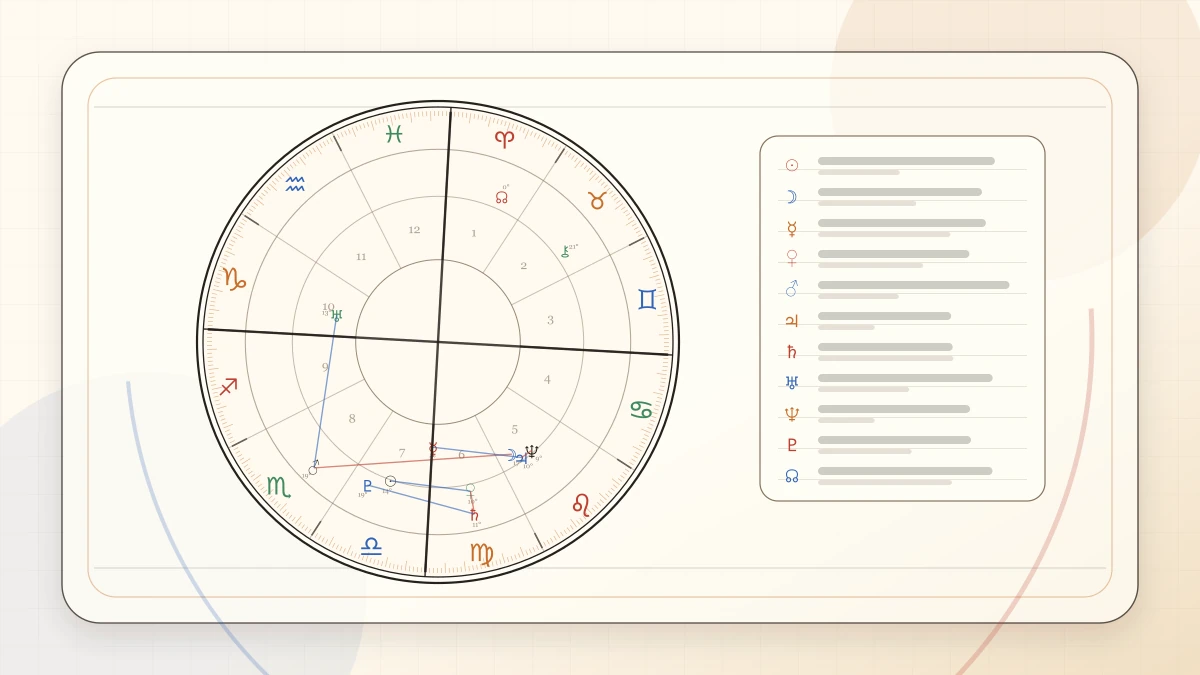
In a constructed chart with Leo rising, a Taurus Sun in the tenth house and a Scorpio Moon in the fourth, the Sun also rules the chart, so career is underlined twice and public life pulls against private life.
What a birth chart is
A birth chart, also called a natal chart, is a map of the sky for one moment and one place: the minute you were born, seen from where you were born. The circle is the zodiac, a band of 360 degrees divided into twelve signs of 30 degrees each. The Sun, the Moon and each planet sit at a particular degree of a particular sign.
The chart itself never changes. What changes is the sky after you were born, and that is what a transit reading compares against it. So the birth chart is the fixed reference, and everything else in astrology is measured from it.
Three ingredients carry most of the meaning. A planet is a function, such as feeling, thinking or acting. A sign is the style in which that function works. A house is the area of life where it shows up. A full reading is these three combined, over and over, for each planet.
What you need before you start
You need three facts: the date of birth, the time of birth and the place of birth. The date fixes the signs of the Sun and the slower planets. The time and place fix the Rising sign and the twelve houses, because those depend on which part of the sky was on the horizon.
The time matters more than most beginners expect. The horizon moves through roughly one degree of the zodiac every four minutes, so a birth time that is an hour out can give a different Rising sign and move planets into different houses. If you have no birth time, you can still read the planets in their signs. You should leave the houses and the Rising sign alone.
The ten bodies and what each one stands for
Western astrology works with the Sun, the Moon and eight planets. The faster a body moves, the more personal it is, because it separates people born close together. The slow planets stay in one sign for years and describe a whole age group.
| Body | Stands for | Time in one sign (approximate) |
|---|---|---|
| Sun | Identity, purpose, vitality | 1 month |
| Moon | Feelings, habits, what you need | About 2.3 days |
| Mercury | Thinking, speaking, learning | About a month on average, from two weeks to much longer with a retrograde |
| Venus | Affection, taste, values | 4 weeks, longer when retrograde |
| Mars | Drive, assertion, how you act | 6 to 7 weeks, longer when retrograde |
| Jupiter | Growth, confidence, opportunity | 1 year |
| Saturn | Limits, duty, long effort | 2.5 years |
| Uranus | Change, independence, disruption | 7 years |
| Neptune | Imagination, ideals, confusion | 14 years |
| Pluto | Deep change, power, endings | 12 to 31 years |
Read the chart in five steps
A chart holds a lot of detail, and the common beginner mistake is to read all of it at once. Work in this order and stop when you have enough to think about.
- Find the Sun, the Moon and the Rising sign. These three give the outline: what you are aiming at, what you need, and how you come across.
- Count the elements. Note how many planets are in fire, earth, air and water signs. A heavy element is read as a strong habit of that kind; a missing one is read as a theme to approach more deliberately, not as a lack.
- See which houses are crowded. Three or more planets in one house are read as marking an area of life that may take a large share of your attention.
- Find the chart ruler. This is the planet that rules your Rising sign, for example Venus for Libra rising. Its sign and house describe where your energy naturally goes.
- Read the two or three closest aspects. An aspect is an angle between two planets. The closer it is to exact, the more it colors both planets.
A short worked reading
Take a constructed chart using whole-sign houses: Leo rising, the Sun in Taurus in the tenth house, and the Moon in Scorpio in the fourth house.
Start with the outline. The Taurus Sun points to a steady, patient person who values what lasts. In the tenth house, that steadiness is aimed at work and public standing. The Scorpio Moon describes a private, intense emotional life, and the fourth house places it at home and with family. Leo rising gives a warm, confident first impression.
Now the chart ruler. Leo is ruled by the Sun, and the Sun is already in the tenth house, so career themes are underlined twice. Finally, Taurus and Scorpio are opposite signs, so the Sun and Moon pull in two directions: public life against private life. A reader would not call that good or bad. It is simply the main tension this chart keeps returning to.
Mistakes that make charts harder than they are
Most confusion comes from a handful of habits. Avoiding them does more for your reading than memorizing extra keywords.
- Reading only the Sun sign. It is one placement out of ten, and often not the one that best describes daily behavior.
- Treating one placement as a verdict. A difficult-sounding Saturn or Mars is a theme to work with, not a sentence.
- Mixing house systems. Placidus and whole-sign houses can put the same planet in different houses. Pick one system and stay with it.
- Trusting the houses when the birth time is a guess. If the time could be an hour out, read signs and aspects and treat the houses as provisional.
- Expecting the chart to predict events. The chart describes tendencies and themes. What you do with them is not written in it.
A one-evening exercise to try with your own chart
Reading about a chart is easier than reading yours. This exercise takes about an hour and needs a notebook and a chart calculated from your birth details.
- Write down your Sun, Moon and Rising signs, or only the Sun and Moon if your birth time is uncertain.
- Next to each, write one sentence in your own words about what that placement is supposed to describe.
- Mark each sentence as fits, partly fits or does not fit, going by your own life and not by the keywords.
- Find your chart ruler and note its sign and house.
- Put the page away for a week, then read it again before adding anything.
What this does and does not establish
A chart describes tendencies rather than events, and if your birth time could be an hour off, treat the houses as provisional.
Related calculators
Use the matching tool when you want a direct chart or timing result after reading the guide.
Free Birth Chart Calculator
Create a birth chart from birth date, time, and place to review placements, houses, angles, and aspects.
Moon Sign Calculator
Exact Moon-sign verification from full birth-chart math for practical emotional and compatibility use cases.
Rising Sign Calculator
Exact Ascendant verification from full birth-chart math for practical house and Big 3 interpretation.
Calculation references
- Swiss Ephemeris: positions, angles and house-system conventions
Technical reference for calculation conventions. It does not certify an interpretation or mean every live tool uses this engine.
Related articles
Keep reading with nearby topics that deepen the same question from another angle.
The 12 Houses Explained
The twelve houses split a birth chart into twelve areas of life, measured from the horizon at your birthplace. A planet's sign shows how it behaves, and its house shows where that behavior appears.
6 min read
How to Read Current Transits Without Overreacting to Every Aspect
Choose your question first, list the slow-planet contacts within a tight orb, then add fast ones only for timing. A Saturn contact lasting months outweighs a Moon contact lasting hours.
6 min read
Sun, Moon, and Rising Signs Explained
Your Sun sign describes what you are aiming to be, your Moon sign what you need to feel settled, and your Rising sign how you meet the world and how it first meets you.
6 min read
What Your Rising Sign Says About Your First Impression
Your Rising sign describes your manner when you meet someone new: how you enter a room, start a conversation and approach a fresh situation. It also sets the layout of the houses.
6 min read
Keep exploring
Use the category page and the main hubs when you want the next layer of context.
Next article
Sun, Moon, and Rising Signs Explained