
Houses, Aspects, and Planets
The 12 Houses Explained
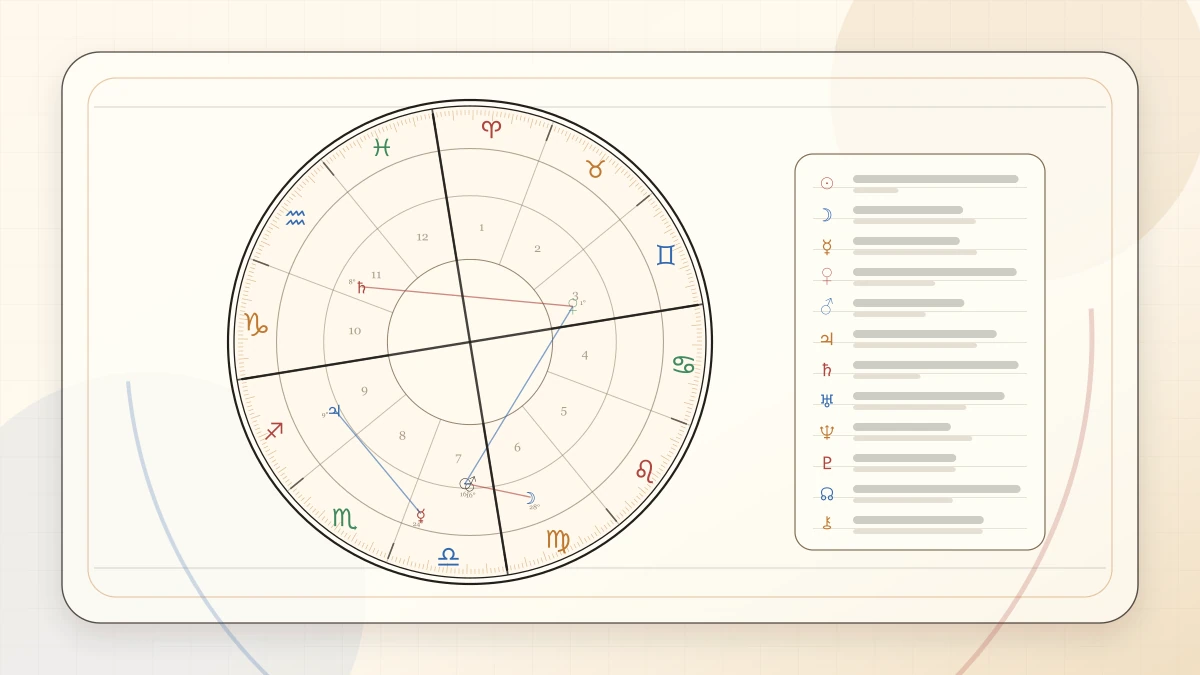
The twelve houses split a birth chart into twelve areas of life, measured from the horizon at your birthplace. A planet's sign shows how it behaves, and its house shows where that behavior appears.
Table of contents
- Example or practical exercise
- What the houses are
- The twelve houses at a glance
- Angular, succedent and cadent houses
- Empty houses are normal
- Why house systems give different answers
- How to read any house in three steps
- The three steps on a sample chart
- Houses depend on an accurate birth time
- A second example: whole-sign houses from a Gemini Rising sign
- Placing planets, and where systems disagree
- Questions readers ask about houses
- What this does and does not establish
Example or practical exercise
In a constructed chart with Capricorn on the seventh-house cusp, no planets in the seventh and its ruler Saturn in the tenth, partnership and working life are read as tied together.
What the houses are
The twelve houses divide the sky into twelve areas of life. In Western astrology the signs are measured along the ecliptic from the March equinox, so a planet is in the same sign for everyone born at that moment, wherever they were. Houses are measured against the horizon at your birthplace, so they depend on the exact time and place of birth.
The first house begins at the Ascendant, the point of the zodiac that was rising in the east. The houses are then counted counterclockwise around the chart. A planet's sign tells you how it behaves. Its house tells you where in life that behavior shows up.
The twelve houses at a glance
These are the traditional topics. Modern astrologers add psychological themes to several of them, but the core subjects have been stable for a very long time.
| House | Area of life | Type |
|---|---|---|
| 1st | Self, body, manner, how you begin things | Angular (Ascendant) |
| 2nd | Money you earn, possessions, what you value | Succedent |
| 3rd | Communication, siblings, neighbors, short journeys | Cadent |
| 4th | Home, family, roots, private life | Angular (IC) |
| 5th | Creativity, play, romance, children | Succedent |
| 6th | Daily work, routines, skills, colleagues, service | Cadent |
| 7th | Partners, marriage, contracts, open rivals | Angular (Descendant) |
| 8th | Shared money, debts, inheritance, intimacy | Succedent |
| 9th | Travel, higher learning, belief, law | Cadent |
| 10th | Career, reputation, public role | Angular (Midheaven) |
| 11th | Friends, groups, hopes for the future | Succedent |
| 12th | Solitude, rest, retreat, what is hidden | Cadent |
Angular, succedent and cadent houses
The houses come in three types. The angular houses (first, fourth, seventh and tenth) begin at the four angles of the chart. Planets here are the most visible in a person's life: they act, and other people notice.
The succedent houses (second, fifth, eighth and eleventh) follow the angles. They hold and build on what the angular houses start, and are linked with resources and staying power. The cadent houses (third, sixth, ninth and twelfth) come before the next angle. They are houses of learning, adjusting and preparing, and planets here tend to work more quietly.
Empty houses are normal
There are ten bodies and twelve houses, so at least two houses are empty in every chart, and because planets often cluster, many charts have more. An empty seventh house does not mean no partnership, and an empty second house does not mean no money.
An empty house simply has no planet drawing constant attention to it. To read it, look at the sign on its cusp and then find that sign's ruling planet. The house the ruler sits in shows where that area of life tends to lead.
Why house systems give different answers
There is more than one way to divide the sky into twelve, and astrologers have never agreed on a single method. Placidus, the most common in modern Western astrology, divides by time and produces houses of unequal size. Whole-sign houses, the oldest method, make each sign one complete house, starting with the Rising sign. Koch, Regiomontanus and Equal houses are other choices you will meet.
The systems agree on the Ascendant but can put the same planet in different houses, especially when it is near a house boundary or the birth was far from the equator. None can be proved correct. Choose one, learn it properly and avoid switching systems in the middle of a reading.
How to read any house in three steps
The same method works for all twelve.
- Note the sign on the cusp. It sets the style of that area of life.
- Note any planets inside the house. Each adds its own function to the topic.
- Find the ruler of the cusp sign and see which house it is in. That shows what the topic is connected to.
The three steps on a sample chart
Take a constructed chart with Capricorn on the seventh-house cusp, no planets in the seventh, and Saturn in the tenth house.
Capricorn on the cusp suggests a serious, committed approach to partnership. The empty house means partnership is not a constant preoccupation. The ruler, Saturn, sits in the house of career, so partnership and working life are tied together in this chart: perhaps partners met through work, or a relationship that has to fit around a demanding job.
Houses depend on an accurate birth time
The Ascendant moves about one degree every four minutes. A birth time rounded to the nearest hour can shift every house cusp by many degrees and move planets from one house to the next.
If you do not know your birth time, read your planets by sign and aspect and leave the houses out. A house reading built on a guessed time looks precise and is not.
A second example: whole-sign houses from a Gemini Rising sign
In whole-sign houses each sign is one complete house, starting with the Rising sign. A constructed chart with Gemini rising runs as follows.
| House | Sign on it |
|---|---|
| 1st | Gemini |
| 2nd | Cancer |
| 3rd | Leo |
| 4th | Virgo |
| 5th | Libra |
| 6th | Scorpio |
| 7th | Sagittarius |
| 8th | Capricorn |
| 9th | Aquarius |
| 10th | Pisces |
| 11th | Aries |
| 12th | Taurus |
Placing planets, and where systems disagree
Venus at 10 degrees Aquarius is in the sign of the ninth house, so it is in the ninth house. Mars at 28 degrees Aries is in the eleventh. A Placidus-type system could put that Mars in the tenth if its eleventh-house cusp fell later, say at 5 degrees Taurus. That is the kind of case where two systems give different answers, and it is why a planet near the end of a sign deserves a second look.
Questions readers ask about houses
Which house is my career in? The tenth is the traditional career house, but daily work belongs to the sixth and earnings to the second, so a question about work usually draws on all three.
Do houses or signs matter more? They answer different questions. The sign describes how a planet behaves and the house describes where, so neither outweighs the other.
Is it odd to have most planets in two or three houses? No. Planets often cluster, and a crowded house simply shows the topic that draws the most attention.
What this does and does not establish
Houses need an accurate birth time, and different house systems can move a planet near a cusp into the neighboring house.
Related calculators
Use the matching tool when you want a direct chart or timing result after reading the guide.
12 Houses Calculator
Complete 12-house overview page for readers who want the full natal house framework before drilling into one exact placement.
House Placement Calculator
Manual placement page that combines one known planet and one known house into a reusable interpretation page.
Planet Meaning Finder
Plain-English planet reference page for beginner chart readers.
Calculation references
- Swiss Ephemeris: positions, angles and house-system conventions
Technical reference for calculation conventions. It does not certify an interpretation or mean every live tool uses this engine.
Related articles
Keep reading with nearby topics that deepen the same question from another angle.
How to Read Your Birth Chart: A Beginner's Guide
Read your birth chart in five steps: find the Sun, Moon and Rising sign, count the elements, note crowded houses, locate the chart ruler, then read the two or three closest aspects.
6 min read
Sun, Moon, and Rising Signs Explained
Your Sun sign describes what you are aiming to be, your Moon sign what you need to feel settled, and your Rising sign how you meet the world and how it first meets you.
6 min read
First House Meaning in Astrology
The first house begins at the Ascendant and describes how you meet the world: your manner, how you start things and the first impression you give.
6 min read
Second House Meaning and Money
The second house covers what you earn, what you own and what you value. It describes your relationship to resources as a theme, not your income or financial future.
6 min read
Keep exploring
Use the category page and the main hubs when you want the next layer of context.
Previous article
The Best Way to Track Transits Weekly
Next article
First House Meaning in Astrology