
Birth Chart Basics
Birth chart basics in plain English
Start here when you want to understand the chart wheel, the Big Three, house structure, and how exact birth details change the result.
Featured in this category
Start with the strongest guides in this topic cluster.

How to Read Your Birth Chart: A Beginner's Guide
Read your birth chart in five steps: find the Sun, Moon and Rising sign, count the elements, note crowded houses, locate the chart ruler, then read the two or three closest aspects.

Sun, Moon, and Rising Signs Explained
Your Sun sign describes what you are aiming to be, your Moon sign what you need to feel settled, and your Rising sign how you meet the world and how it first meets you.

What Your Rising Sign Says About Your First Impression
Your Rising sign describes your manner when you meet someone new: how you enter a room, start a conversation and approach a fresh situation. It also sets the layout of the houses.
More in this category
Keep reading with the rest of the articles in this category.

Moon Sign Meaning in Love, Emotions, and Daily Life
Your Moon sign describes what you need to feel safe: your moods, instincts, habits and the kind of comfort that settles you, which shows most clearly at home and in close relationships.

How Birth Time Changes Your Chart
Birth time sets your Rising sign, Midheaven and house placements, because the Ascendant moves about one degree every four minutes. Most planet signs stay the same across the day.

What Does the Ascendant Mean in Astrology?
The Ascendant is the exact zodiac degree rising on the eastern horizon at your birth time and place. Its sign is your Rising sign, read as your style of approach.

What Does the Midheaven Mean in a Birth Chart?
The Midheaven is the zodiac degree at the top of your chart, overhead at birth. Astrologers read its sign as your style of public visibility and direction, not as a job title.

How to Understand Planetary Aspects in Your Birth Chart
An aspect is an angle between two planets, measured in degrees. Read the planet pair first to learn which functions are linked, then the angle and its orb to learn how they interact.

What Each Planet Means in a Birth Chart
Each planet stands for a function: the Sun for identity, the Moon for emotional needs, Mercury for thinking, Venus for values, Mars for drive, Jupiter for growth and Saturn for limits.
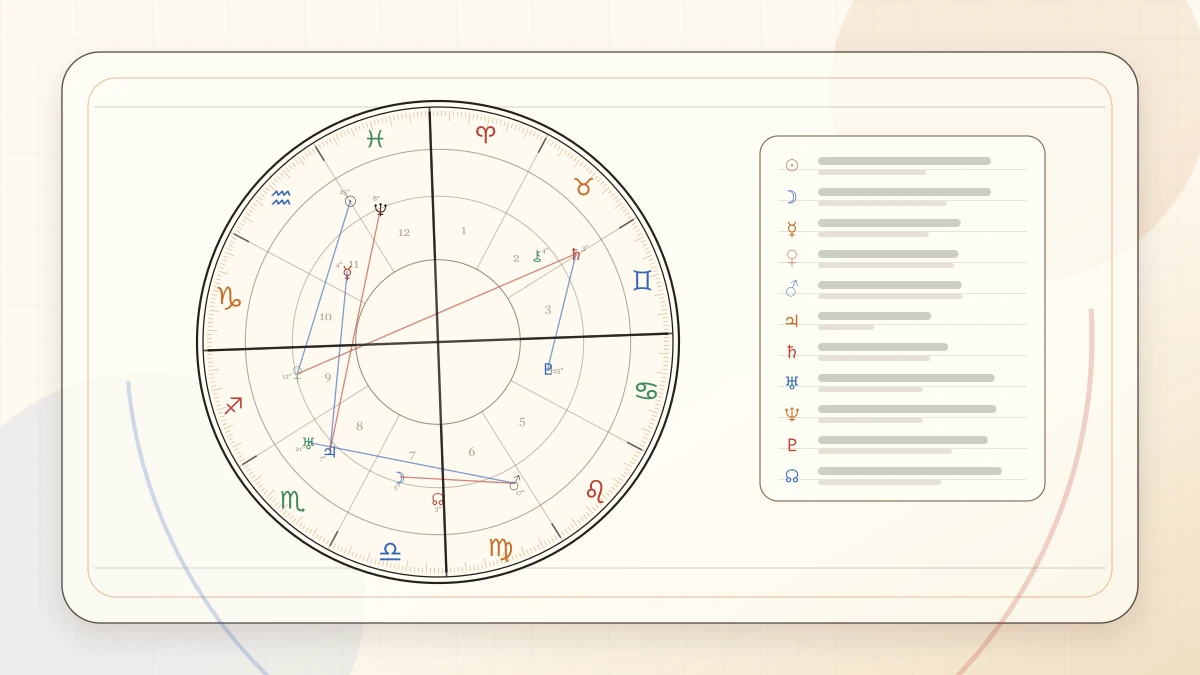
Zodiac Elements and Modalities Explained
Elements sort the twelve signs into fire, earth, air and water, describing the kind of energy, while modalities sort them into cardinal, fixed and mutable, describing its tempo. Each sign has one of each.

How to Read Houses and Signs Together
A house is the area of life and a sign is the style. Read the sign on each house cusp, then follow its ruler to see where that area's story continues.

North Node and South Node: A Beginner's Guide
The lunar nodes are the two points where the Moon's orbit crosses the Sun's path, always opposite each other. Modern readers treat the South Node as familiar ground and the North Node as growth.

What Retrograde Planets Mean in a Natal Chart
A natal retrograde means a planet appeared to move backward through the zodiac, as seen from Earth, when you were born. Modern readers describe its themes as worked on inwardly or revisited.

A Beginner's Guide to Chart Rulers: Following the Chain
Your chart ruler is the planet that rules your Rising sign. Follow it to the ruler of the sign it occupies, and onward, to trace a chain that ends at a planet in its own sign.

What a Dominant Planet Can Suggest in Your Chart
A dominant planet is the one a stated method ranks as most prominent, using points for angularity, dignity, rulership and aspects. It points to themes that repeat, not to a strength.
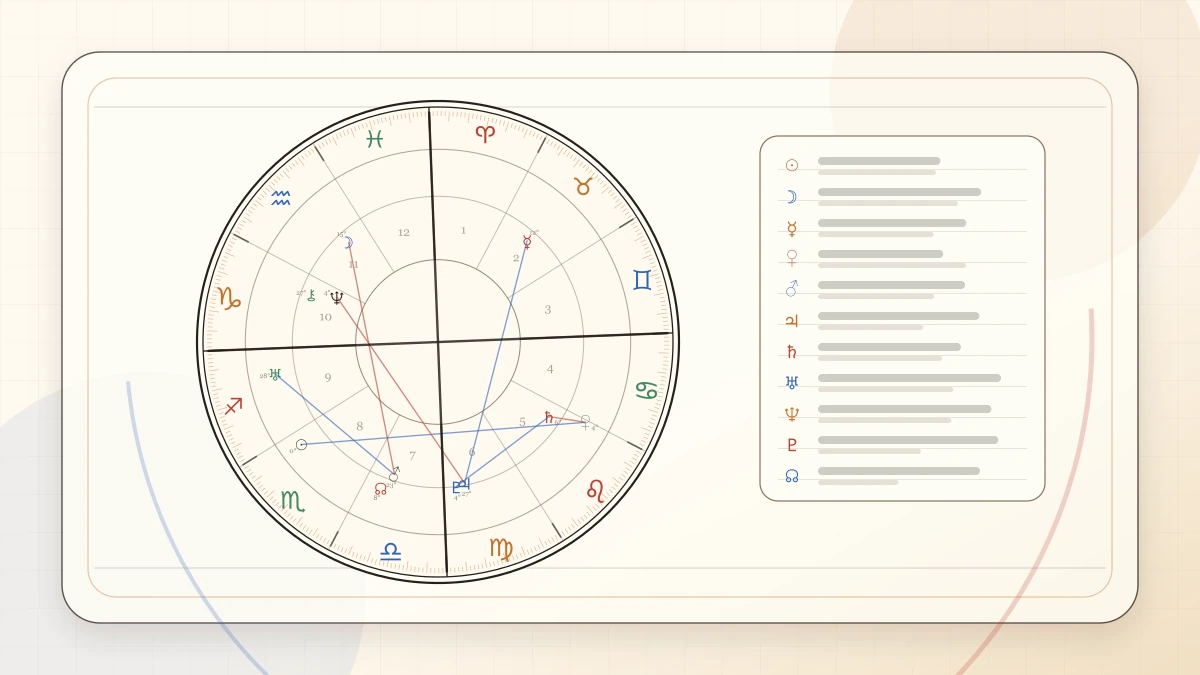
How to Read and Test Chart Patterns Without Getting Lost
Test a chart pattern by declaring which bodies you count and which orb you allow, then measuring every leg in degrees. A pattern exists only if each required aspect passes.

What an Empty House May Suggest in Astrology
An empty house simply holds no planets, and every chart has several. You read it through the sign on its cusp, that sign's ruler and the house where the ruler sits.

How to Start Learning Astrology Without Overwhelm
Learn in layers: the Sun, Moon and Rising sign first, then planets, signs, houses and a few major aspects, at about 20 minutes a day, five days a week, leaving specialist points for later.

Birth Chart Questions to Ask After Your First Reading
Ask first about inputs and method: the birth time and its source, daylight saving, house system and orbs. Then ask which placements are central, what would contradict them and what not to use them for.
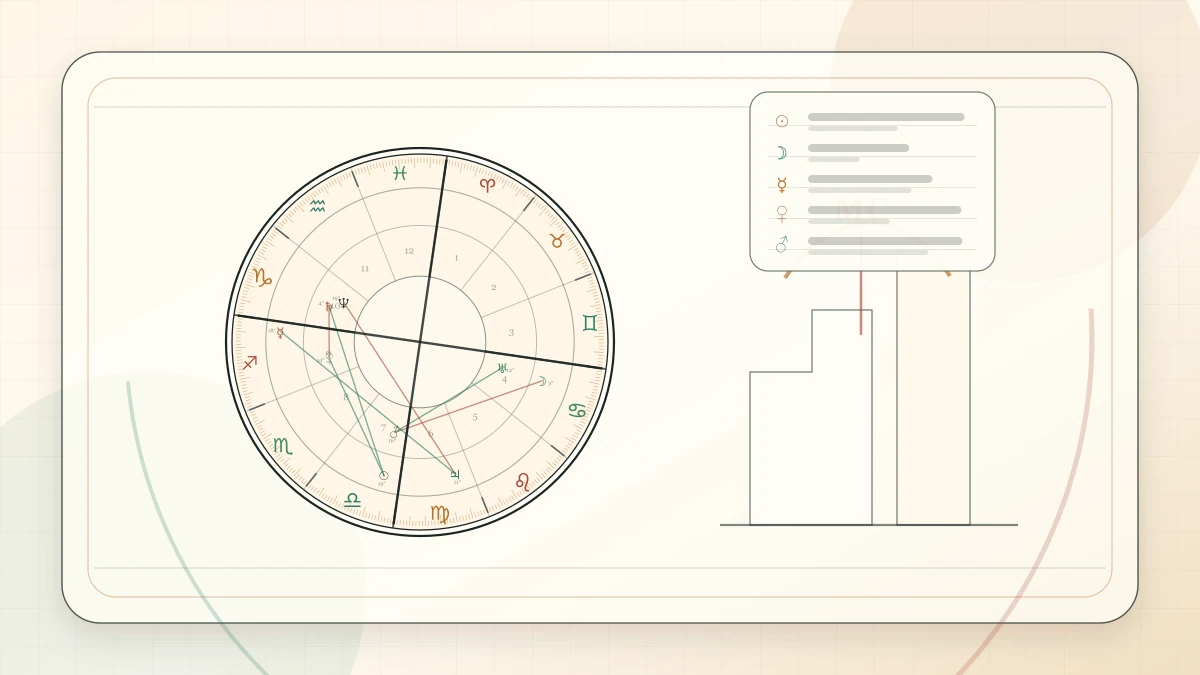
Astrocartography Basics: How to Read Location Lines Without Overclaiming the Map
Astrocartography draws lines on a world map where each planet was rising, setting, overhead or underfoot at your birth. Each line names a symbolic theme for that place, not a verdict on living there.

Birth Chart Symbols Explained for Beginners
Chart symbols are shorthand glyphs for the ten planets, twelve signs and five main aspects, plus marks such as the retrograde R. Learn them in layers with a printed table beside the chart.

What the IC Means in Astrology
The IC, or Imum Coeli, is the chart point directly opposite the Midheaven, at the bottom of the wheel. Astrologers read its sign as your private foundation: home, roots and inner life.

What the Descendant Means in Astrology
The Descendant is the point where the zodiac meets the western horizon, exactly opposite your Ascendant. Astrologers read its sign as how you meet partners and other people one to one.

Birth Chart Stellium Meaning
A stellium is a cluster of usually three or more planets in one sign or one house. It concentrates attention there, but the planets in it keep their separate jobs.

How to Read Intercepted Signs in a Birth Chart
An intercepted sign lies wholly inside one house without touching any cusp, which happens only in unequal house systems such as Placidus. Its opposite sign is intercepted too, and two other signs repeat on cusps.

Chart Ruler by Rising Sign Explained
Your chart ruler is the traditional ruler of your Rising sign, such as Venus for Libra or Saturn for Capricorn. Read its sign, house and aspects to see where the chart's agenda is carried out.

Day Chart vs Night Chart Explained
A day chart has the Sun above the horizon at birth and a night chart has it below. This is called sect, and it changes which planets traditional astrologers treat as most helpful.

Mutual Reception Meaning in Astrology
Mutual reception happens when two planets each sit in a sign the other rules, such as Venus in Aries and Mars in Libra. Traditional astrologers read the exchange as a link between the two.

How to Read Retrograde Planets in the Houses
Start with the house topic, then add the retrograde as a note on style: the planet's themes in that area of life are handled more inwardly, privately or with repeated review.

How to Find Your Dominant Element in a Birth Chart
Count the ten planets by the element of their signs, then recount giving two points each to the Sun, Moon and Ascendant. Compare the two totals to see which element leads.

Birth Chart Patterns Explained for Beginners
Birth chart patterns come in two kinds: shape patterns, such as a bowl or bucket, describe how planets spread around the wheel, and aspect patterns, such as a T-square, link planets by set angles.

Angular Houses Explained
The angular houses are the first, fourth, seventh and tenth, which begin at the four angles. Astrologers give planets there extra weight because their themes are harder to overlook.

Succedent and Cadent Houses Explained
Succedent houses, the 2nd, 5th, 8th and 11th, are read as holding and building, and cadent houses, the 3rd, 6th, 9th and 12th, as adapting, learning and withdrawing.

The Four Angles in Astrology Explained
The four angles are the Ascendant, Descendant, Midheaven and IC. They form two axes, the horizon and the meridian, and planets close to them are read as especially prominent.

How to Prioritize the Most Important Placements in a Birth Chart
Start with your question, then read the Sun, Moon and Rising sign, the chart ruler, planets near angles, the tightest aspects and any stellium. Stop when you have about five items worth a closer look.

House Rulership Basics for Beginners
A house ruler is the planet that rules the sign on that house's cusp. Where that planet sits shows which other area of life the house's matters are steered through.

How to Read a Birth Chart Without Memorizing Everything
Read by combining three building blocks: a planet is a function, a sign is a style and a house is an area of life. Five short questions turn any placement into one sentence.

What an Empty First House Can Mean
An empty first house still has the Ascendant, its sign and its ruler. Read the Rising sign for your approach, then follow the ruling planet to see where first impressions lead.

What an Empty Seventh House Can Mean
An empty seventh house still has the Descendant, a sign and a ruler. Read the sign for your style in partnership, then follow the ruler to see where that theme plays out.

How to Compare Planets, Signs, and Houses in One Placement
Write one sentence for the planet's function, one for the sign's style and one for the house's area of life, then combine them and notice whether the layers echo, pull apart or soften each other.
What Is Kundli?
A Kundli is a Vedic birth chart calculated from your birth date, time and place, usually with the sidereal zodiac. It shows your Lagna, Moon sign, nakshatra, houses and planetary periods.
What Is Nakshatra?
A nakshatra is one of 27 equal lunar mansions, each spanning 13 degrees 20 minutes of the sidereal zodiac. Your birth nakshatra is usually the one holding the Moon, and each has four padas.
What Is Rashi?
Rashi means zodiac sign, and in Vedic astrology your Rashi usually means the sidereal sign the Moon occupied at your birth, which often differs from your Western Sun sign.
What Is Lagna?
Lagna is the Vedic name for the Ascendant, the sign rising on the eastern horizon at your birth. It sets the first house, so every house in the chart is counted from it.
Frequently asked questions
Who should start with Birth Chart Basics?
Start here if you want to understand a chart before moving into deeper timing, compatibility, or relocation topics.
Do these articles require an exact birth time?
Some do, especially the articles about Rising signs, houses, and birth time sensitivity. Others work as general guides.