
Birth Chart Basics
The Four Angles in Astrology Explained
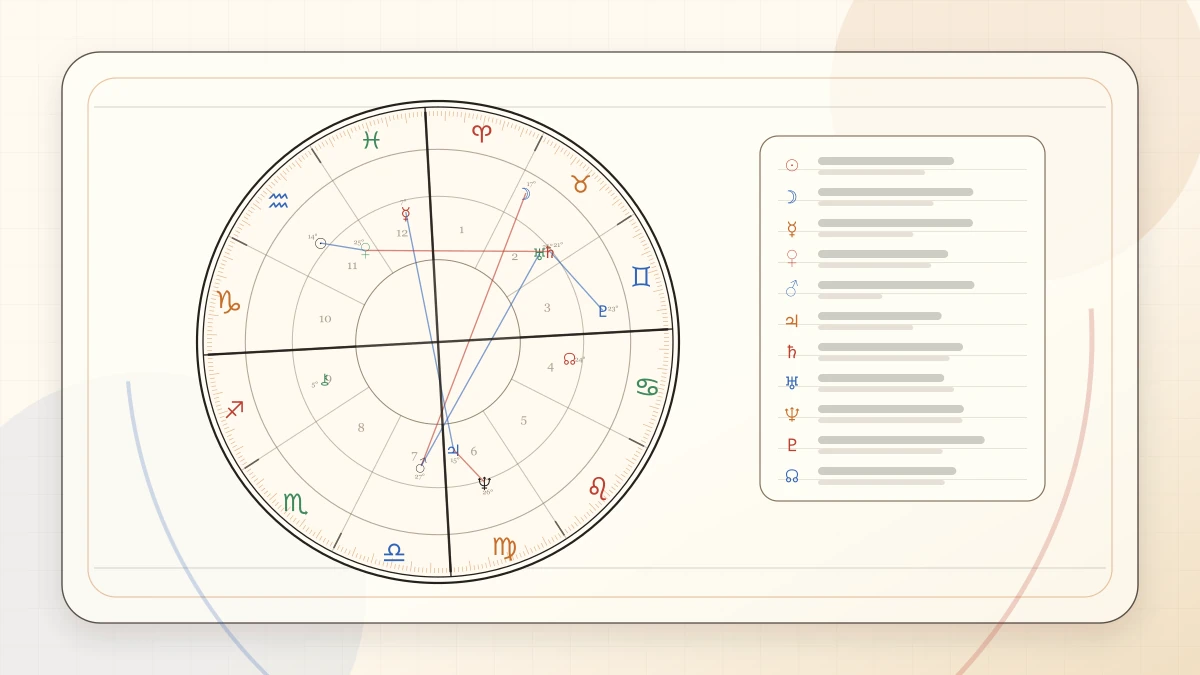
The four angles are the Ascendant, Descendant, Midheaven and IC. They form two axes, the horizon and the meridian, and planets close to them are read as especially prominent.
Table of contents
- Example or practical exercise
- What the four angles are and why they carry weight
- The four angles at a glance
- Two axes, and why the four points are not a neat cross
- What fixes each angle, and how fast it moves
- All four angles in one constructed chart
- Planets close to an angle
- A short routine for your own angles
- A second constructed example: angles that stray far from 90 degrees
- What this does and does not establish
Example or practical exercise
With a constructed Ascendant at 20 Libra and Midheaven at 28 Cancer, the Descendant is 20 Aries and the IC 28 Capricorn, and the four gaps between them measure 82, 98, 82 and 98 degrees.
What the four angles are and why they carry weight
A birth chart has four angles: the Ascendant, the Descendant, the Midheaven and the Imum Coeli (IC). They are not planets. Each is a degree of the zodiac, found where the zodiac crosses one of two great lines in the sky over your birthplace: the horizon and the meridian. That makes them the points where the chart is tied most directly to the place and the minute you were born.
This is why they matter. The planet positions show where the Sun, Moon and planets were along the zodiac. The angles show how that zodiac was turned relative to you at that moment, which is why two people born on the same day at different times get different angles even when their planets look alike.
Many astrologers treat the angles as the strongest points in a chart, and each one starts an angular house. Here they are side by side.
The four angles at a glance
MC stands for Medium Coeli, Latin for the middle of the sky. The house columns describe quadrant systems such as Placidus.
| Angle | Where it is | Opposite | House it begins | Theme word |
|---|---|---|---|---|
| Ascendant | Zodiac degree rising on the eastern horizon | Descendant | First | Self and approach |
| Descendant | Zodiac degree setting on the western horizon | Ascendant | Seventh | Other people |
| Midheaven (MC) | Zodiac degree crossing the meridian above the horizon | IC | Tenth | Public direction |
| IC | Zodiac degree crossing the meridian below the horizon, directly opposite the Midheaven | Midheaven | Fourth | Roots and home |
Two axes, and why the four points are not a neat cross
The four points form two axes. The horizon axis joins the Ascendant and Descendant. The meridian axis joins the Midheaven and IC. Within each pair the two points are exactly 180 degrees apart, so one end is always the opposite sign of the other, at the same degree.
The axes are not at right angles. It would be tidy if the Midheaven sat 90 degrees from the Ascendant, but the horizon and the meridian are tilted against the zodiac, and the gap between the points changes with the time and the latitude. It is often near 90 degrees and can be well above or below it.
Reading each axis as a pair keeps you balanced. The Ascendant and Descendant are self and other; the Midheaven and IC are public direction and private foundation. Each axis is a see-saw: what one end shows, the other end answers.
What fixes each angle, and how fast it moves
The Midheaven and IC depend on the time of day and the longitude of your birthplace. The Ascendant and Descendant depend on those as well, and also on latitude. As the Earth turns, all four move through the zodiac at about one degree every four minutes, or about 15 degrees an hour, though the rate is uneven.
| Error in birth time | Shift in the angles | What can change |
|---|---|---|
| 4 minutes | About 1 degree | Rarely anything you would notice |
| 20 minutes | About 5 degrees | A sign, if an angle was within 5 degrees of a sign boundary |
| 1 hour | About 15 degrees | Often the sign of an angle, and which house some planets fall in |
| 2 hours | About 30 degrees on average | Usually a different Rising sign altogether |
All four angles in one constructed chart
Take a constructed chart with the Ascendant at 20 degrees of Libra. Libra starts at 180, so that is 200. The Descendant is 200 minus 180, which is 20, or 20 degrees of Aries. Say the Midheaven is at 28 degrees of Cancer. Cancer starts at 90, so that is 118. The IC is 118 plus 180, or 298, which is 28 degrees of Capricorn (270 plus 28).
Now measure the gaps around the wheel. From Midheaven to Ascendant is 200 minus 118, or 82 degrees. From Ascendant to IC is 298 minus 200, or 98. From IC to Descendant is 380 minus 298, or 82 (counting through 360 back to 20). From Descendant to Midheaven is 118 minus 20, or 98. The four gaps add up to 360, but none is 90.
A reader would note a Libra Rising (a diplomatic first impression), an Aries Descendant (directness arriving through others), a Cancer Midheaven (a public path built around care or belonging) and a Capricorn IC (a private foundation of structure and duty). Each axis already contains a tension: Libra against Aries, Cancer against Capricorn.
Planets close to an angle
A planet within about 5 to 8 degrees of an angle is said to be conjunct it, and tradition gives it extra weight because it sits at a corner of the chart. A planet at the Ascendant is read in personal terms, at the Descendant in terms of relationships, at the Midheaven in public terms and at the IC in terms of home. The closer the planet, the stronger the emphasis.
The detailed readings belong with each angle separately. Here it is enough to know the rule: check every angle for company.
A short routine for your own angles
Get your angles from a birth chart calculator, then work through these steps.
- Get the best birth time you can, and note how certain it is.
- Write down the four signs and degrees, and check that each pair adds up to 180 degrees apart.
- Look up the traditional ruler of each of the four signs and see where those planets sit.
- Mark any planet within 5 degrees of an angle.
- Write one sentence for each axis: self and other, public and private.
- Note which angles sit near a sign boundary, so you know which ones a small time error could change.
A second constructed example: angles that stray far from 90 degrees
This chart is invented for teaching, with a birthplace in mind, such as a far northern one, where the gaps stray further from 90. The Ascendant is at 6 degrees Aquarius, which is 306 (Aquarius starts at 300). The Midheaven is at 14 degrees Sagittarius, which is 254 (Sagittarius starts at 240).
The Descendant is 306 minus 180, or 126, which is 6 degrees Leo (Leo starts at 120). The IC is 254 minus 180, or 74, which is 14 degrees Gemini (Gemini starts at 60).
Now the gaps in zodiac order. Midheaven to Ascendant is 306 minus 254, or 52. Ascendant to IC is 74 plus 360 minus 306, or 128. IC to Descendant is 126 minus 74, or 52, and Descendant to Midheaven is 254 minus 126, or 128. They total 360. Opposite gaps are always equal, because each angle’s partner sits exactly 180 away, so a chart’s four gaps come in two matching pairs.
What this does and does not establish
The angles almost never form a neat 90-degree cross, and all four depend on an accurate birth time and place.
Related calculators
Use the matching tool when you want a direct chart or timing result after reading the guide.
Free Birth Chart Calculator
Create a birth chart from birth date, time, and place to review placements, houses, angles, and aspects.
Rising Sign Calculator
Exact Ascendant verification from full birth-chart math for practical house and Big 3 interpretation.
12 Houses Calculator
Complete 12-house overview page for readers who want the full natal house framework before drilling into one exact placement.
Calculation references
- Swiss Ephemeris: positions, angles and house-system conventions
Technical reference for calculation conventions. It does not certify an interpretation or mean every live tool uses this engine.
Related articles
Keep reading with nearby topics that deepen the same question from another angle.
Succedent and Cadent Houses Explained
Succedent houses, the 2nd, 5th, 8th and 11th, are read as holding and building, and cadent houses, the 3rd, 6th, 9th and 12th, as adapting, learning and withdrawing.
6 min read
How to Prioritize the Most Important Placements in a Birth Chart
Start with your question, then read the Sun, Moon and Rising sign, the chart ruler, planets near angles, the tightest aspects and any stellium. Stop when you have about five items worth a closer look.
6 min read
How to Read Your Birth Chart: A Beginner's Guide
Read your birth chart in five steps: find the Sun, Moon and Rising sign, count the elements, note crowded houses, locate the chart ruler, then read the two or three closest aspects.
6 min read
Sun, Moon, and Rising Signs Explained
Your Sun sign describes what you are aiming to be, your Moon sign what you need to feel settled, and your Rising sign how you meet the world and how it first meets you.
6 min read
Keep exploring
Use the category page and the main hubs when you want the next layer of context.
Previous article
Succedent and Cadent Houses Explained
Next article
How to Prioritize the Most Important Placements in a Birth Chart