
Birth Chart Basics
Succedent and Cadent Houses Explained
Succedent houses, the 2nd, 5th, 8th and 11th, are read as holding and building, and cadent houses, the 3rd, 6th, 9th and 12th, as adapting, learning and withdrawing.
Table of contents
- Example or practical exercise
- The three house groups and how they repeat around the wheel
- Succedent houses (2, 5, 8, 11): what holds and builds
- Cadent houses (3, 6, 9, 12): adapting, learning and withdrawing
- Succedent and cadent houses compared
- Counting planets by group in a constructed chart
- Another way older books sort the houses
- How to use the groups without over-reading them
- Planetary joys: a traditional twist on the three groups
- Questions readers ask about succedent and cadent houses
- What this does and does not establish
Example or practical exercise
A constructed chart with ten bodies has one angular, four succedent and five cadent placements, so it leans toward learning, adjusting and background work, with the Sun in the tenth as its single strong public note.
The three house groups and how they repeat around the wheel
The twelve houses fall into three groups of four, and the groups repeat as you move around the wheel: angular, succedent, cadent, then angular again. Houses 1, 4, 7 and 10 are angular. The ones after them, 2, 5, 8 and 11, are succedent. The ones after those, 3, 6, 9 and 12, are cadent. Each trio therefore reads in the same order: a house that starts something at an angle, a house that builds on it, and a house that adapts before the next angle arrives.
Succedent comes from a Latin word for following, and cadent from one for falling. The angular group has its own treatment elsewhere; the focus here is on the other eight.
Succedent houses (2, 5, 8, 11): what holds and builds
Each succedent house follows an angular house, which gives the name. A common summary is that angular houses start, and succedent houses consolidate. The second house holds resources and values, the fifth holds creativity, pleasure and play, the eighth holds shared resources and deep commitments, and the eleventh holds friends, groups and hopes.
By their place on the natural wheel they match the fixed signs, Taurus, Leo, Scorpio and Aquarius, which is a good clue to their character: staying power, loyalty, and things that continue once started.
Cadent houses (3, 6, 9, 12): adapting, learning and withdrawing
Cadent means falling away. Each cadent house sits just before an angle, furthest from the corner it follows. The third covers everyday learning, communication and short trips. The sixth covers routine, daily work and service. The ninth covers higher learning, belief and long journeys. The twelfth covers solitude, rest and what is hidden or unfinished.
They match the mutable signs, Gemini, Virgo, Sagittarius and Pisces, which are the signs of adjusting, sorting and changing. In practice the cadent houses are where people adapt, practice and prepare.
Older writers called cadent houses the weakest, because a planet there is far from the angles and less visible. Modern readers more often say these houses are about inner and background work, which is quieter rather than lesser.
Succedent and cadent houses compared
| House | Group | Everyday topics | Natural-wheel sign | A question to ask |
|---|---|---|---|---|
| Second | Succedent | Money, possessions, values | Taurus | What do I rely on? |
| Fifth | Succedent | Creativity, play, romance, children | Leo | What do I enjoy making? |
| Eighth | Succedent | Shared resources, intimacy, loss and change | Scorpio | What do I share, and what do I risk? |
| Eleventh | Succedent | Friends, groups, hopes | Aquarius | Who do I belong with? |
| Third | Cadent | Siblings, neighbors, everyday learning | Gemini | What am I curious about? |
| Sixth | Cadent | Routine, daily work, service | Virgo | How do I keep things running? |
| Ninth | Cadent | Beliefs, higher study, long journeys | Sagittarius | What do I believe, and why? |
| Twelfth | Cadent | Solitude, rest, the unseen | Pisces | What do I need to step back from? |
Counting planets by group in a constructed chart
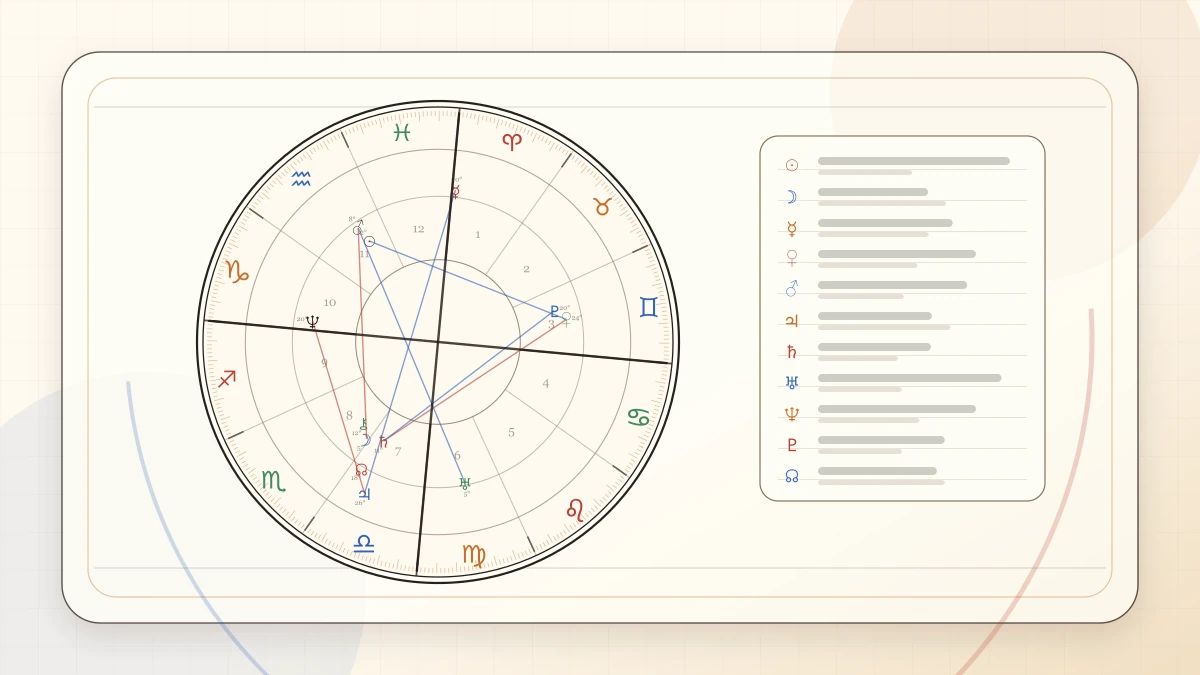
Take a constructed chart with the ten bodies placed like this: Sun in the 10th, Moon in the 2nd, Mercury in the 9th, Venus in the 11th, Mars in the 3rd, Jupiter in the 6th, Saturn in the 12th, Uranus in the 2nd, Neptune in the 3rd and Pluto in the 5th.
Count by group. Angular: one (the Sun). Succedent: four (Moon, Venus, Uranus and Pluto). Cadent: five (Mercury, Mars, Jupiter, Saturn and Neptune). Ten bodies split evenly across three groups of four houses would put about three or four in each, so this chart leans toward the cadent group and has few angular planets.
A reader might say the weight of the chart is in learning, adjusting and background work, with less starting of things in the open, and that the Sun in the tenth is the single strong public note. That describes a style of working, not a limit.
Another way older books sort the houses
Some traditional writers also sort houses by whether they have a whole-sign aspect to the first house. The second, sixth, eighth and twelfth do not form a major aspect to it by sign, and were called houses of aversion. That older scheme cuts across the three groups: the second and eighth are succedent, the sixth and twelfth are cadent.
It shows that these labels are tools, and different traditions sort the same wheel in different ways. When you read about a house being strong or weak, check which scheme the author means, because a house can be well placed in one and poorly placed in the other.
How to use the groups without over-reading them
- Count the ten bodies by group and write down the three totals.
- Compare them with an even spread, which is about three or four per group.
- Read each planet’s house topic first. The group is a background note, not the main message.
- If a group is nearly empty, ask what that kind of activity looks like in your life, rather than what is missing.
- Look at the same planet in both a succedent and a cadent house, such as the Moon in the second against the Moon in the third, and note how the topic changes the reading even though the planet does not.
Planetary joys: a traditional twist on the three groups
Hellenistic astrologers, writing in the centuries around the start of the common era, also gave each of seven planets a house where it was said to rejoice, or have its joy. The table below shows why the older view of cadent houses as weak was never the whole story.
Four of the seven joys fall in cadent houses and two in succedent ones, and only Mercury’s is angular. In that scheme a cadent house is where certain planets are at ease, which fits the modern view of those houses as quieter, not lesser. Joys are a traditional idea that many modern astrologers use little.
| Planet | House of its joy | Group |
|---|---|---|
| Mercury | First | Angular |
| Moon | Third | Cadent |
| Venus | Fifth | Succedent |
| Mars | Sixth | Cadent |
| Sun | Ninth | Cadent |
| Jupiter | Eleventh | Succedent |
| Saturn | Twelfth | Cadent |
Questions readers ask about succedent and cadent houses
Why is the fifth house, the house of play, called one that consolidates? It follows the fourth house of home. The tradition’s logic is that enjoyment grows from a secure base, and consolidating here means making something your own, not making it dull.
Do the groups still work in whole-sign houses? Yes. Count signs from the Rising sign: the second, fifth, eighth and eleventh signs are succedent, and the third, sixth, ninth and twelfth are cadent. Only the question of where an angle falls inside a house changes between systems.
What this does and does not establish
The house groups describe a style of working, not a limit, and a cadent planet is not weak in every part of life.
Related calculators
Use the matching tool when you want a direct chart or timing result after reading the guide.
Free Birth Chart Calculator
Create a birth chart from birth date, time, and place to review placements, houses, angles, and aspects.
Rising Sign Calculator
Exact Ascendant verification from full birth-chart math for practical house and Big 3 interpretation.
12 Houses Calculator
Complete 12-house overview page for readers who want the full natal house framework before drilling into one exact placement.
Calculation references
- Swiss Ephemeris: positions, angles and house-system conventions
Technical reference for calculation conventions. It does not certify an interpretation or mean every live tool uses this engine.
Related articles
Keep reading with nearby topics that deepen the same question from another angle.
Angular Houses Explained
The angular houses are the first, fourth, seventh and tenth, which begin at the four angles. Astrologers give planets there extra weight because their themes are harder to overlook.
6 min read
The Four Angles in Astrology Explained
The four angles are the Ascendant, Descendant, Midheaven and IC. They form two axes, the horizon and the meridian, and planets close to them are read as especially prominent.
6 min read
How to Read Your Birth Chart: A Beginner's Guide
Read your birth chart in five steps: find the Sun, Moon and Rising sign, count the elements, note crowded houses, locate the chart ruler, then read the two or three closest aspects.
6 min read
Sun, Moon, and Rising Signs Explained
Your Sun sign describes what you are aiming to be, your Moon sign what you need to feel settled, and your Rising sign how you meet the world and how it first meets you.
6 min read
Keep exploring
Use the category page and the main hubs when you want the next layer of context.
Previous article
Angular Houses Explained
Next article
The Four Angles in Astrology Explained