
Birth Chart Basics
Angular Houses Explained
The angular houses are the first, fourth, seventh and tenth, which begin at the four angles. Astrologers give planets there extra weight because their themes are harder to overlook.
Table of contents
- Example or practical exercise
- What angular houses are
- The four angular houses and their everyday topics
- Why astrologers give angular houses extra weight
- Being in an angular house and being near an angle are different
- Sorting planets in a constructed chart
- Check your own angular planets in five steps
- What angular does not mean
- Why whole-sign angular houses share one modality
- What this does and does not establish
Example or practical exercise
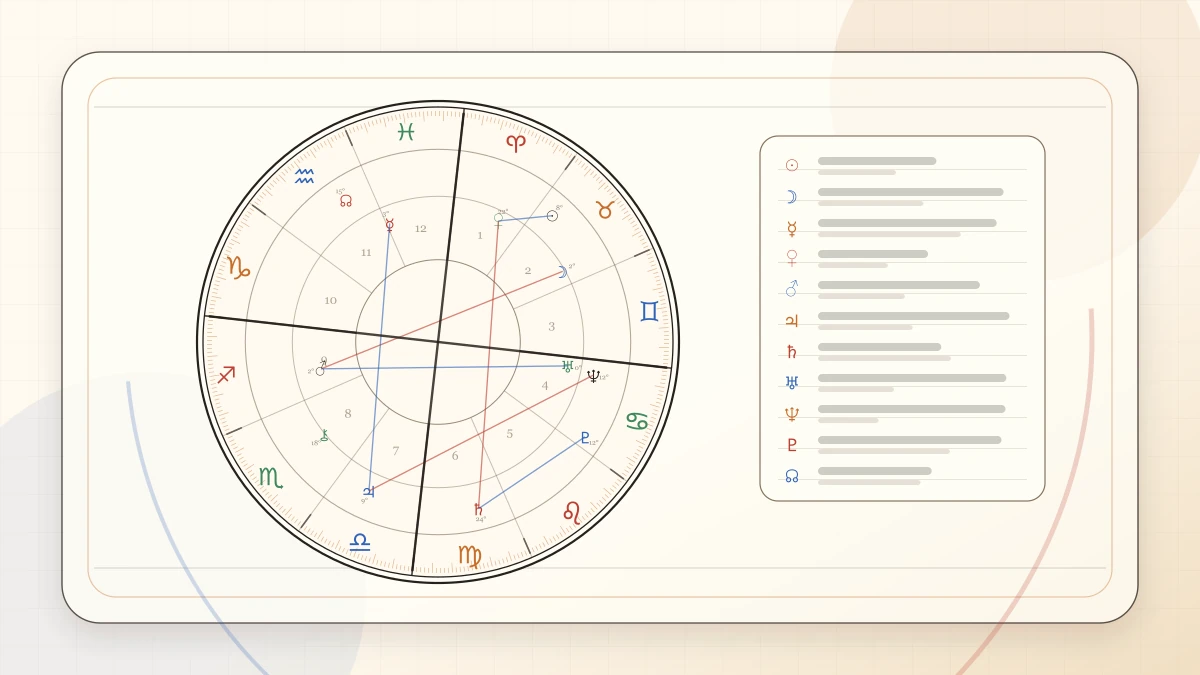
In a constructed chart, the Sun at 8 Taurus is in the tenth house and 3 degrees past the Midheaven, so it is emphasized both ways, while Venus at 3 Scorpio is cadent yet 2 degrees from the IC.
What angular houses are
Angular houses are the first, fourth, seventh and tenth houses of a birth chart. The word describes where they sit: each one begins at an angle (the Ascendant, IC, Descendant and Midheaven), the four corners of the chart. Older books also call them the cardinal houses, a word that comes from the Latin for a hinge, which is the idea: the rest of the chart turns on them.
The other eight houses are grouped as succedent and cadent. The angular houses come first because they are the ones tied to the horizon and the meridian, the two lines against which your birth place and time are measured.
The four angular houses and their everyday topics
The topics below are the standard house meanings. What is new is the grouping: all four are houses that begin at a corner of the chart.
| House | Begins at | Everyday topics | A question it asks |
|---|---|---|---|
| First | Ascendant | Body, approach, first impressions, how you start things | How do I begin? |
| Fourth | IC | Home, roots, family background, a private base | Where do I belong? |
| Seventh | Descendant | Partners and close one-to-one relationships | Who stands across from me? |
| Tenth | Midheaven | Work direction, public role, reputation | What am I known for? |
Why astrologers give angular houses extra weight
The traditional reasoning is visual. A planet near the Ascendant is rising, one near the Midheaven is at its highest point, one near the Descendant is setting and one near the IC is at its lowest. Those are the moments when a body is most noticeable, and astrology reads the chart as a picture of the sky at the moment of birth.
From this comes the rule of thumb that planets in angular houses act more in the open and are easier to see in a person’s life, while planets elsewhere work with less fanfare. Treat that as a tendency of emphasis, not a verdict. A planet can be quiet in a very visible house, and a person can be known for something in a house called weak.
There is also a neat link to signs. By their order on the natural wheel, the angular houses match the cardinal signs: Aries, Cancer, Libra and Capricorn. Cardinal signs are the ones that start things, and the angular houses are read as the places where things start.
Being in an angular house and being near an angle are different
This is the most common confusion. Being in an angular house means a planet falls somewhere inside a house that begins at an angle. Being angular in the stronger sense means being within a few degrees of the angle itself. House sizes are often about 30 degrees but can be much larger or smaller in quadrant systems, so the two ideas overlap without always agreeing.
A constructed example with whole-sign houses: the Ascendant is at 3 degrees of Taurus, or 33. Mars at 28 degrees of Taurus (58) is in the first house, which is angular, but it is 25 degrees from the Ascendant. Venus at 29 degrees of Aries (29) is in the twelfth house, a cadent house, yet only 4 degrees before the Ascendant, so many astrologers would still treat it as a planet on the angle.
Which one counts? Many astrologers read both: Venus is strongly colored by the angle even though its house is the twelfth, and Mars gets the first-house topics but less angle emphasis.
Sorting planets in a constructed chart
Here is a constructed chart with Placidus-type houses. The Ascendant is 12 degrees of Leo (132), the Midheaven is 5 degrees of Taurus (35), the IC is 5 degrees of Scorpio (215) and the Descendant is 12 degrees of Aquarius (312).
| Planet | Position | House | Distance from the angle | How a reader might treat it |
|---|---|---|---|---|
| Sun | 8 degrees Taurus | Tenth, angular | 3 degrees past the Midheaven | Angular both ways, so strongly emphasized |
| Moon | 15 degrees Scorpio | Fourth, angular | 10 degrees past the IC | In an angular house, but too far from the point for much angle emphasis |
| Venus | 3 degrees Scorpio | Third, cadent | 2 degrees before the IC | In a cadent house, yet on the angle, so read with home themes |
Check your own angular planets in five steps
You need your chart’s angle degrees and planet positions in a table, such as those from a birth chart calculator.
- Write the four angle degrees as numbers from 0 to 360, and do the same for every planet.
- For each planet, subtract to find the gap to the nearest angle, counting the short way around the wheel. A gap of 350 degrees is really 10.
- Mark planets within about 5 degrees of an angle, or up to 8 if you prefer a wider orb.
- Separately, mark every planet that sits in the first, fourth, seventh or tenth house.
- Compare the two marked lists. Planets on both are the most emphasized; a planet on only one list deserves a note saying why.
What angular does not mean
Angular does not mean good, lucky or successful, and a planet outside the angular houses is not wasted. A demanding planet in an angular house may simply make its themes harder to avoid.
Use the label to decide where to look first, then read the planet’s sign, aspects and ruler as you normally would.
Why whole-sign angular houses share one modality
In whole-sign houses, the angular houses are the first, fourth, seventh and tenth signs counted from the Rising sign. Those signs are three apart, and signs three apart share a modality, so the four angular houses always match the Rising sign’s modality.
An Aries Rising chart has cardinal signs on all four angular houses, while a Taurus Rising chart has fixed ones. The other nine Rising signs follow the same pattern. The link between angular houses and cardinal signs holds only when the Rising sign is cardinal; otherwise the angular houses carry fixed or mutable signs. That gives you a quick modality note for the angles in your own chart.
| Rising sign | Modality | Signs in the angular houses (1st, 4th, 7th, 10th) |
|---|---|---|
| Aries | Cardinal | Aries, Cancer, Libra, Capricorn |
| Taurus | Fixed | Taurus, Leo, Scorpio, Aquarius |
| Gemini | Mutable | Gemini, Virgo, Sagittarius, Pisces |
What this does and does not establish
Angular does not mean lucky or successful, and a planet outside these houses is not wasted; sitting in an angular house differs from sitting near an angle.
Related calculators
Use the matching tool when you want a direct chart or timing result after reading the guide.
Free Birth Chart Calculator
Create a birth chart from birth date, time, and place to review placements, houses, angles, and aspects.
Rising Sign Calculator
Exact Ascendant verification from full birth-chart math for practical house and Big 3 interpretation.
12 Houses Calculator
Complete 12-house overview page for readers who want the full natal house framework before drilling into one exact placement.
Calculation references
- Swiss Ephemeris: positions, angles and house-system conventions
Technical reference for calculation conventions. It does not certify an interpretation or mean every live tool uses this engine.
Related articles
Keep reading with nearby topics that deepen the same question from another angle.
Birth Chart Patterns Explained for Beginners
Birth chart patterns come in two kinds: shape patterns, such as a bowl or bucket, describe how planets spread around the wheel, and aspect patterns, such as a T-square, link planets by set angles.
6 min read
Succedent and Cadent Houses Explained
Succedent houses, the 2nd, 5th, 8th and 11th, are read as holding and building, and cadent houses, the 3rd, 6th, 9th and 12th, as adapting, learning and withdrawing.
6 min read
How to Read Your Birth Chart: A Beginner's Guide
Read your birth chart in five steps: find the Sun, Moon and Rising sign, count the elements, note crowded houses, locate the chart ruler, then read the two or three closest aspects.
6 min read
Sun, Moon, and Rising Signs Explained
Your Sun sign describes what you are aiming to be, your Moon sign what you need to feel settled, and your Rising sign how you meet the world and how it first meets you.
6 min read
Keep exploring
Use the category page and the main hubs when you want the next layer of context.
Previous article
Birth Chart Patterns Explained for Beginners
Next article
Succedent and Cadent Houses Explained