
Birth Chart Basics
Birth Chart Patterns Explained for Beginners
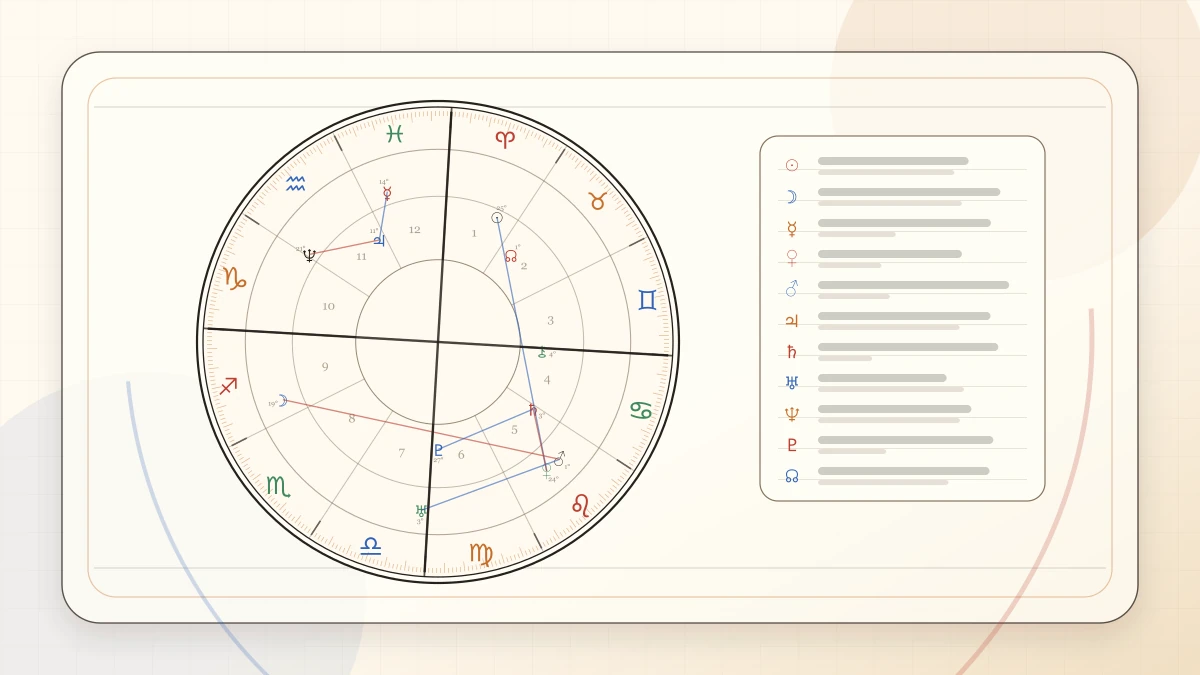
Birth chart patterns come in two kinds: shape patterns, such as a bowl or bucket, describe how planets spread around the wheel, and aspect patterns, such as a T-square, link planets by set angles.
Table of contents
- Example or practical exercise
- Shape patterns and aspect patterns
- The seven shape patterns and how each is recognized
- How to measure the shape from raw degrees
- A constructed example: ten planets and one big gap
- The five aspect patterns
- A constructed T-square worked out in degrees
- How to use patterns without overreading them
- A second constructed example: finding a bucket handle
- What this does and does not establish
Example or practical exercise
Ten constructed planets placed from 10 to 160 degrees leave one 210-degree gap, so they span 150 degrees: under 180 makes a bowl, while over 120 rules out a bundle.
Shape patterns and aspect patterns
Birth chart patterns come in two families. Shape patterns describe how the planets are spread around the wheel as a whole: clustered, split, scattered. Aspect patterns describe the geometry of angles between particular planets: three in a triangle, four in a square. Marc Edmund Jones, an American astrologer, set out seven shape types in the twentieth century, and they remain a common reference set.
Both are interpretive frameworks, not measurements of anything in the sky. Astrologers define them with slightly different rules about orbs, which bodies count and how wide a gap must be, so check which rules a book or program is using before you compare results.
The seven shape patterns and how each is recognized
The tests below use the ten bodies from the Sun to Pluto. Degrees are approximate, since definitions vary.
| Pattern | How it is recognized | Common reading |
|---|---|---|
| Bowl | All planets within about 180 degrees, leaving the other half empty | Self-contained; the empty half is where you reach for what is missing |
| Bucket | A bowl-like group plus one planet alone in the empty part, with clear gaps on both sides | Energy is funneled through the lone planet, the handle |
| Bundle | All planets within about 120 degrees, a third of the wheel | A narrow, concentrated focus |
| Locomotive | Planets spread across about 240 degrees, with about a third of the wheel empty | Drive, with the planet at the leading edge setting the pace |
| Seesaw | Two groups roughly opposite each other, with empty space between them | Weighing two sides; a pull between two camps |
| Splash | Planets spread widely around the wheel with no large gaps | Many interests, a wide range |
| Splay | Irregular clusters with uneven gaps and no single shape | An individual, uneven style |
How to measure the shape from raw degrees
Judging by eye is unreliable, because the wheel looks different depending on where the chart starts. Measure instead.
- Write every planet’s position as a number from 0 to 360 and sort them from smallest to largest.
- Subtract each number from the next to get the gaps between neighbors.
- Work out the last gap by going from the final planet back round to the first: add 360 to the first number and subtract the last.
- Find the largest gap. The span the planets occupy is 360 minus that gap.
- Compare the span with 120 (bundle), 180 (bowl) and about 240 (locomotive), then look at the other gaps for a seesaw, splash or splay.
A constructed example: ten planets and one big gap
Take ten constructed positions: 10, 25, 40, 55, 70, 95, 110, 130, 150 and 160 degrees. The gaps are 15, 15, 15, 15, 25, 15, 20, 20 and 10. The wrap-around gap runs from 160 to 10 plus 360, which is 210. All ten gaps add up to 360.
The largest gap is 210, so the span is 360 minus 210, or 150 degrees. That is under 180, so the chart is a bowl, with the planets all between 10 degrees Aries and 10 degrees Virgo. It is not a bundle, because 150 is more than 120.
A reader would note the bowl’s two rim planets, at 10 and 160 degrees, because they mark where the group begins and ends. The empty stretch of 210 degrees, from 10 degrees Virgo around to 10 degrees Aries and including all of Libra through Pisces, is read as the area the chart tends to look toward rather than start from.
The five aspect patterns
Aspect patterns need aspects: a conjunction is 0 degrees, a sextile 60, a square 90, a trine 120 and an opposition 180. A quincunx, which appears in the yod, is about 150. Natal orbs of about 6 to 8 degrees are common, and some astrologers use tighter ones for patterns.
| Pattern | Planets | How it is recognized | Common reading |
|---|---|---|---|
| Grand trine | Three | Each planet about 120 degrees from the others, often in one element | Ease and flow, with a risk of too little friction |
| T-square | Three | Two planets in opposition, both square to a third, the apex | Tension that finds an outlet at the apex |
| Grand cross | Four | Two oppositions and four squares, often in one modality | Strong tension and a lot of drive |
| Yod | Three | Two planets in sextile, both about 150 degrees from a third | A sense of needing to adjust |
| Kite | Four | A grand trine plus a fourth planet opposite one trine planet and sextile to the other two | The flow of the trine gains a focus |
A constructed T-square worked out in degrees
Put the Sun at 10 degrees Aries (10), Saturn at 10 degrees Libra (190) and Mars at 12 degrees Cancer (102). Saturn minus the Sun is 180, an exact opposition. Mars minus the Sun is 92 and Saturn minus Mars is 88, so Mars is within 2 degrees of a square to both. That fits comfortably inside a 6 degree orb.
All three are in cardinal signs, and Mars is the apex. The point opposite the apex, 12 degrees Capricorn (102 plus 180 is 282), is the empty leg of the pattern. A reader would describe a tension between the Sun’s self-assertion and Saturn’s limits, released through the active planet at the apex.
How to use patterns without overreading them
Many charts show no clear pattern, and some show several. A pattern does not outweigh the rest of the chart, and a strict definition can exclude a chart that a looser one would include. Use a pattern as a question: where does the energy gather, and what is the planet doing that sits at its edge or apex?
A practical start is to sort your own planet degrees, find the largest gap and decide whether the shape fits any of the seven. To check aspect patterns leg by leg, including yods and kites, use our guide to reading chart patterns without getting lost.
A second constructed example: finding a bucket handle
This pattern is easy to miss because the handle is one planet among ten. Take these invented positions in degrees: 10, 25, 45, 60, 80, 100, 120, 140, 170 and 260.
Start by setting aside the most isolated planet, 260. The eight gaps among the other nine are 15, 20, 15, 20, 20, 20, 20 and 30, which add up to a span of 160 degrees, from 10 degrees Aries to 20 degrees Virgo. That is under 180, so the nine form a bowl.
Now check the lone planet at 20 degrees Sagittarius (240 plus 20). It sits 90 degrees past the last bowl planet (260 minus 170) and 110 degrees before the first one (370 minus 260). With clear space on both sides, it is a bucket handle on most definitions, and it is the planet to study first.
What this does and does not establish
A pattern is one layer among many, and the spacing on a drawn wheel is no substitute for measuring raw degrees, including the gap across zero.
Related calculators
Use the matching tool when you want a direct chart or timing result after reading the guide.
Free Birth Chart Calculator
Create a birth chart from birth date, time, and place to review placements, houses, angles, and aspects.
Rising Sign Calculator
Exact Ascendant verification from full birth-chart math for practical house and Big 3 interpretation.
12 Houses Calculator
Complete 12-house overview page for readers who want the full natal house framework before drilling into one exact placement.
Calculation references
- Swiss Ephemeris: positions, angles and house-system conventions
Technical reference for calculation conventions. It does not certify an interpretation or mean every live tool uses this engine.
Related articles
Keep reading with nearby topics that deepen the same question from another angle.
Angular Houses Explained
The angular houses are the first, fourth, seventh and tenth, which begin at the four angles. Astrologers give planets there extra weight because their themes are harder to overlook.
6 min read
How to Read Your Birth Chart: A Beginner's Guide
Read your birth chart in five steps: find the Sun, Moon and Rising sign, count the elements, note crowded houses, locate the chart ruler, then read the two or three closest aspects.
6 min read
Sun, Moon, and Rising Signs Explained
Your Sun sign describes what you are aiming to be, your Moon sign what you need to feel settled, and your Rising sign how you meet the world and how it first meets you.
6 min read
How Birth Time Changes Your Chart
Birth time sets your Rising sign, Midheaven and house placements, because the Ascendant moves about one degree every four minutes. Most planet signs stay the same across the day.
6 min read
Keep exploring
Use the category page and the main hubs when you want the next layer of context.
Previous article
How to Review a Quarter With Astrology
Next article
Angular Houses Explained