
Birth Chart Basics
How to Prioritize the Most Important Placements in a Birth Chart
Start with your question, then read the Sun, Moon and Rising sign, the chart ruler, planets near angles, the tightest aspects and any stellium. Stop when you have about five items worth a closer look.
Table of contents
- Example or practical exercise
- Why a chart needs a ranking before you read it
- A ranking method in six steps
- What goes in the top tiers and why
- A constructed chart, ranked
- How to prioritize when the birth time is uncertain
- Placements to read later
- Turn the ranking into a one-page summary
- Common misreadings when ranking a chart
- Where schools disagree about what comes first
- What this does and does not establish
Example or practical exercise
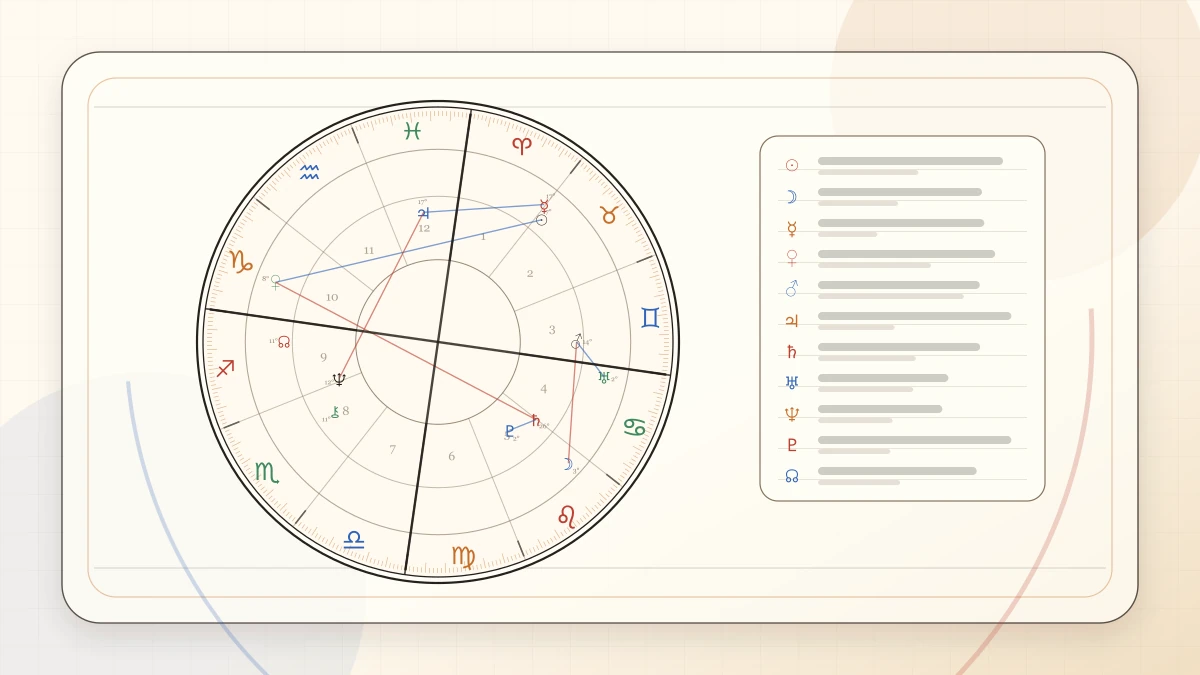
In a constructed Capricorn-rising chart, the top items include the Scorpio Sun within 2 degrees of Mars, the Moon opposite the Ascendant within 4 degrees, and Saturn, the chart ruler, 3 degrees from the Midheaven.
Why a chart needs a ranking before you read it
A full chart can hold ten planets, four angles, twelve houses and dozens of aspects, and most beginners stall because every item looks equally loud. In practice readers do not give every placement the same weight. Prioritizing is the habit of deciding what to read first, so the main themes appear before the details.
There is no official scoring system, and schools weigh things differently. What follows is one workable method with its reasons stated, so you can adjust it to your own question.
A ranking method in six steps
Work down the list and stop when you have about five items worth a closer look.
- Start with your question. A question about work points to the Midheaven, the 10th house and its ruler. One about partnership points to the Descendant, the 7th house, Venus and the Moon.
- Read the Sun, Moon and Rising sign next. They form the basic frame of nearly every chart reading.
- Find the chart ruler, the traditional ruler of the Rising sign, and note its sign, house and aspects.
- Look for planets in angular houses (1, 4, 7 and 10), especially within about 5° of an angle, because they are read as more prominent.
- Rank aspects by tightness. Natal orbs of about 6° to 8° are common, but a conjunction or opposition within 2° or 3° is read as stronger than one at 7°.
- Look for stelliums (three or more planets in one sign or house) and for repeated themes, such as several placements in the same element.
What goes in the top tiers and why
The method boils down to four tiers. Relevance to your question can lift any item up a tier, and the reasons matter more than the labels.
| Tier | Factor | Why it ranks here |
|---|---|---|
| First | Sun, Moon and Rising sign | The basic frame that most readings start from |
| First | Anything tied to your question | Relevance beats general rank |
| Second | The chart ruler | Carries the Rising sign’s agenda into a house |
| Second | Planets within about 5° of an angle | Angular planets are read as prominent |
| Third | Aspects within 3° | Tighter contacts are read as stronger |
| Third | Stelliums | Several planets pointing at one theme |
| Fourth | Repeated themes | The same message arrives from several factors |
A constructed chart, ranked
This chart is constructed and is not a real person. It uses whole-sign houses. The Ascendant is 6° Capricorn, the Midheaven 25° Libra, the Sun 18° Scorpio (11th house), the Moon 2° Cancer (7th), Mercury 12° Scorpio, Mars 20° Scorpio, Venus 15° Sagittarius, Jupiter 9° Pisces and Saturn 28° Libra.
The frame is a Scorpio Sun, a Cancer Moon and a Capricorn Rising sign. Saturn rules Capricorn, so it is the chart ruler, and at 28° Libra it sits in the 10th house, 28 − 25 = 3° from the Midheaven. That makes it both chart ruler and angular, which lifts it high on the list.
Now the aspects. The Moon at 2° Cancer is 90 + 2 = 92° and the Ascendant at 6° Capricorn is 270 + 6 = 276°. The gap is 276 − 92 = 184°, so the Moon opposes the Ascendant with a 4° orb. The Sun (210 + 18 = 228°) and Mars (230°) are 2° apart, a close conjunction. Mercury at 222° is 6° from the Sun, a looser one. Mercury, Sun and Mars together form a Scorpio stellium spanning 8°, and five of the seven classical planets are in water signs, so the water theme repeats.
- The Scorpio Sun conjunct Mars within 2°, in the 11th house
- The Moon opposite the Capricorn Ascendant within 4°, with the Moon in the 7th house
- Saturn, the chart ruler, at 28° Libra in the 10th house and 3° from the Midheaven
- The Scorpio stellium of Mercury, the Sun and Mars
- Water repeating through Scorpio, Cancer and Pisces
How to prioritize when the birth time is uncertain
The Rising sign, Midheaven and house positions depend on the exact birth time. The Ascendant moves about 1 degree every 4 minutes, so a two-hour error shifts it about 30°, roughly a whole sign.
Do not make up for a shaky time by giving angles extra weight. Move them down and lean on what the time barely touches: the Sun’s sign, the aspects between planets and, unless the Moon is near a sign boundary, the Moon, which moves about 13° a day.
Placements to read later
Some points are real parts of many charts but belong to a second pass, once the ranked items make sense. Leaving them for later is a way of sequencing, not a verdict that they do not matter.
- The lunar nodes
- Chiron and other asteroids
- Minor aspects, such as the quincunx at 150°
- Midpoints and calculated points such as the Arabic parts
- Planets in cadent houses with no tight aspect, which tend to be quieter
Turn the ranking into a one-page summary
Write your top five items on one page with a reason for each, using the chart’s own numbers: the sign, the house, the orb. Put your question at the top. If an item is on the list only because it sounds dramatic, cross it off.
Come back in a month and see whether the same five still look right. A ranking you can explain is more useful than a long list you cannot.
Common misreadings when ranking a chart
Most ranking mistakes come from a feeling that a placement is important, so each row below names the feeling and a check you can run instead.
| The misreading | Why it happens | What to check instead |
|---|---|---|
| The most dramatic aspect is the most important | A square or opposition to an outer planet sounds weighty | The orb, whether it touches your question, and whether the planets are prominent |
| Every aspect counts the same | The wheel draws dozens of lines that all look alike | Sort by orb and read only the tightest few |
| A placement ranks high because it fits what you already believe | A familiar or flattering line feels right | Write the ranking first, then read the interpretations |
| The order is a score | A numbered list looks like a verdict | Use the order only to decide what to read first |
Where schools disagree about what comes first
Modern psychological astrologers usually start with the Sun, Moon and Rising sign. Traditional astrologers more often start with the Ascendant, its ruler and the planet that rules the topic in question. They weigh different things, so a method that suits one school can look odd to the other.
Neither starting point is wrong. Say which one you chose at the top of your page, and you will know why your ranking looks the way it does.
What this does and does not establish
A ranking reflects your question and method, not a universal order, and an uncertain birth time should lower the weight you give the angles.
Related calculators
Use the matching tool when you want a direct chart or timing result after reading the guide.
Free Birth Chart Calculator
Create a birth chart from birth date, time, and place to review placements, houses, angles, and aspects.
Rising Sign Calculator
Exact Ascendant verification from full birth-chart math for practical house and Big 3 interpretation.
12 Houses Calculator
Complete 12-house overview page for readers who want the full natal house framework before drilling into one exact placement.
Calculation references
- Swiss Ephemeris: positions, angles and house-system conventions
Technical reference for calculation conventions. It does not certify an interpretation or mean every live tool uses this engine.
Related articles
Keep reading with nearby topics that deepen the same question from another angle.
The Four Angles in Astrology Explained
The four angles are the Ascendant, Descendant, Midheaven and IC. They form two axes, the horizon and the meridian, and planets close to them are read as especially prominent.
6 min read
House Rulership Basics for Beginners
A house ruler is the planet that rules the sign on that house's cusp. Where that planet sits shows which other area of life the house's matters are steered through.
7 min read
How to Read Your Birth Chart: A Beginner's Guide
Read your birth chart in five steps: find the Sun, Moon and Rising sign, count the elements, note crowded houses, locate the chart ruler, then read the two or three closest aspects.
6 min read
Sun, Moon, and Rising Signs Explained
Your Sun sign describes what you are aiming to be, your Moon sign what you need to feel settled, and your Rising sign how you meet the world and how it first meets you.
6 min read
Keep exploring
Use the category page and the main hubs when you want the next layer of context.
Previous article
The Four Angles in Astrology Explained
Next article
House Rulership Basics for Beginners