
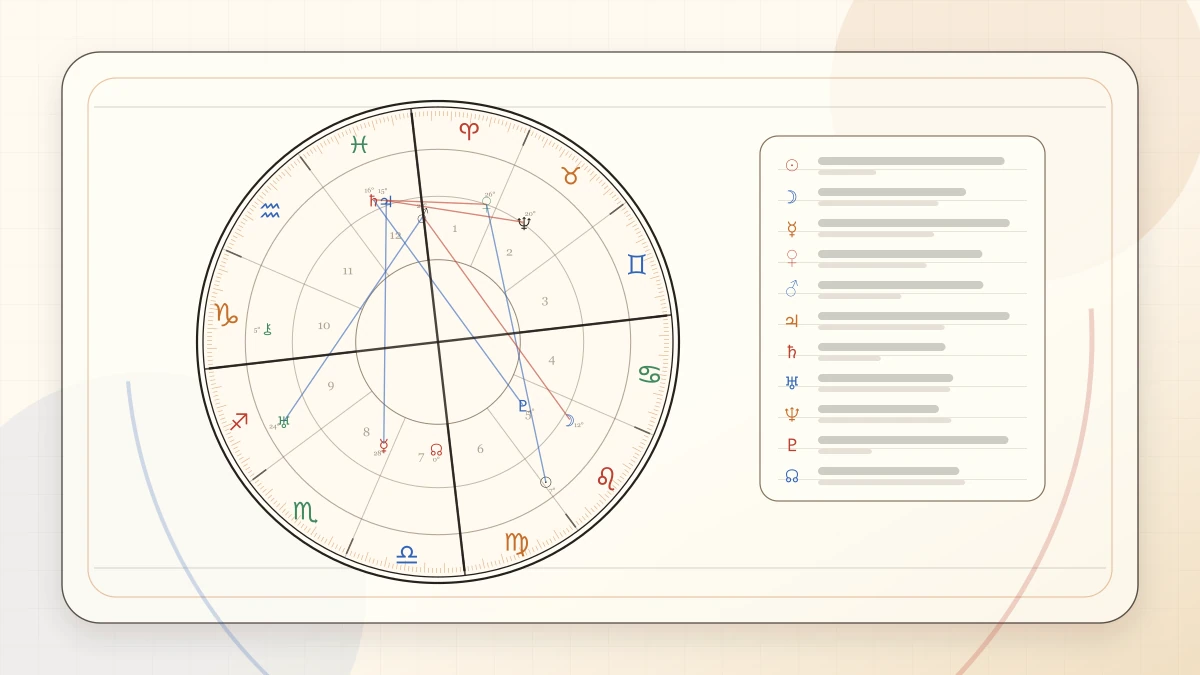
Birth Chart Basics
House Rulership Basics for Beginners
A house ruler is the planet that rules the sign on that house's cusp. Where that planet sits shows which other area of life the house's matters are steered through.
Table of contents
- Example or practical exercise
- What a house ruler is
- The rulers of the twelve signs
- Traditional or modern rulers: which should you use?
- Find a house ruler in your own chart
- The chart ruler: the most important house ruler
- A constructed chain of rulers
- Common slips to avoid
- One planet, two houses: rulers that link an area to itself
- Questions readers ask about house rulers
- What this does and does not establish
Example or practical exercise
In a constructed Libra-rising chart, Venus sits in Gemini in the ninth, Mercury in Cancer in the tenth and the Moon in Libra in the first, so the chain of rulers closes in a loop.
What a house ruler is
Every house in a birth chart begins in a zodiac sign, and every sign has a ruling planet. The planet that rules the sign at the start of a house is called the ruler of that house. Where that ruler sits in the chart connects two areas of life: the house it rules and the house it occupies.
This matters because it lets the chart talk to itself. Rather than reading each house in isolation, you follow a thread. If the ruler of the second house sits in the ninth, the tradition links the second house’s themes with the ninth’s, a way of asking how one area of life is steered through another.
The idea is an interpretive convention, so it describes links to think about, not outcomes.
The rulers of the twelve signs
Traditional rulers use only the seven bodies visible to the naked eye. Modern rulers add Uranus, Neptune and Pluto, which were found later, for three signs.
| Sign | Traditional ruler | Modern ruler (if different) |
|---|---|---|
| Aries | Mars | Same |
| Taurus | Venus | Same |
| Gemini | Mercury | Same |
| Cancer | Moon | Same |
| Leo | Sun | Same |
| Virgo | Mercury | Same |
| Libra | Venus | Same |
| Scorpio | Mars | Pluto, often as a co-ruler |
| Sagittarius | Jupiter | Same |
| Capricorn | Saturn | Same |
| Aquarius | Saturn | Uranus, often as a co-ruler |
| Pisces | Jupiter | Neptune, often as a co-ruler |
Traditional or modern rulers: which should you use?
The choice affects only houses that begin in Scorpio, Aquarius or Pisces, and astrologers disagree about it. Traditionalists keep Mars, Saturn and Jupiter as the rulers. Many modern astrologers prefer Pluto, Uranus and Neptune, and some use both, giving the older planet the main role and the newer one a supporting role.
A fair approach for a beginner is to pick one system, say which, and notice what changes if you try the other. The examples here use traditional rulers because each sign has exactly one of them, which keeps the chains easy to follow.
Find a house ruler in your own chart
Start with whole-sign houses if you can, because each house is exactly one sign. In quadrant systems the cusp sign can differ from the house’s main sign, and the same sign can begin two houses, in which case the same planet rules both.
- Find the sign on the house cusp (in whole-sign houses, the sign that is the house).
- Look up that sign’s ruler in the table.
- Find the ruler in your chart and note its sign and house.
- Write the link as a sentence. For example, if the ruler of the first house sits in the second house: the matters of the first house are steered through the second house’s area.
- Note anything about the ruler worth adding, such as a close aspect or being in its own sign.
The chart ruler: the most important house ruler
The ruler of the Rising sign is called the chart ruler. Libra rising, for example, has Venus as its chart ruler. Because the Rising sign describes how you meet the world, its ruler is read as a kind of driver for the whole chart, and its sign and house show where much of your energy naturally goes.
If you are short of time, start here. Read the chart ruler’s sign, house and closest aspects before you try the other eleven houses.
A constructed chain of rulers
Take a constructed chart with Libra rising and whole-sign houses: Libra is the first house, Scorpio the second, and so on, so Gemini is the ninth and Cancer the tenth. Place Venus in Gemini, Mercury in Cancer and the Moon in Libra.
Follow the thread. The first house is Libra, ruled by Venus, which sits in Gemini in the ninth house. Gemini is ruled by Mercury, which sits in Cancer in the tenth house. Cancer is ruled by the Moon, which sits in Libra in the first house, and Libra returns us to Venus. The chain closes in a loop.
A reader might say: how this person comes across (first house) is steered through learning, beliefs and wide horizons (ninth), which connect to work direction and public role (tenth), which come back to a sense of self shaped by feelings and a wish for balance. That is a story to test, not a forecast. For one more link, the second house begins in Scorpio, ruled by Mars traditionally and Pluto in the modern system, so you would look for either planet to see where resources and values are steered.
Common slips to avoid
A few habits keep rulership readings clear.
- Do not confuse a sign’s ruler with a house’s ruler. The house ruler is simply the ruler of the sign on that house’s cusp. Two houses with different signs usually have different rulers, but not always: Taurus and Libra both have Venus, so houses on those signs share a ruler.
- Say which ruler system you are using, especially for Scorpio, Aquarius and Pisces.
- Remember that an empty house still has a ruler. The ruler’s location is how that house speaks.
- Start with the chart ruler and add one or two more links. Reading all twelve at once muddies the picture.
- Treat each link as a theme to consider, not a prediction about a particular event.
One planet, two houses: rulers that link an area to itself
With whole-sign houses and traditional rulers, five of the seven planets each rule two houses, and only the Sun and Moon rule one. The sign table explains why: Mars rules Aries and Scorpio, Venus rules Taurus and Libra, Mercury rules Gemini and Virgo, Jupiter rules Sagittarius and Pisces, and Saturn rules Capricorn and Aquarius. Whichever houses those signs occupy in your chart, the pair shares a ruler and is read as quietly connected.
Take a constructed chart with Aquarius rising, so Aquarius is the first house and Capricorn is the twelfth. Saturn rules both. Place Saturn in Capricorn, in the twelfth house. The ruler of the first house then sits in its own sign, in the house next door, and it also rules the house it occupies. A reader might say that how this person comes across is tied closely to solitude, rest and what happens out of sight, with Saturn’s careful manner as the common thread. A modern reader who gives Aquarius to Uranus would send the first-house thread to wherever Uranus sits instead.
Questions readers ask about house rulers
What if the ruler sits in the house it rules? Then the house is often read as self-contained: its topics are handled largely on their own ground, with little need to look elsewhere in the chart. If that planet also rules a second sign, as Saturn rules both Capricorn and Aquarius, the house on that second sign is still drawn in. Many astrologers add that a planet in its own sign works comfortably, though that is a traditional idea that plenty of modern astrologers use little.
Does the ruler’s sign matter as well as its house? Yes. The house tells you which area is connected, and the sign tells you the style of the link. A second-house ruler in a steady sign reads differently from one in a restless sign, even if both sit in the sixth house.
Do I need the ruler of every house? No. Begin with the chart ruler, then add only the houses that match the question you are asking. For a question about work, the tenth-house ruler is a sensible place to start.
What this does and does not establish
A ruler link is a story to test against your life, not a forecast, and it can shift with traditional or modern rulers.
Related calculators
Use the matching tool when you want a direct chart or timing result after reading the guide.
Free Birth Chart Calculator
Create a birth chart from birth date, time, and place to review placements, houses, angles, and aspects.
Rising Sign Calculator
Exact Ascendant verification from full birth-chart math for practical house and Big 3 interpretation.
12 Houses Calculator
Complete 12-house overview page for readers who want the full natal house framework before drilling into one exact placement.
Calculation references
- Swiss Ephemeris: positions, angles and house-system conventions
Technical reference for calculation conventions. It does not certify an interpretation or mean every live tool uses this engine.
Related articles
Keep reading with nearby topics that deepen the same question from another angle.
How to Prioritize the Most Important Placements in a Birth Chart
Start with your question, then read the Sun, Moon and Rising sign, the chart ruler, planets near angles, the tightest aspects and any stellium. Stop when you have about five items worth a closer look.
6 min read
How to Read a Birth Chart Without Memorizing Everything
Read by combining three building blocks: a planet is a function, a sign is a style and a house is an area of life. Five short questions turn any placement into one sentence.
6 min read
How to Read Your Birth Chart: A Beginner's Guide
Read your birth chart in five steps: find the Sun, Moon and Rising sign, count the elements, note crowded houses, locate the chart ruler, then read the two or three closest aspects.
6 min read
Sun, Moon, and Rising Signs Explained
Your Sun sign describes what you are aiming to be, your Moon sign what you need to feel settled, and your Rising sign how you meet the world and how it first meets you.
6 min read
Keep exploring
Use the category page and the main hubs when you want the next layer of context.
Previous article
How to Prioritize the Most Important Placements in a Birth Chart
Next article
How to Read a Birth Chart Without Memorizing Everything