
Birth Chart Basics
How to Read a Birth Chart Without Memorizing Everything
Read by combining three building blocks: a planet is a function, a sign is a style and a house is an area of life. Five short questions turn any placement into one sentence.
Table of contents
- Example or practical exercise
- Why memorizing every meaning does not work
- Read in three layers, not one long list
- Five questions to ask of any placement
- Build one sentence for each placement
- A constructed worked reading in four sentences
- Keep a one-page list instead of a long memory
- Habits that make chart reading easier
- Common misreadings when you read by building blocks
- A second constructed reading: a placement you have never met
- What to do when two placements seem to contradict each other
- What this does and does not establish
Example or practical exercise
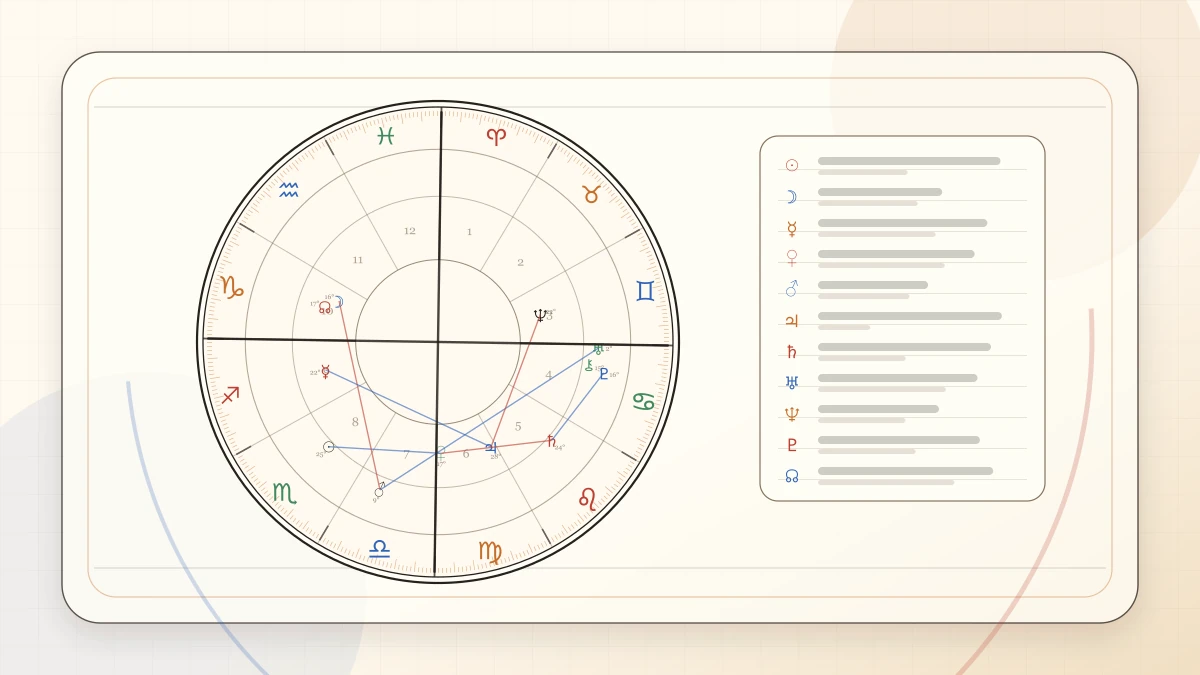
In a constructed Sagittarius-rising chart, the Moon at 17 degrees Virgo in the tenth and Mars at 14 degrees Gemini in the seventh are 93 degrees apart, so a fourth sentence names a pull between calm order and quick exchange.
Why memorizing every meaning does not work
A planet in a sign in a house is a three-part combination. With ten bodies, twelve signs and twelve houses, that is 10 times 12 times 12, or 1,440 combinations before you add a single aspect. No one carries that many definitions in their head, and sources differ on many of them anyway.
Astrologers read by combining a small set of building blocks. A planet is a function, a sign is a style and a house is an area of life. Once those few ideas are solid, you can assemble a sentence for any placement, including ones you have never seen.
Read in three layers, not one long list
A calm reading moves from the big picture to the details. Each layer is small, so you can finish one before starting the next.
| Layer | The question | What to look at | About how many items |
|---|---|---|---|
| Outline | Who is this, broadly? | Sun, Moon and Rising sign | 3 |
| Emphasis | Where does the weight fall? | Heavy elements, crowded houses, planets close to an angle | 2 or 3 |
| Connections | What is linked to what? | The chart ruler and the two or three closest aspects | 3 to 4 |
Five questions to ask of any placement
When you meet a placement you do not recognize, you can still work it out.
- What is this planet’s job? Use one word: feel, think, value, act, grow, limit.
- How does it do that job? Let the sign set the style.
- Where in life does it show up? Let the house set the topic.
- Who steers it? Find the ruler of its sign and see where that planet sits.
- What does it touch? Find its closest aspect, if any is within about 6 to 8 degrees.
Build one sentence for each placement
Fit the answers into one sentence: the planet’s job, done in the sign’s style, in the house’s area. A sign is also just an element plus a modality; Virgo is earth and mutable, so it works practically and adapts. That lets you rebuild a sign’s style rather than recall it.
Keep a small reference table for the planet jobs.
| Body | One-word job | A question it asks |
|---|---|---|
| Sun | Identity | What am I aiming to be? |
| Moon | Needs | What helps me feel settled? |
| Mercury | Thinking | How do I take in and share ideas? |
| Venus | Valuing | What do I like and want near me? |
| Mars | Acting | How do I go after what I want? |
| Jupiter | Growth | Where do I expand and trust? |
| Saturn | Limits | Where do I commit and build slowly? |
| Uranus | Change | Where do I break from the pattern? |
| Neptune | Imagination | Where do I dream or lose focus? |
| Pluto | Depth | Where do I face intensity and renewal? |
A constructed worked reading in four sentences
Take a constructed chart with Sagittarius rising and whole-sign houses, so Virgo is the tenth house, Gemini the seventh and Aquarius the third. The Moon is at 17 degrees of Virgo, Mars at 14 degrees of Gemini, and Jupiter, the ruler of Sagittarius and so the chart ruler, is in Aquarius.
Moon: I settle by being useful and orderly, and that need is aimed at my work and public role. Mars: I push by asking, debating and quick exchanges, mostly in one-to-one relationships. Jupiter, the chart ruler: my general direction grows through ideas, learning and conversation with peers and neighbors.
Now the connection. The Moon is at 167 degrees (150 plus 17) and Mars at 74 (60 plus 14). The gap is 93 degrees, within 3 degrees of a square. Fourth sentence: the wish for calm order and the urge for quick back-and-forth pull against each other. That is a coherent reading built from four sentences and almost no memorized definitions.
Keep a one-page list instead of a long memory
A single page next to your chart replaces most of what beginners try to memorize.
- The ten planet jobs, one word each, as in the table above.
- Four elements and three modalities, one word each.
- The twelve house topics, two or three words each.
- The five aspects with their angles: 0, 60, 90, 120 and 180 degrees.
- The traditional rulers of the twelve signs, with the modern ones in brackets.
Habits that make chart reading easier
These habits do more than extra keywords.
- Read one chart at a time, and stop when you have a page of sentences.
- Write sentences rather than keywords. A sentence exposes what you do not yet understand.
- Check numbers in the position table, not by eye on the wheel.
- Use one house system and say which, especially if you compare readings.
- Return to the same chart after a month and see which sentences still feel true.
- Phrase everything as tendencies and questions, not as things that must happen.
Common misreadings when you read by building blocks
Reading from a few parts is quick, and quick readings slip in predictable ways. The table lists five.
| Misreading | Why it happens | What to check instead |
|---|---|---|
| A sign gives a planet one fixed meaning | A keyword list feels like a definition | Add the house and the ruler before you decide |
| A house is an event | House names sound like places or scenes | Read it as an area of life and ask what you do there |
| Every aspect weighs the same | A wide orb still draws a line on the wheel | Measure the gap in degrees and start with the tightest |
| The Sun sign is the whole chart | It is the one placement most people know | Add the Moon and Rising sign first |
| An empty house is a missing area of life | A house with no planets looks blank | Find its ruler, which is where that house speaks |
A second constructed reading: a placement you have never met
Take a constructed chart with Saturn at 20 degrees of Cancer in the eleventh house and the Moon at 17 degrees of Libra. You do not need a definition of Saturn in Cancer in the eleventh; ask the five questions instead.
Job: Saturn means limits and commitment. Style: Cancer is a cardinal water sign, so protective, feeling-led and quick to take care. Area: the eleventh house covers friends, groups and hopes. Steered by: the Moon, which rules Cancer. Touches: Saturn is at 110 degrees (Cancer starts at 90) and the Moon at 197 (Libra starts at 180), a gap of 87 degrees, within 3 degrees of a square.
One sentence: I take commitments to friends and groups seriously and guard them carefully, while my own wish for ease and harmony pulls against that heavy sense of duty. The sentence came from parts you already know.
What to do when two placements seem to contradict each other
Contradictions are normal. A Moon in Libra may want peace while a Mars in Aries wants to argue. Do not choose a winner. Write both sentences, then ask in which settings each one tends to appear: at work or at home, with friends or with strangers.
A chart describes a person with several modes, not one consistent type, so a tension between two sentences is usually the most useful thing on the page.
What this does and does not establish
A sentence built from keywords is a starting point, not a finished reading, and the rest of the chart can change it.
Related calculators
Use the matching tool when you want a direct chart or timing result after reading the guide.
Free Birth Chart Calculator
Create a birth chart from birth date, time, and place to review placements, houses, angles, and aspects.
Rising Sign Calculator
Exact Ascendant verification from full birth-chart math for practical house and Big 3 interpretation.
12 Houses Calculator
Complete 12-house overview page for readers who want the full natal house framework before drilling into one exact placement.
Calculation references
- Swiss Ephemeris: positions, angles and house-system conventions
Technical reference for calculation conventions. It does not certify an interpretation or mean every live tool uses this engine.
Related articles
Keep reading with nearby topics that deepen the same question from another angle.
House Rulership Basics for Beginners
A house ruler is the planet that rules the sign on that house's cusp. Where that planet sits shows which other area of life the house's matters are steered through.
7 min read
What an Empty First House Can Mean
An empty first house still has the Ascendant, its sign and its ruler. Read the Rising sign for your approach, then follow the ruling planet to see where first impressions lead.
6 min read
How to Read Your Birth Chart: A Beginner's Guide
Read your birth chart in five steps: find the Sun, Moon and Rising sign, count the elements, note crowded houses, locate the chart ruler, then read the two or three closest aspects.
6 min read
Sun, Moon, and Rising Signs Explained
Your Sun sign describes what you are aiming to be, your Moon sign what you need to feel settled, and your Rising sign how you meet the world and how it first meets you.
6 min read
Keep exploring
Use the category page and the main hubs when you want the next layer of context.
Previous article
House Rulership Basics for Beginners
Next article
What an Empty First House Can Mean