
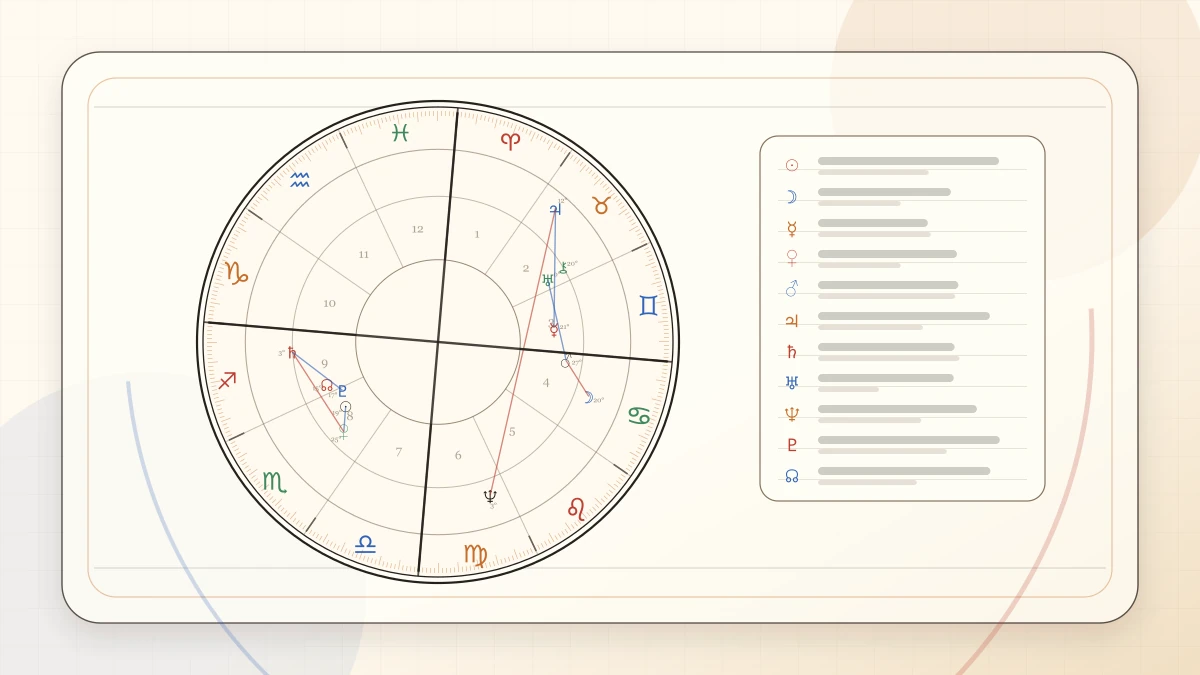
Birth Chart Basics
What Each Planet Means in a Birth Chart
Each planet stands for a function: the Sun for identity, the Moon for emotional needs, Mercury for thinking, Venus for values, Mars for drive, Jupiter for growth and Saturn for limits.
Table of contents
- Example or practical exercise
- Think of each planet as a function, not a character
- The ten bodies: function, everyday expression and the two extremes
- The Sun, Moon, Mercury, Venus and Mars in more depth
- Jupiter, Saturn and the outer planets
- How to combine a planet, a sign and a house in one sentence
- The same planet, two different sentences
- Try one question for each personal planet
- Common misreadings of the planets
- Questions readers ask about the planets
- What this does and does not establish
Example or practical exercise
In a constructed Gemini-rising chart, Mars at 8 degrees Virgo in the fourth house reads as careful drive around home, but moved to 8 degrees Aries in the eleventh it becomes direct, impatient drive among friends.
Think of each planet as a function, not a character
In astrology a planet stands for a function, a kind of activity every person has: thinking, wanting, caring, pushing, limiting. The sign describes how that function is carried out, and the house describes where in life it tends to show up. Beginners often read planets as little personalities, which makes each placement sound like a verdict. Reading them as functions keeps the language flexible.
Any function can run too high or too low. For each planet below you get both versions, as tendencies to notice and not as a diagnosis. They are prompts for reflection, not measurements of how much of anything a person has.
The ten bodies: function, everyday expression and the two extremes
Astrologers call all ten bodies planets for convenience, even though the Sun and Moon are not planets in the astronomical sense and Pluto has been classed as a dwarf planet since 2006. Read across a row for the whole picture of one body.
| Body | Function | Everyday expression | Overworked | Underworked |
|---|---|---|---|---|
| Sun | Core identity and purpose | Wanting to be seen and to contribute | Needing the spotlight | Hiding or deferring |
| Moon | Emotional needs and habits | What feels soothing and familiar | Clinging to routine and mood | Overlooking your own needs |
| Mercury | Thinking and communicating | Talking, learning, sorting information | Overthinking, constant chatter | Leaving things unsaid |
| Venus | Valuing and attracting | Taste, affection, what feels pleasing | Pleasing others, avoiding friction | Cool toward closeness and pleasure |
| Mars | Drive and assertion | Starting, competing, defending | Pushing, impatience, quarrels | Passivity, not asking for things |
| Jupiter | Growth and meaning | Optimism, generosity, belief | Overpromising, excess | Cynicism, small horizons |
| Saturn | Structure and limits | Responsibility, patience, boundaries | Rigidity, harsh self-judgment | Avoiding commitment and effort |
| Uranus | Change and independence | Originality, reform, breaking habit | Restlessness, contrariness | Clinging to the familiar |
| Neptune | Imagination and dissolving edges | Compassion, intuition, creativity | Escapism, vagueness | Cut off from imagination or empathy |
| Pluto | Depth and transformation | Facing what is hidden, intensity | Control, all-or-nothing thinking | Avoiding depth and difficult truths |
The Sun, Moon, Mercury, Venus and Mars in more depth
The Sun and Moon are the luminaries. The Sun moves about 1° a day and spends about a month in each sign. The Moon travels about 13° a day, about 2.3 days per sign on average, which is why a Moon sign is more sensitive to birth time than a Sun sign. Roughly, the Sun is who you are working toward being and the Moon is what you need in order to feel settled.
Mercury and Venus never stray far from the Sun. Mercury is always in the Sun’s sign or an adjacent one, and Venus is always within two signs of it. Mars, by contrast, can be anywhere, which is part of why its sign often differs more from your Sun’s.
Jupiter, Saturn and the outer planets
Jupiter and Saturn are the social planets, because they describe how you meet shared structures: beliefs and opportunity for Jupiter, rules and responsibility for Saturn. Jupiter takes about 12 years to circle the zodiac, about a year per sign. Saturn takes about 29.5 years, about 2.5 years per sign.
Uranus, Neptune and Pluto are the outer planets. Uranus circles in about 84 years, about 7 per sign. Neptune takes about 165 years, about 14 per sign. Pluto takes about 248 years, with a very uneven pace of roughly 12 to 31 years per sign. Everyone born within a few years shares their sign, so they read as generational backdrops, and their house and aspects are what make them personal.
How to combine a planet, a sign and a house in one sentence
A short template keeps the three layers apart: a function, carried out in a certain style, around a certain topic.
- Name the function in plain words, such as Mars as drive.
- Name the sign’s style in one or two words, such as Virgo as careful and detail-minded.
- Name the house’s topic, such as the 4th house as home and roots.
- Join them: drive works in a careful, detail-minded way around home and family roots.
The same planet, two different sentences
This chart is constructed for teaching and has Gemini Rising. Mars at 8° Virgo is 150 + 8 = 158°. Counting whole-sign houses from Gemini (Gemini 1, Cancer 2, Leo 3, Virgo 4), Virgo is the 4th house. The sentence reads: drive works in a careful, detail-minded way around home and family roots.
Now move Mars to 8° Aries, which is 8°. Counting on (Libra 5, Scorpio 6, Sagittarius 7, Capricorn 8, Aquarius 9, Pisces 10, Aries 11), Aries is the 11th house, so the sentence becomes: drive works directly and a little impatiently around friends and groups. The planet is the same, the function is the same, and the two sentences are very different. Aspects would add a further clause to either.
Try one question for each personal planet
These questions turn the table into a small exercise. Answer them from your own life first and look up your placements afterward.
- Sun: when do you feel most like yourself?
- Moon: what reliably settles you after a hard day?
- Mercury: how do you work a problem out, by talking, writing or thinking alone?
- Venus: what do you find beautiful, and how do you show you care?
- Mars: how do you act when you want something and the answer is no?
Common misreadings of the planets
A few popular keywords turn one expression of a planet into its whole meaning. Each row below gives the shortcut, why it spreads and a better question.
| The misreading | Why it happens | What to check instead |
|---|---|---|
| Saturn means bad luck | Its tradition of limits and delay sounds like a warning | Where do I build, and where do I hold back? |
| Mars means anger | Anger is the best-known sign of drive being blocked | How do I act on something I want? Anger is one expression |
| Venus is only romance | Love is the popular headline | What do I value, find pleasing and enjoy with friends? |
| The Moon is about your mother | Old keyword lists link the Moon to mothers | What are my emotional habits and needs? Treat family as a later question |
Questions readers ask about the planets
Why is Pluto still used when astronomers reclassified it? Astronomers called it a dwarf planet in 2006. Astrologers kept it as a symbolic body, and the astronomical label does not change how it is read.
Which planet matters most? There is no ranking. The Sun, Moon and Rising sign usually come first as the frame, and any planet gains weight by sitting near an angle, ruling the Rising sign or making a tight aspect.
Do I need all ten to read a chart? No. The Sun, Moon, Mercury, Venus and Mars are the fast-moving bodies that astrologers usually read first for everyday style. Add Jupiter and Saturn next, and leave the outer three until the rest feels familiar.
What this does and does not establish
Planet meanings are traditional keywords, not measured traits, and shortcuts such as Saturn means bad luck or Mars means anger leave out most of the picture.
Related calculators
Use the matching tool when you want a direct chart or timing result after reading the guide.
Free Birth Chart Calculator
Create a birth chart from birth date, time, and place to review placements, houses, angles, and aspects.
Moon Sign Calculator
Exact Moon-sign verification from full birth-chart math for practical emotional and compatibility use cases.
Rising Sign Calculator
Exact Ascendant verification from full birth-chart math for practical house and Big 3 interpretation.
Calculation references
- Swiss Ephemeris: positions, angles and house-system conventions
Technical reference for calculation conventions. It does not certify an interpretation or mean every live tool uses this engine.
Related articles
Keep reading with nearby topics that deepen the same question from another angle.
The 12 Houses Explained
The twelve houses split a birth chart into twelve areas of life, measured from the horizon at your birthplace. A planet's sign shows how it behaves, and its house shows where that behavior appears.
6 min read
How to Read Current Transits Without Overreacting to Every Aspect
Choose your question first, list the slow-planet contacts within a tight orb, then add fast ones only for timing. A Saturn contact lasting months outweighs a Moon contact lasting hours.
6 min read
How to Understand Planetary Aspects in Your Birth Chart
An aspect is an angle between two planets, measured in degrees. Read the planet pair first to learn which functions are linked, then the angle and its orb to learn how they interact.
6 min read
Zodiac Elements and Modalities Explained
Elements sort the twelve signs into fire, earth, air and water, describing the kind of energy, while modalities sort them into cardinal, fixed and mutable, describing its tempo. Each sign has one of each.
6 min read
Keep exploring
Use the category page and the main hubs when you want the next layer of context.
Previous article
How to Understand Planetary Aspects in Your Birth Chart
Next article
Zodiac Elements and Modalities Explained