
Birth Chart Basics
How to Understand Planetary Aspects in Your Birth Chart
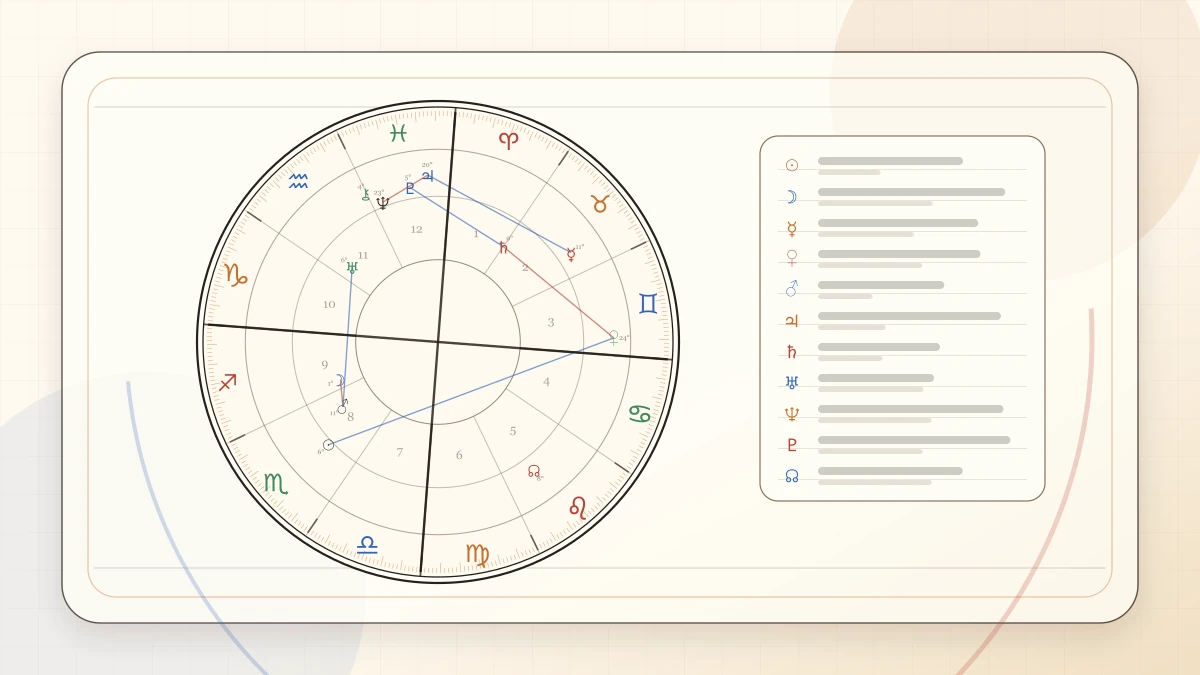
An aspect is an angle between two planets, measured in degrees. Read the planet pair first to learn which functions are linked, then the angle and its orb to learn how they interact.
Table of contents
- Example or practical exercise
- What an aspect adds that signs and houses do not
- Read the planet pair first, the angle second
- One pair, five angles: Venus and Saturn
- Which aspects to read first in a crowded chart
- How to read an aspect grid without drowning
- A constructed chart, aspect by aspect
- Turning the six aspects into a short reading
- Questions readers ask about aspects
- A one-page aspect sketch to make from your own chart
- What this does and does not establish
Example or practical exercise
In a constructed chart, Venus at 7 degrees Virgo and Saturn at 6 degrees Taurus are 121 degrees apart, a trine just 1 degree from exact, while the Sun at 8 degrees Leo squares Saturn within 2 degrees.
What an aspect adds that signs and houses do not
A birth chart gives you three layers of information about each planet: the sign it was in, the house it fell in, and the aspects it makes. Sign and house describe a planet on its own. An aspect describes a relationship, the angle between two planets measured along the zodiac, and that is where a chart starts to read like a story instead of a list.
Think of it this way. Mars in Gemini tells you about one planet’s style. Mars square Saturn tells you that two planets with different aims sit ninety degrees apart, so the question becomes how they share one life. The angle is the grammar, and the two planets are the nouns.
Read the planet pair first, the angle second
Beginners often start with the angle and ask whether a square is good or bad. A better first move is to ask what the two planets are about, because the pair sets the subject. The angle then describes how the two meet. The table gives four pairs and the question each one raises. They are questions on purpose, since a chart cannot answer them for you.
| Pair | Subject | A question to ask |
|---|---|---|
| Sun and Moon | Purpose and need | Do what you want to do and what you need to feel secure point the same way? |
| Mercury and Mars | Thought and action | How quickly does an idea turn into speech or a decision? |
| Venus and Saturn | Affection and caution | How do warmth and reserve share the same space? |
| Sun and Saturn | Identity and limits | What does it cost, and what does it give, to be taken seriously? |
One pair, five angles: Venus and Saturn
To see what the angle changes, hold the pair still. Here is how an astrologer might word Venus and Saturn at each of the five major angles. These are tendencies drawn from tradition, not outcomes.
- Conjunction (0 degrees): affection and caution act as one voice, so closeness may be offered slowly and meant in full.
- Sextile (60 degrees): the two can cooperate, but usually only when you put them to work, for example by choosing to deepen a friendship at a steady pace.
- Square (90 degrees): they pull in different directions, which can look like wanting closeness and safety at once and asks for deliberate adjustment.
- Trine (120 degrees): they blend without effort, so steadiness in affection may feel natural and be easy to take for granted.
- Opposition (180 degrees): each sits across from the other, so reserve and warmth may first be played out through other people.
Which aspects to read first in a crowded chart
A chart with the ten planets has forty-five pairs, and many of them will make some aspect. Reading every one leaves you with a list rather than a picture. A simple order of priority keeps the picture clear.
- Start with aspects that include the Sun, the Moon or the chart ruler, the planet that rules your Rising sign, because they touch the core of the chart.
- Next take the tightest ones, with orbs under about two degrees, since they are the easiest to hear in the chart’s overall tone.
- Look for repetition. A planet that appears in three aspects is a theme, so note it once instead of writing three separate points.
- Leave loose aspects, near the edge of your orb, until the end, and let them add detail rather than lead.
How to read an aspect grid without drowning
Many chart programs print an aspect grid, a triangle of small boxes with the planets along the edges. Each box holds that pair’s aspect symbol, and a blank box means no major aspect within the program’s orb.
Scan the grid by planet rather than by box. A planet with several aspects is a hub, and the chart tends to speak through it. A planet with none is called unaspected, and modern readers sometimes describe it as acting on its own. That is an interpretive idea, and a looser orb can give an unaspected planet two contacts.
A constructed chart, aspect by aspect
This chart is constructed for teaching and belongs to no real person. Each position becomes a count from 0 degrees Aries, adding 30 for every sign passed. Sun at 8 Leo is 120 + 8 = 128. Moon at 14 Libra is 180 + 14 = 194. Venus at 7 Virgo is 150 + 7 = 157. Mars at 11 Sagittarius is 240 + 11 = 251. Saturn at 6 Taurus is 30 + 6 = 36. Subtract to get each gap.
| Pair | Gap | Aspect | Orb |
|---|---|---|---|
| Venus and Saturn | 157 - 36 = 121 | Trine | 1 |
| Sun and Saturn | 128 - 36 = 92 | Square | 2 |
| Sun and Mars | 251 - 128 = 123 | Trine | 3 |
| Moon and Mars | 251 - 194 = 57 | Sextile | 3 |
| Venus and Mars | 251 - 157 = 94 | Square | 4 |
| Sun and Moon | 194 - 128 = 66 | Sextile | 6 |
Turning the six aspects into a short reading
Mars and the Sun each appear in three of the six aspects, so they are the hubs. Mars trines the Sun, sextiles the Moon and squares Venus, while the Sun also squares Saturn and sextiles the Moon. The tightest contact is Venus trine Saturn, one degree from exact, with the Sun square Saturn close behind. A reader might summarize it this way: steady affection that does not hurry, an identity that tests itself against limits, and an active Mars that supports the Sun and Moon but complicates what Venus wants.
Questions readers ask about aspects
Should I read an aspect by degree or by sign? Most modern readers use degrees, as in the table above. Some traditional astrologers count by sign, so planets in signs that stand in a sextile, square, trine or opposition relationship count even when the degrees are far apart. If you use sign-based aspects, say so.
Can two aspects in one chart contradict each other? Yes, and that is normal. Mars trine the Sun and Mars square Venus ask different things of the same planet. Treat that as a tension in the chart’s description, not an error.
Do I need a birth time? Only for aspects to the Ascendant or Midheaven. Between planets a date is often enough, though the Moon moves about 13 degrees a day.
A one-page aspect sketch to make from your own chart
Use one orb throughout and write it at the top of the page.
- Write each planet’s position as a number from 0 to 360, counting 30 degrees per sign.
- Subtract each pair and keep the gaps that fall within your orb of 0, 60, 90, 120 or 180 degrees.
- Underline planets that appear three times or more, and circle any that appear not at all.
- Write one sentence per aspect, beginning with the pair’s subject and then the angle.
- Label each sentence close, clear or background, then reread the page and cross out anything that sounds like a fixed fact about you.
What this does and does not establish
An aspect list depends on the orb you choose, and no aspect, hard or soft, tells you whether life will go well.
Related calculators
Use the matching tool when you want a direct chart or timing result after reading the guide.
Free Birth Chart Calculator
Create a birth chart from birth date, time, and place to review placements, houses, angles, and aspects.
Moon Sign Calculator
Exact Moon-sign verification from full birth-chart math for practical emotional and compatibility use cases.
Rising Sign Calculator
Exact Ascendant verification from full birth-chart math for practical house and Big 3 interpretation.
Calculation references
- Swiss Ephemeris: positions, angles and house-system conventions
Technical reference for calculation conventions. It does not certify an interpretation or mean every live tool uses this engine.
Related articles
Keep reading with nearby topics that deepen the same question from another angle.
The 12 Houses Explained
The twelve houses split a birth chart into twelve areas of life, measured from the horizon at your birthplace. A planet's sign shows how it behaves, and its house shows where that behavior appears.
6 min read
How to Read Current Transits Without Overreacting to Every Aspect
Choose your question first, list the slow-planet contacts within a tight orb, then add fast ones only for timing. A Saturn contact lasting months outweighs a Moon contact lasting hours.
6 min read
What Does the Midheaven Mean in a Birth Chart?
The Midheaven is the zodiac degree at the top of your chart, overhead at birth. Astrologers read its sign as your style of public visibility and direction, not as a job title.
7 min read
What Each Planet Means in a Birth Chart
Each planet stands for a function: the Sun for identity, the Moon for emotional needs, Mercury for thinking, Venus for values, Mars for drive, Jupiter for growth and Saturn for limits.
6 min read
Keep exploring
Use the category page and the main hubs when you want the next layer of context.
Previous article
What Does the Midheaven Mean in a Birth Chart?
Next article
What Each Planet Means in a Birth Chart