
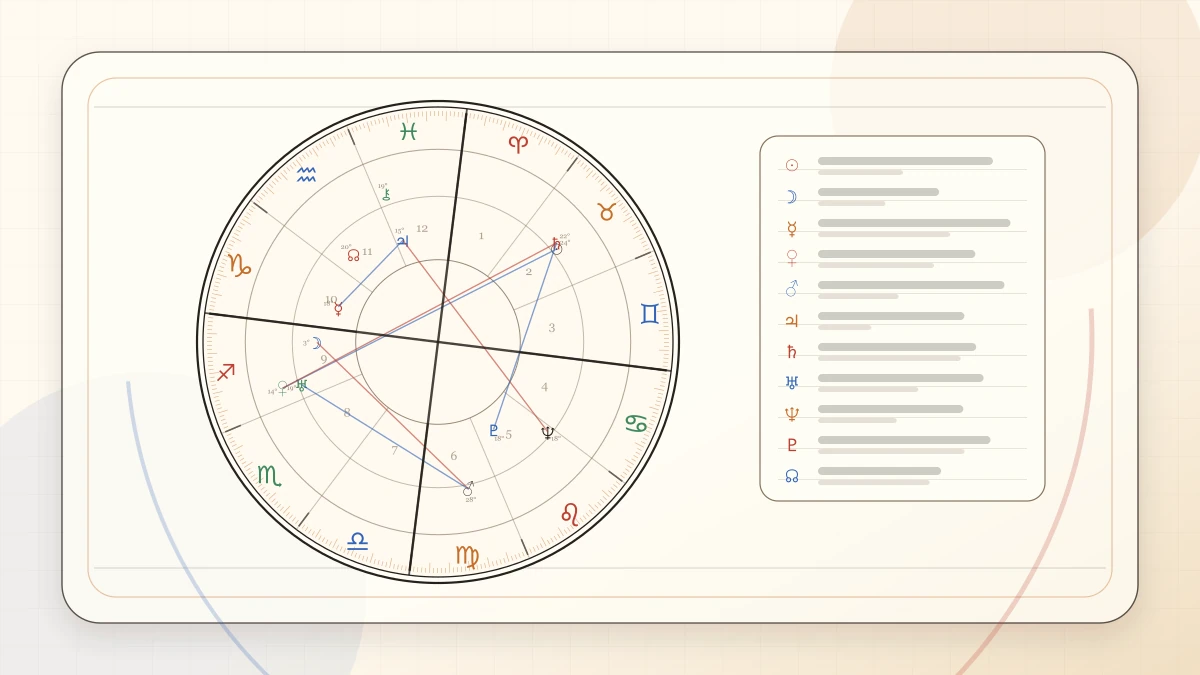
Birth Chart Basics
What Does the Midheaven Mean in a Birth Chart?
The Midheaven is the zodiac degree at the top of your chart, overhead at birth. Astrologers read its sign as your style of public visibility and direction, not as a job title.
Table of contents
- Example or practical exercise
- The Midheaven is the degree at the top of the sky
- What the Midheaven needs from your birth data, and what it ignores
- The Midheaven and the Imum Coeli form one axis
- One degree, three house systems
- A constructed chart: Gemini rising, Midheaven in early Aquarius
- How close counts as a planet on the Midheaven?
- How to read your own Midheaven in four steps
- Common questions about the Midheaven
- A short reflection for your own chart
- What this does and does not establish
Example or practical exercise
In a constructed Gemini-rising chart with the Midheaven at 2 degrees Aquarius, Placidus puts it on the tenth cusp while whole-sign houses put it in the ninth, and Venus at 29 degrees Capricorn sits just 3 degrees away.
The Midheaven is the degree at the top of the sky
Picture a line running from due south to due north, passing straight overhead, through the place where you were born. That line is the meridian. At the moment of your birth, one degree of the zodiac stood on that line above the horizon, at the point where the ecliptic (the Sun's apparent path) crosses the meridian. That degree is your Midheaven, written MC from the Latin medium coeli, the middle of the sky. Because the horizon and the zodiac are tilted against each other, it is usually not exactly 90 degrees from the Ascendant.
It is a point: one degree in one sign, such as 14 degrees of Virgo. It is not a region and it is not a house. Sign and house are separate questions you ask afterward, and mixing them up is the most common source of confusion about this angle.
Astrologers call it an angle because, with the Ascendant, Descendant and Imum Coeli, it marks one of the four corners of the chart. Modern readers connect it with public role, reputation and the direction a person is moving in. Older texts tie it to status and career. Both are vocabularies for reflection, not job titles.
What the Midheaven needs from your birth data, and what it ignores
The Midheaven depends on two inputs: the moment of birth and the longitude of the birthplace, which together fix local sidereal time (time kept by the stars rather than the Sun). It does not depend on latitude. Two people born at the same instant on the same line of longitude, one far to the north and one far to the south, share a Midheaven, while their Ascendants differ.
The MC runs through the whole zodiac in about a day, so on average it advances about 1 degree every 4 minutes, though not evenly, because some signs cross the meridian faster than others. A birth time that is 20 minutes off shifts it by about 5 degrees (20 divided by 4), and an hour off shifts it by about 15. That is enough to change the sign if your MC sits near a boundary.
The Midheaven and the Imum Coeli form one axis
Exactly opposite the Midheaven, 180 degrees away, sits the Imum Coeli (IC), the lowest point of the chart, beneath your feet. If your MC is 14 Virgo, your IC is 14 Pisces. The pair is read as a vertical axis: what is visible at one end, what you stand on at the other.
This also means a planet that aspects one end aspects the other. A planet conjunct the MC opposes the IC, and the reverse. When you read a planet near this axis, ask how it shows up both in public and at home.
One degree, three house systems
The Midheaven is not automatically the same as the tenth house, and the relationship depends on the house system your chart uses. Many charts online default to a quadrant system, so it is worth checking.
| House system | What the tenth house is | Where the MC falls |
|---|---|---|
| Placidus or Koch | A zone that begins at the MC | On the tenth-house cusp, by construction |
| Whole sign | The entire sign tenth from the Rising sign | In the ninth, tenth or eleventh house at most birthplaces, depending on the chart |
| Equal houses from the Ascendant | 30 degrees counted from the Ascendant degree | Usually near the tenth, but it can land in the ninth or eleventh |
A constructed chart: Gemini rising, Midheaven in early Aquarius
Take a made-up chart for a birthplace at about 51 degrees north, with the Ascendant at 5 degrees of Gemini (65 on the wheel) and the Midheaven at 2 degrees of Aquarius (302). From the MC forward to the Ascendant is 65 plus 360 minus 302, or 123 degrees, a normal gap at that latitude. Counting whole signs from Gemini (Gemini 1, Cancer 2, Leo 3, Virgo 4, Libra 5, Scorpio 6, Sagittarius 7, Capricorn 8, Aquarius 9, Pisces 10), the tenth house is Pisces and the MC falls in Aquarius, the ninth house. In Placidus, the tenth house simply starts at 2 degrees of Aquarius.
So the same point supports two readings. A Placidus reader hears Aquarius directly in the public-role house. A whole-sign reader sees a Pisces tenth house and notes that the MC itself lands in the ninth, the house of study, travel and belief. Neither is the correct version; they are two procedures, so say which one you used.
Now add Venus at 29 degrees of Capricorn. On the wheel that is 299 degrees, one degree short of the start of Aquarius at 300, and the MC is 2 degrees past it, so the two are 1 plus 2 equals 3 degrees apart. That is a close conjunction even though the signs differ. A reader who stops at sign boundaries would miss it.
How close counts as a planet on the Midheaven?
There is no official orb for angles. Many astrologers treat a planet within about 5 degrees of the MC or IC as the usual candidate, some stretch to 8, and a few stay tighter. A planet that merely sits in the tenth house, 25 degrees from the MC, is a different kind of statement: it concerns the house topic, not the angle.
Count in both directions, and across sign lines as the Venus example shows.
How to read your own Midheaven in four steps
This takes about ten minutes with a chart in front of you.
- Confirm the birth time and note which house system your chart used.
- Write down the MC degree and sign, and the IC directly opposite it.
- List any planets within about five degrees of the MC or IC, counting across sign boundaries.
- Note the planet that rules the MC sign and where it sits, then write one question the Midheaven raises for you, not an answer.
Common questions about the Midheaven
Is the Midheaven my career? It is one symbol some astrologers use when they talk about work. It describes a style of visibility, and every sign appears in every occupation.
Does it change over a lifetime? The natal MC is fixed by your birth. People who watch transits note when a slow planet passes over it and treat that as a period to reflect on public matters, not as a forecast.
What if I do not know my birth time? Then the MC cannot be reliable. A chart cast for noon as a placeholder produces an arbitrary degree. A birth certificate or a family record may hold the time.
Is it the same as the Ascendant? No. The Ascendant is the degree rising in the east and answers to latitude as well as time. The Midheaven is the degree overhead and answers to longitude and time.
A short reflection for your own chart
Write three sentences. First, how do people outside your family tend to describe what you do or care about? Second, how does that compare with the sign and degree of your MC? Third, what part of your life feels more like the IC end, rooted and private?
If the answers disagree with the chart, that is useful information about how much weight the symbol deserves for you.
What this does and does not establish
The Midheaven cannot name your career, and without a known birth time its degree is arbitrary.
Related calculators
Use the matching tool when you want a direct chart or timing result after reading the guide.
Free Birth Chart Calculator
Create a birth chart from birth date, time, and place to review placements, houses, angles, and aspects.
Moon Sign Calculator
Exact Moon-sign verification from full birth-chart math for practical emotional and compatibility use cases.
Rising Sign Calculator
Exact Ascendant verification from full birth-chart math for practical house and Big 3 interpretation.
Calculation references
- Swiss Ephemeris: positions, angles and house-system conventions
Technical reference for calculation conventions. It does not certify an interpretation or mean every live tool uses this engine.
Related articles
Keep reading with nearby topics that deepen the same question from another angle.
The 12 Houses Explained
The twelve houses split a birth chart into twelve areas of life, measured from the horizon at your birthplace. A planet's sign shows how it behaves, and its house shows where that behavior appears.
6 min read
How to Read Current Transits Without Overreacting to Every Aspect
Choose your question first, list the slow-planet contacts within a tight orb, then add fast ones only for timing. A Saturn contact lasting months outweighs a Moon contact lasting hours.
6 min read
What Does the Ascendant Mean in Astrology?
The Ascendant is the exact zodiac degree rising on the eastern horizon at your birth time and place. Its sign is your Rising sign, read as your style of approach.
6 min read
How to Understand Planetary Aspects in Your Birth Chart
An aspect is an angle between two planets, measured in degrees. Read the planet pair first to learn which functions are linked, then the angle and its orb to learn how they interact.
6 min read
Keep exploring
Use the category page and the main hubs when you want the next layer of context.
Previous article
What Does the Ascendant Mean in Astrology?
Next article
How to Understand Planetary Aspects in Your Birth Chart