
Birth Chart Basics
What Does the Ascendant Mean in Astrology?
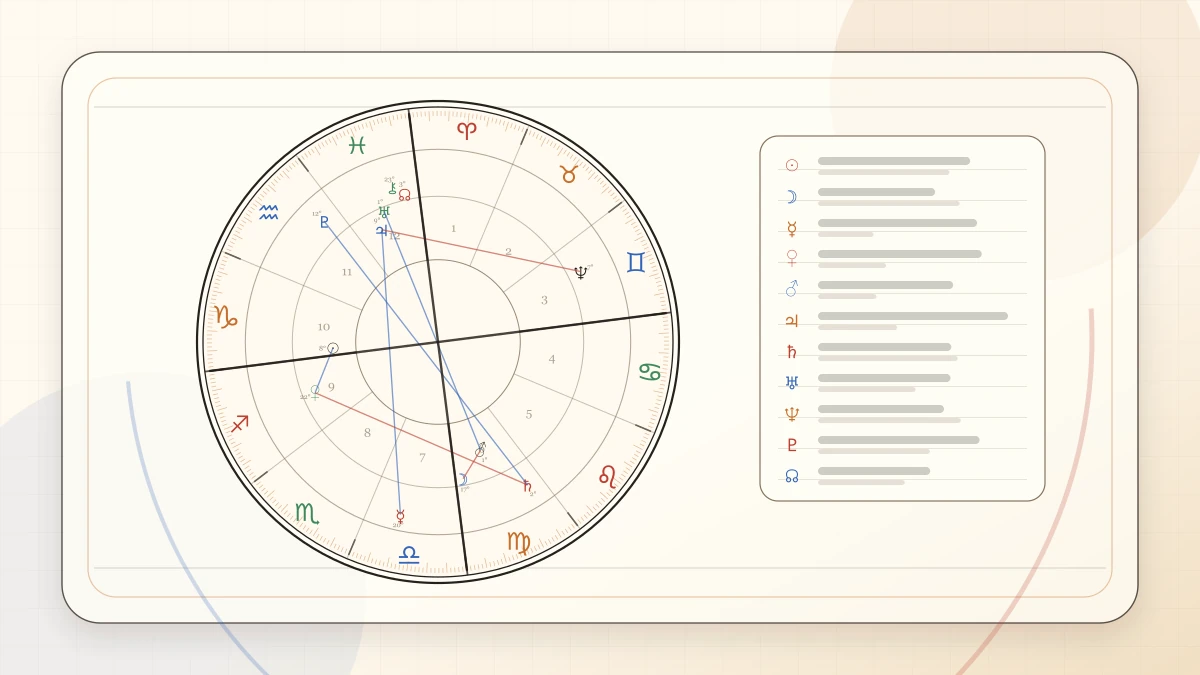
The Ascendant is the exact zodiac degree rising on the eastern horizon at your birth time and place. Its sign is your Rising sign, read as your style of approach.
Table of contents
- Example or practical exercise
- The Ascendant is a point; the Rising sign is the sign it falls in
- Where the Ascendant comes from: the horizon and the zodiac
- How much does a small error in birth time move it?
- Why some signs rise faster than others
- A rule of thumb to sanity-check your Ascendant
- A constructed example: an Ascendant near a sign edge
- How to find your Ascendant and check it
- The Ascendant and the first house are not the same thing
- Questions readers ask about the Ascendant
- What this does and does not establish
Example or practical exercise
A constructed Ascendant at 28 degrees 30 minutes Leo sits 1.5 degrees from Virgo, about six minutes of birth time, so a time six minutes later would switch the chart ruler from the Sun to Mercury.
The Ascendant is a point; the Rising sign is the sign it falls in
People use the words Ascendant and Rising sign as if they were the same, and in everyday talk they are. Strictly, the Ascendant is a single degree of the zodiac, such as 12 degrees Leo, and the Rising sign is the sign that degree sits in, here Leo. The degree matters, because it is the first house cusp in quadrant and equal systems and the Descendant sits exactly opposite it. The Midheaven and IC are found separately, from the time and the longitude.
It is not a planet. It is a calculated position that needs your birth date, exact time and place, and it describes how the sky was framed from where you stood, not any body in the sky.
Where the Ascendant comes from: the horizon and the zodiac
The Sun appears to travel along a line across the sky called the ecliptic, and the Moon and planets stay close to it, in a band called the zodiac. The Ascendant is the degree of the ecliptic crossing the eastern horizon at the moment of birth. Because Earth turns once a day, a new degree rises about every four minutes on average, which is 360 degrees in 24 hours, or 15 degrees an hour.
The point exactly opposite, setting in the west, is the Descendant. The word horoscope comes from a Greek phrase for the hour marker, a reminder that early astrologers treated this rising point as the heart of a chart. Modern readers usually read its sign as a style of approach: how you meet new situations and how others first meet you.
How much does a small error in birth time move it?
At the average rate, the Ascendant moves about one degree every four minutes. The rate varies by sign and latitude, so these are averages.
| Error in birth time | Shift in the Ascendant |
|---|---|
| 4 minutes | About 1 degree |
| 15 minutes | About 4 degrees |
| 1 hour | About 15 degrees |
| 2 hours | About one sign |
Why some signs rise faster than others
A sign takes about two hours to rise on average, but the figure is not even. For most birthplaces in the Northern Hemisphere, Capricorn through Gemini rise more quickly and Cancer through Sagittarius more slowly. The pattern reverses in the Southern Hemisphere. Close to the poles the contrast is large, and some signs pass the horizon in well under an hour.
In practice this means that a person born with a sign that rises quickly has a narrower window for that Rising sign, and a small error in the recorded time is more likely to change it.
A rule of thumb to sanity-check your Ascendant
If a chart program gives an Ascendant that seems odd, compare it with your Sun sign and the time of day. Use local solar time and allow a sign either way, because the rule is rough and shifts with latitude.
| Time of birth | Sun’s position | Ascendant relative to the Sun sign |
|---|---|---|
| Around sunrise | On the eastern horizon | Often the same sign |
| Around midday | At its highest point | About three signs after |
| Around sunset | On the western horizon | About six signs away, the opposite sign |
| Around midnight | At its lowest point | About three signs before |
A constructed example: an Ascendant near a sign edge
This chart is constructed and belongs to no real person. Its Ascendant is 28 degrees 30 minutes of Leo, which is 120 + 28.5 = 148.5 degrees from 0 Aries. The next sign, Virgo, begins at 150 degrees, so the gap is 1.5 degrees. At the average rate of one degree per four minutes, that is about six minutes.
So a birth time recorded six minutes later could flip the Rising sign from Leo to Virgo, and the chart ruler would change from the Sun to Mercury. The Descendant would change too: it now sits at 148.5 + 180 = 328.5 degrees, or 28 degrees 30 minutes of Aquarius, and would cross the edge into Pisces. A reader with a time this close to a boundary should check the source of the time and read both signs.
How to find your Ascendant and check it
A reliable result needs reliable inputs. Follow these steps in order.
- Find the most trustworthy source for the birth time, such as a birth certificate, instead of a family memory.
- Confirm the birth place and whether daylight saving time was in effect on that date, since clock time differs from standard time.
- Enter the details into the birth chart calculator on this site and note the Ascendant degree as well as the sign.
- Compare it with the rule of thumb above, and try times ten or fifteen minutes either side to see whether the sign changes.
The Ascendant and the first house are not the same thing
In quadrant house systems such as Placidus, the Ascendant is the cusp, the starting edge, of the first house, and the house runs from there to the second cusp. In whole-sign houses the first house is the entire Rising sign, so the Ascendant can sit anywhere inside it. With the Ascendant at 12 degrees Leo, the whole-sign first house covers all of Leo, from 120 to 150 degrees, with the Ascendant 12 degrees in.
That produces a difference worth knowing. A planet at 5 degrees Leo, 125 degrees, is in the first house by whole signs, yet it lies 132 - 125 = 7 degrees behind the Ascendant, so a quadrant system may put it in the twelfth. The planet ruling the Rising sign is also the chart ruler, which gets its own reading.
Questions readers ask about the Ascendant
Is the Ascendant my real self? It is one piece of a chart, not a truer layer. Many readers describe it as the style of approach you show and use, and the Sun and Moon speak to other themes.
Can I have an Ascendant without a birth time? Not a dependable one. A date alone cannot fix it, since the Rising sign cycles through all twelve signs every day.
Does it change over time? The natal Ascendant is fixed to the moment of birth. Planets that move past it later are called transits, and they are read separately.
Do planets near the Ascendant matter? A planet within about five degrees of it, either side, is often read as prominent in how you come across. Orbs vary by astrologer, and house systems can move a planet in or out of the first house.
What this does and does not establish
Without a reliable birth time the Ascendant cannot be fixed, since all twelve signs rise in the course of a single day.
Related calculators
Use the matching tool when you want a direct chart or timing result after reading the guide.
Free Birth Chart Calculator
Create a birth chart from birth date, time, and place to review placements, houses, angles, and aspects.
Moon Sign Calculator
Exact Moon-sign verification from full birth-chart math for practical emotional and compatibility use cases.
Rising Sign Calculator
Exact Ascendant verification from full birth-chart math for practical house and Big 3 interpretation.
Calculation references
- Swiss Ephemeris: positions, angles and house-system conventions
Technical reference for calculation conventions. It does not certify an interpretation or mean every live tool uses this engine.
Related articles
Keep reading with nearby topics that deepen the same question from another angle.
The 12 Houses Explained
The twelve houses split a birth chart into twelve areas of life, measured from the horizon at your birthplace. A planet's sign shows how it behaves, and its house shows where that behavior appears.
6 min read
How to Read Current Transits Without Overreacting to Every Aspect
Choose your question first, list the slow-planet contacts within a tight orb, then add fast ones only for timing. A Saturn contact lasting months outweighs a Moon contact lasting hours.
6 min read
How Birth Time Changes Your Chart
Birth time sets your Rising sign, Midheaven and house placements, because the Ascendant moves about one degree every four minutes. Most planet signs stay the same across the day.
6 min read
What Does the Midheaven Mean in a Birth Chart?
The Midheaven is the zodiac degree at the top of your chart, overhead at birth. Astrologers read its sign as your style of public visibility and direction, not as a job title.
7 min read
Keep exploring
Use the category page and the main hubs when you want the next layer of context.
Previous article
How Birth Time Changes Your Chart
Next article
What Does the Midheaven Mean in a Birth Chart?