
Planetary Transits
How to Read Current Transits Without Overreacting to Every Aspect
Choose your question first, list the slow-planet contacts within a tight orb, then add fast ones only for timing. A Saturn contact lasting months outweighs a Moon contact lasting hours.
Table of contents
- Example or practical exercise
- Transit planets versus natal planets
- Fast planets versus slow planets
- Which aspects and orbs to watch
- Transits through the houses
- A three-step method for reading a transit
- A constructed example with the arithmetic
- Keep a short log to test your reading
- A second constructed example: an aspect that crosses a sign line
- Questions readers ask about transits
- What this does and does not establish
Example or practical exercise
With natal Sun at 15 degrees of Cancer, transit Saturn at 14 Capricorn makes a 179-degree opposition and Mars at 14 Libra an 89-degree square; Saturn is the backdrop, Mars a four-day spike.
Transit planets versus natal planets
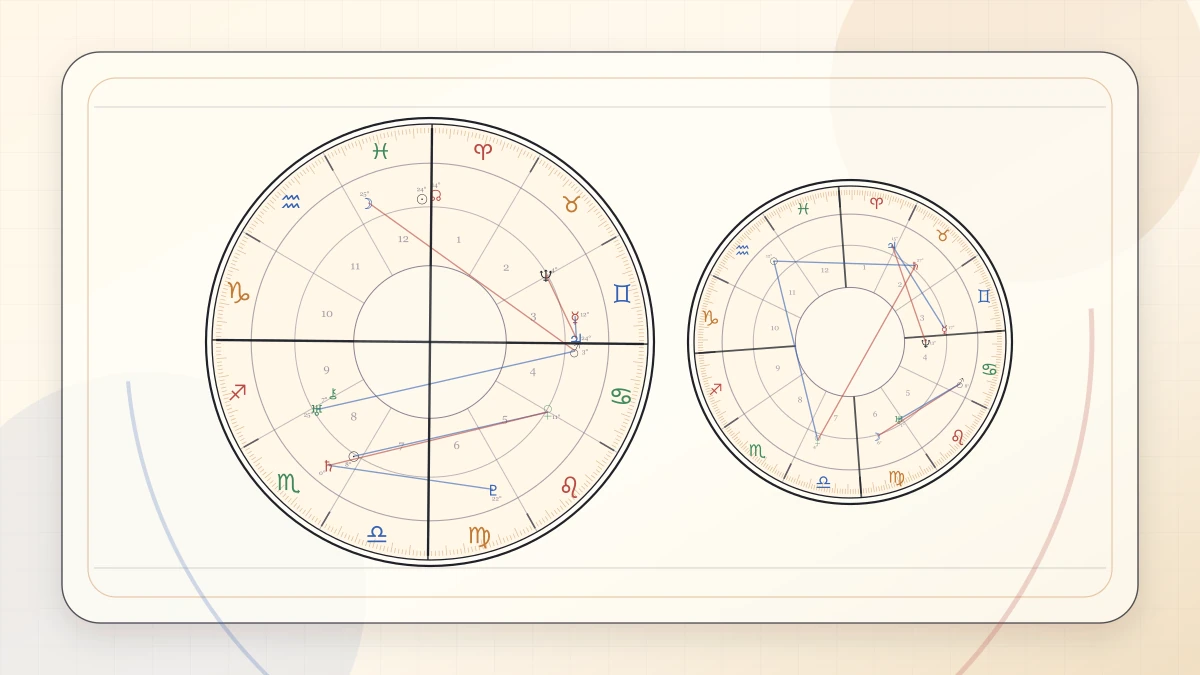
A transit is a planet’s current position in the sky, compared with a position in your birth chart. The planets in the sky today are the transit planets. The ones in your birth chart, frozen at the moment you were born, are the natal planets.
When a transit planet makes an aspect, an angle such as a square or an opposition, to a natal planet, astrologers read the pair together. The transit planet shows what is active, the natal planet shows which part of you it touches, and the aspect describes how the two meet.
Fast planets versus slow planets
Speed decides how much a transit matters. A contact from the Moon is over within hours and works like a passing mood note. A contact from Saturn lasts months and is a theme you live alongside. Reading them with equal weight is the main way beginners end up overreacting.
Speed is one of several things that decide how much attention a contact deserves. Rough durations for every planet are set out in our guide to how long transits last; the table here sorts the factors that should move a contact up or down your list.
| Factor | Give it more attention | Give it less attention |
|---|---|---|
| Moving planet | Saturn, Uranus, Neptune or Pluto, whose contacts last months | The Moon or the Sun, whose contacts pass in hours or days |
| Orb | Within about 1 degree of exact | Wider than about 3 degrees, or 1 degree for a fast planet |
| Natal point | The Sun, the Moon, the Ascendant or the chart ruler | A point you rarely use, unless the contact is very close |
| Your question | It touches the area you chose to ask about | It has nothing to do with what you asked |
| Repetition | Several contacts point to the same theme | One contact stands alone with nothing to echo it |
Which aspects and orbs to watch
Start with the major aspects only: conjunction (0 degrees), sextile (60), square (90), trine (120) and opposition (180). An orb is how far an aspect can be from exact and still count. Natal charts often allow 6 to 8 degrees, but for transits many astrologers tighten this to about 1 to 3 degrees for the slow planets and about 1 degree for the fast ones. There is no official figure, so pick one and apply it consistently.
Prefer contacts to the points that define you: the Sun, the Moon, the Ascendant and the chart ruler. A transit to an obscure point is worth noting only if it is very close.
Transits through the houses
A transit planet also passes through your houses, which are the twelve areas of life in your chart. A slow planet in a house describes a long stretch in which that area of life gets attention. Count houses the same way as in your birth chart: if you use whole-sign houses, each sign is one house counted from your Rising sign.
For example, with Virgo rising, Virgo is the first house, Libra the second and so on, so Capricorn is the fifth house. A slow planet in Capricorn would then focus on the fifth house topics of creativity, pleasure and play.
A three-step method for reading a transit
Use this order and stop when you have a single clear sentence.
- Choose the question and the window. Decide what you are asking about and over what span of weeks, so you are not reading everything in the sky.
- List the slow-planet contacts first. Find Saturn, Jupiter and the outer planets within your orb of a natal planet or angle, and check which house each is crossing. Add fast-planet contacts only to place timing inside that backdrop.
- Write one sentence per contact. Name the transit planet, the natal planet, the aspect and the house, then phrase the result as a question you can answer yourself.
A constructed example with the arithmetic
Take a made-up chart with natal Sun at 15 degrees of Cancer. The signs start at multiples of 30 degrees, and Cancer starts at 90, so the Sun is at 105 degrees. Now imagine a transit sky where Saturn is at 14 degrees of Capricorn, which is 270 plus 14, or 284 degrees. The gap is 284 minus 105, which is 179 degrees. That is within 1 degree of an opposition, so the contact is close.
Suppose Mars is at 14 degrees of Libra, which is 180 plus 14, or 194 degrees. The gap to the Sun is 194 minus 105, or 89 degrees, a square with an orb of 1, which is tight enough for a fast planet. Mars, at about half a degree a day, stays inside a 2-degree window for about four days, while Saturn, at about a degree a month, stays about two months, so you would read the Saturn contact as the backdrop and treat the Mars one as a brief spike of friction on top.
Keep a short log to test your reading
The best protection against overreacting is evidence of your own. Keep a log for six to eight weeks and judge whether your readings help.
- Date and the contact you are watching, with its orb.
- What you expected it to mean, written before the week begins.
- What actually happened, in a sentence, with no interpretation.
- At the end, count the weeks when the reading fit, the weeks it did not and the weeks it was too vague to judge.
A second constructed example: an aspect that crosses a sign line
Take a made-up natal Moon at 28 degrees of Taurus. Taurus starts at 30, so the Moon is at 58 degrees. Suppose transiting Jupiter is at 1 degree of Leo, or 121. As signs, Taurus and Leo sit 90 degrees apart, which suggests a square, but the degrees say otherwise. The gap is 121 minus 58, or 63 degrees, a sextile with an orb of 3. Measure the gap, not the sign names.
A second question is direction. An aspect that is still closing is called applying, and one that is opening again is called separating. Exact would be at 118 degrees, or 28 degrees of Cancer. Jupiter has already passed it, so this sextile is separating. At about 2.5 degrees a month, Jupiter took roughly a month to cover the 3 degrees since exact. With a 3 degree orb the contact is just inside, and with a tighter 2 degree orb it has already left.
Questions readers ask about transits
What if I do not know my birth time? Slow-planet contacts to your natal planets by sign and degree still work. Houses and angles cannot be set. The Moon is uncertain, because in one day it moves about 13 degrees, so Moon contacts are best left out.
Do I need to look at every contact? No. Choose the question, take the slow planets within your orb and add the fast ones only for timing, as in the three-step method above.
What this does and does not establish
Orbs and weightings are choices with no official figure, and a reading of current contacts is a prompt, not a forecast of events.
Related calculators
Use the matching tool when you want a direct chart or timing result after reading the guide.
Current Transits Calculator
Exact current-sky snapshot for a selected city, built for repeat-use daily astrology readers.
Transit to Natal Calculator
Exact current-sky comparison against one verified natal chart for more personal practical transit guidance.
Retrograde Calendar
Exact retrograde-period page for year-based planning, editorial planning, and current-sky timing checks.
Calculation references
- Swiss Ephemeris: positions, angles and house-system conventions
Technical reference for calculation conventions. It does not certify an interpretation or mean every live tool uses this engine.
Related articles
Keep reading with nearby topics that deepen the same question from another angle.
Yearly Astrology Guide
A yearly astrology guide maps the cycles that run through any twelve months, from the monthly Sun and Moon to slow Saturn, and separates checkable dates from symbolic interpretation.
6 min read
Solar Return Chart Guide: How to Read the Year Without Overpredicting It
A solar return chart is cast for the moment the Sun returns to its exact birth position, once a year near your birthday, and read as a yearly theme for planning rather than a forecast of events.
6 min read
How Planetary Transits Affect Your Birth Chart
Transits do not change your birth chart. A planet in today's sky forms an angle to a fixed natal point, and astrologers read that pairing as a prompt for attention.
6 min read
Transit-to-Natal Astrology for Beginners
Transit-to-natal astrology compares where a planet is now with where planets stood at your birth. Your natal point is the fixed reference, and the moving planet is the clock.
6 min read
Keep exploring
Use the category page and the main hubs when you want the next layer of context.
Previous article
How Planetary Transits Affect Your Birth Chart
Next article
Transit-to-Natal Astrology for Beginners