
Planetary Transits
Transit-to-Natal Astrology for Beginners
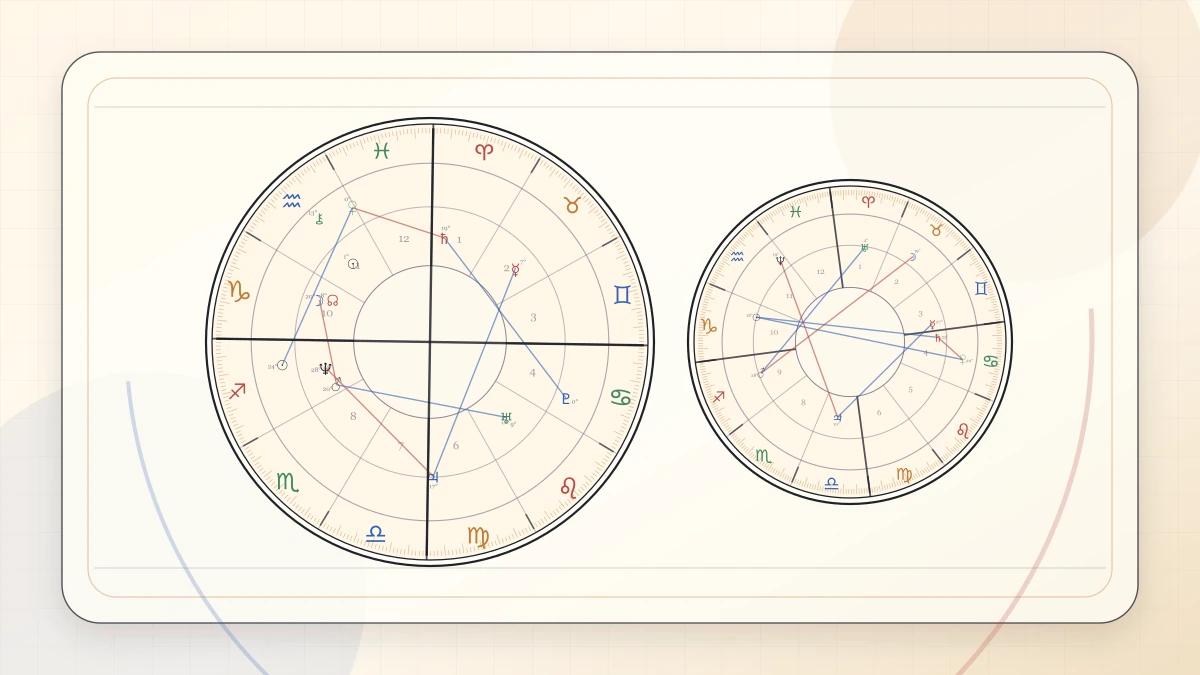
Transit-to-natal astrology compares where a planet is now with where planets stood at your birth. Your natal point is the fixed reference, and the moving planet is the clock.
Table of contents
- Example or practical exercise
- What “transit to natal” means in plain terms
- Seven words you need to read a transit list
- How to read one contact as a sentence
- What a contact looks like in a constructed chart
- What birth data you need to find your own contacts
- Applying, separating and the three passes
- Which transits to learn first
- Questions beginners ask about transits
- A first week of practice
- What this does and does not establish
Example or practical exercise
Ana's natal Venus is at 2 Scorpio, and transiting Mars at 29 Libra conjoins it at a 3-degree orb, about six days from exact, read as Mars pushing on what she values in closeness.
What “transit to natal” means in plain terms
Transit-to-natal astrology compares where a planet is now with where planets stood at your birth. “Transit” means a planet’s current position and “natal” means “of birth”. A contact is a pairing, written the way astrologers write it: transiting Venus trine natal Mars.
Natal-to-natal aspects, the ones in an ordinary birth chart reading, compare two birth positions that will never change. Transit-to-natal pairs do change, because one side keeps moving. Your natal point is the fixed reference and the transit is the clock.
Two planets that touch each other in today’s sky are a general event, shared by everyone. A contact turns personal only when one side is a point from a specific person’s chart.
Seven words you need to read a transit list
A transit list is mostly shorthand. These terms cover nearly all of it.
| Term | Plain meaning | Example |
|---|---|---|
| Transiting planet | The planet’s position on the day you check | Saturn at 12 Virgo |
| Natal planet | The planet’s position at birth | Sun at 14 Gemini |
| Aspect | The angle between them: 0, 60, 90, 120 or 180 degrees | A square is 90 |
| Orb | How far the angle is from exact | 2 degrees |
| Applying | The moving planet is heading toward exact | The gap is shrinking |
| Separating | The moving planet is leaving exact | The gap is growing |
| Pass | One crossing of the exact degree | Slow planets can make up to three |
How to read one contact as a sentence
A contact becomes readable when you turn it into a sentence with a fixed shape: transiting planet, angle, natal planet, house. Give each planet a short verb. The Moon reacts, the Sun spotlights, Mercury discusses, Venus appreciates, Mars pushes, Jupiter expands, Saturn tests and structures, and Uranus interrupts.
- Name the moving planet’s verb.
- Name what the natal planet stands for in your life, such as feelings, speech or taste.
- Name the angle’s quality: a conjunction merges the two, a sextile or trine lets them cooperate, a square or opposition sets them in tension.
- Add the house where the natal planet sits, which tells you the setting.
- Finish with one question that begins with “what” or “how”.
What a contact looks like in a constructed chart
Take a constructed person, Ana, with natal Venus at 2 Scorpio and natal Mercury at 20 Capricorn. Scorpio begins at 210, so Venus is at 212. Capricorn begins at 270, so Mercury is at 290.
Transiting Mars is at 29 Libra, which is 180 plus 29, or 209. The gap to natal Venus is 212 minus 209, which is 3 degrees, so the contact is a conjunction at a three degree orb, which is wide for a fast planet. Mars is moving about half a degree a day, so it reaches exact in roughly six days if it keeps moving direct, and the contact is applying.
Read as a sentence: Mars pushes on the part of Ana that values closeness and taste. A question might be how directly she asks for what she wants in a close tie. Meanwhile transiting Venus at 20 Pisces is at 350, and 350 minus 290 is 60, an exact sextile to natal Mercury: a small, easy opening for conversation.
What birth data you need to find your own contacts
Different parts of a transit reading call for different pieces of birth information.
- Birth date: enough for the planet positions, though the Moon’s natal position is uncertain without a time.
- Birth time: needed for the Ascendant, the Midheaven, the houses and a precise Moon.
- Birth place: needed with the time to build the houses and angles.
- The date you are checking: the transit side of every contact comes from this one date.
Applying, separating and the three passes
A contact has a before, a peak and an after. While the moving planet closes the gap, the angle is applying, and many readers feel the theme as anticipation. Once it passes exact and the gap widens, it is separating, and the theme tends to be read as settling.
Slow planets complicate this. Imagine natal Sun at 16 Taurus and transiting Saturn creeping forward to 19 Taurus. Saturn turns retrograde and backs up to 14 Taurus, which is five degrees of reverse travel, then turns direct and moves forward again. It has crossed 16 Taurus three times: forward, backward and forward. Each crossing is a pass, so one contact is read as a first meeting, a revisit and a final resolution over a long span.
Which transits to learn first
Start small. Choose the Sun, the Moon and the Ascendant as natal targets, because they are the points most people already know. Then watch only Jupiter and Saturn as the moving planets. That gives you a short list of slow contacts to track without drowning in daily Moon angles.
Once that feels comfortable, add one fast planet, such as Venus or Mars, for a rhythm you can feel within a week. Add the outer planets last, since their contacts last for many months and rarely produce anything you can pin to a day.
Questions beginners ask about transits
Are transits good or bad? Older astrology did sort planets and angles into helpful and difficult ones, calling Jupiter and Venus benefics and Saturn and Mars malefics, but many modern astrologers avoid that sorting. An easy angle can mean a lack of pressure, and a hard one can mean a push toward action. Both are read as invitations to notice something.
Is a transit chart the same as a transit-to-natal reading? Not quite. A chart for today’s sky alone shows no personal data. The transit-to-natal step is what ties it to you.
How tight must an angle be? There is no official rule. Many astrologers use one to three degrees for slow planets and about one degree for quick ones.
Do transits happen to everyone? Everyone has contacts at all times, and most pass without anything you would call dramatic.
A first week of practice
Pick one contact from your own chart and write it as a sentence. Note the orb and whether it is applying or separating. For seven days, jot down one line each evening about what stood out, then compare your notes with the sentence you wrote.
If the match is weak, that is useful information. A transit is a vocabulary for asking questions about your week, and you decide whether the questions were worth asking.
What this does and does not establish
Most contacts pass without anything dramatic, and a transit gives you questions to ask about your week, not a verdict on it.
Related calculators
Use the matching tool when you want a direct chart or timing result after reading the guide.
Current Transits Calculator
Exact current-sky snapshot for a selected city, built for repeat-use daily astrology readers.
Transit to Natal Calculator
Exact current-sky comparison against one verified natal chart for more personal practical transit guidance.
Retrograde Calendar
Exact retrograde-period page for year-based planning, editorial planning, and current-sky timing checks.
Calculation references
- Swiss Ephemeris: positions, angles and house-system conventions
Technical reference for calculation conventions. It does not certify an interpretation or mean every live tool uses this engine.
Related articles
Keep reading with nearby topics that deepen the same question from another angle.
Yearly Astrology Guide
A yearly astrology guide maps the cycles that run through any twelve months, from the monthly Sun and Moon to slow Saturn, and separates checkable dates from symbolic interpretation.
6 min read
Solar Return Chart Guide: How to Read the Year Without Overpredicting It
A solar return chart is cast for the moment the Sun returns to its exact birth position, once a year near your birthday, and read as a yearly theme for planning rather than a forecast of events.
6 min read
How to Read Current Transits Without Overreacting to Every Aspect
Choose your question first, list the slow-planet contacts within a tight orb, then add fast ones only for timing. A Saturn contact lasting months outweighs a Moon contact lasting hours.
6 min read
Uranus Transit Meaning
A Uranus transit is a slow contact, often lasting a year or more with up to three exact hits, that astrologers read as a push toward change, independence and fresh experiments.
6 min read
Keep exploring
Use the category page and the main hubs when you want the next layer of context.
Previous article
How to Read Current Transits Without Overreacting to Every Aspect
Next article
Uranus Transit Meaning