
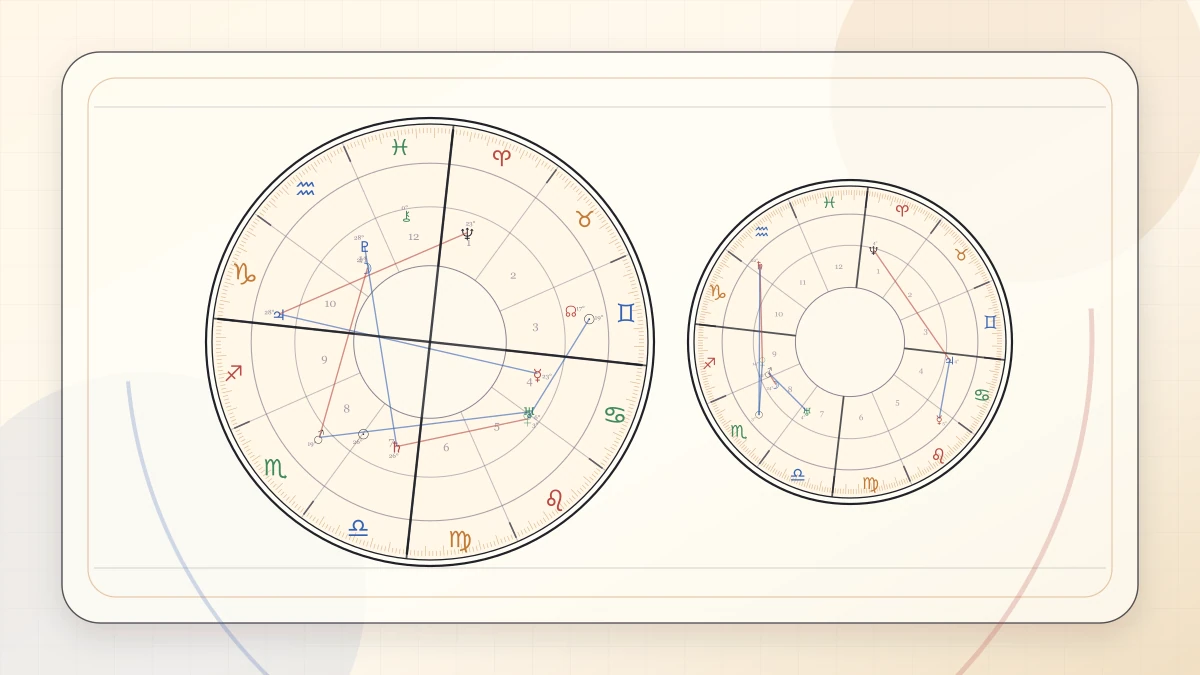
Planetary Transits
Uranus Transit Meaning
A Uranus transit is a slow contact, often lasting a year or more with up to three exact hits, that astrologers read as a push toward change, independence and fresh experiments.
Table of contents
- Example or practical exercise
- What Uranus represents: change, independence and restlessness
- The ages when Uranus touches its own birth place
- What a Uranus contact to a planet or angle can look like
- Why a Uranus contact lasts a year or more and can happen three times
- The Uranus opposition in the early forties
- A constructed example: Uranus approaching a natal Sun
- Why Uranus is described as generational
- A reflective method: the reversible experiment
- A second constructed example: a contact that crosses 0 degrees of Aries
- Questions readers ask about Uranus
- What this does and does not establish
Example or practical exercise
Transiting Uranus at 13 degrees of Leo nears a square to natal Sun at 15 Taurus, a window of about 11 months; the person tries one small, reversible change and names one commitment to keep.
What Uranus represents: change, independence and restlessness
Uranus takes about 84 years to circle the zodiac and about 7 years to cross each sign. It is the modern ruler of Aquarius, and astrologers describe it as the planet of the unexpected: change that arrives from outside the usual pattern, the urge to be independent, and restlessness with anything that has gone stale.
Where Saturn conserves, Uranus disrupts and experiments. The tradition sees both sides: freedom, originality and fresh air, and also abruptness, detachment and a habit of cutting ties before asking what could be repaired.
The ages when Uranus touches its own birth place
With a cycle of about 84 years, you can estimate when Uranus has traveled each quarter of the way back to the degree it held at your birth. These are averages, because Uranus does not move at a perfectly even pace.
| Distance traveled | Part of the cycle | Approximate age | Common name |
|---|---|---|---|
| 90 degrees | A quarter | About 21 | First square |
| 180 degrees | Half | About 40 to 42 | Uranus opposition |
| 270 degrees | Three quarters | About 63 | Second square |
| 360 degrees | Full circle | About 84 | Uranus return |
What a Uranus contact to a planet or angle can look like
A Uranus contact means Uranus is at the same degree as a natal point (conjunction), 90 degrees from it (square) or 180 degrees from it (opposition). A working orb of about 1 to 3 degrees either side of exact is common, with no official standard.
- Conjunction: the point’s themes get a jolt of novelty. Uranus on the natal Moon is read as emotional restlessness and a wish for more independence at home.
- Square: pressure between the old arrangement and the urge to change it, usually felt as friction rather than a single event.
- Opposition: change tends to arrive through other people or circumstances, not only your own choice.
- Angles: the Ascendant concerns how you present yourself, the Midheaven your direction and public role, the IC home and roots, and the Descendant close partnerships.
Why a Uranus contact lasts a year or more and can happen three times
Uranus averages about 4 degrees a year, since 360 divided by 84 is about 4.3. A contact counted within 2 degrees either side of exact spans about 4 degrees, which is close to a year of steady forward motion.
Uranus is retrograde for roughly five months of every year. When it turns back over the point, the contact becomes exact going forward, again going backward and once more going forward. One transit can therefore hold three exact hits spread over a year or two. Many astrologers read the first as the theme introduced, the second as a reconsideration, and the third as the question settled.
The Uranus opposition in the early forties
At about age 40 to 42, Uranus sits opposite its own birth place. Popular writing calls this a midlife awakening. The tradition’s wording is milder: a stretch when the structures you built in your twenties and thirties are weighed against who you have become.
For most people Neptune is also square its own natal position in the same years, so the early forties carry two slow contacts at once. Neither is an event. Plenty of people pass through those years with nothing dramatic, and no chart can tell whether a person will change jobs, move or end a relationship.
A constructed example: Uranus approaching a natal Sun
This chart is made up, in a made-up sky. Natal Sun is at 15 degrees of Taurus, and transiting Uranus is at 13 degrees of Leo. Taurus and Leo are three signs apart, so they are square, and the aspect is exact when Uranus reaches 15 degrees of Leo.
The arithmetic: Uranus has 2 degrees to travel, and 2 divided by 4.3 is about half a year. A 2-degree orb ends at 17 Leo, so the window runs from 13 to 17 Leo, which is 4 degrees, and 4 divided by 4.3 is about 0.93 years, or roughly 11 months of forward motion. A retrograde turn could add two more exact hits.
A person with this contact might ask which part of their identity runs on habit, and which small change they would try first.
Why Uranus is described as generational
Uranus stays about seven years in a sign, so a cluster of birth years shares its sign. The tradition treats that as a generation’s style of innovation or rebellion. What is personal is the house it occupies for you, the aspects it makes to your planets and the timing of your own contacts.
A reflective method: the reversible experiment
Uranus asks for experiments, not escapes. No Uranus transit requires quitting a job or ending a relationship, and the steps below keep the change small enough to learn from.
- Name the planet or angle touched, the exact angle and the orb.
- Write one sentence on what that point governs in your life.
- List what feels stale or confining in that area, and what you would miss if it changed.
- Choose one change that is small and reversible, such as a different routine for a month.
- Name one commitment you intend to keep, so that freedom does not turn into drift.
- Check in at each exact pass and record what the experiment taught you.
A second constructed example: a contact that crosses 0 degrees of Aries
Wrap-around arithmetic trips people up, so here is a case at the start of the zodiac. This chart is made up, in a made-up sky. Natal Venus is at 28 degrees of Pisces, which is 330 plus 28, or 358. Transiting Uranus is at 1 degree of Aries, which is 1. The raw difference is 357, but the short way around the circle is 360 minus 357, or 3 degrees.
So Uranus is 3 degrees past a conjunction with Venus. Moving forward at about 4.3 degrees a year, that exact hit came about 0.7 years ago (3 divided by 4.3), and the contact is separating, though it is still inside a 3-degree orb. Venus concerns values and affection, so this person might ask what they now value that they once took for granted.
Questions readers ask about Uranus
Why do traditional astrologers not mention Uranus? It was not found until 1781, long after the traditional system was set, so older texts treat Saturn as the outermost planet. Its astrological meanings come from modern interpretation and not from ancient doctrine.
Does a Uranus contact need an exact birth time? Mostly not, because Uranus moves slowly. Contacts to the Ascendant are the main exception, and the natal Moon is another, since it moves about 13 degrees a day. One degree of Ascendant is about 4 minutes of birth time, so a 20-minute error shifts the point about 5 degrees, which is more than a year of Uranus’s motion.
What this does and does not establish
No Uranus transit requires quitting a job, moving or ending a relationship, and no chart can tell whether such changes will happen.
Related calculators
Use the matching tool when you want a direct chart or timing result after reading the guide.
Current Transits Calculator
Exact current-sky snapshot for a selected city, built for repeat-use daily astrology readers.
Transit to Natal Calculator
Exact current-sky comparison against one verified natal chart for more personal practical transit guidance.
Retrograde Calendar
Exact retrograde-period page for year-based planning, editorial planning, and current-sky timing checks.
Calculation references
- Swiss Ephemeris: positions, angles and house-system conventions
Technical reference for calculation conventions. It does not certify an interpretation or mean every live tool uses this engine.
Related articles
Keep reading with nearby topics that deepen the same question from another angle.
Yearly Astrology Guide
A yearly astrology guide maps the cycles that run through any twelve months, from the monthly Sun and Moon to slow Saturn, and separates checkable dates from symbolic interpretation.
6 min read
Solar Return Chart Guide: How to Read the Year Without Overpredicting It
A solar return chart is cast for the moment the Sun returns to its exact birth position, once a year near your birthday, and read as a yearly theme for planning rather than a forecast of events.
6 min read
Transit-to-Natal Astrology for Beginners
Transit-to-natal astrology compares where a planet is now with where planets stood at your birth. Your natal point is the fixed reference, and the moving planet is the clock.
6 min read
Neptune Transit Meaning
A Neptune transit is a slow contact, often lasting about two years, that astrologers read as a time when certainty softens, ideals get tested and facts need extra checking.
6 min read
Keep exploring
Use the category page and the main hubs when you want the next layer of context.
Previous article
Transit-to-Natal Astrology for Beginners
Next article
Neptune Transit Meaning