
Planetary Transits
Neptune Transit Meaning
A Neptune transit is a slow contact, often lasting about two years, that astrologers read as a time when certainty softens, ideals get tested and facts need extra checking.
Table of contents
- Example or practical exercise
- What Neptune stands for in astrology
- Neptune’s 165-year cycle and the ages it reaches
- What a Neptune contact to a natal planet or angle means
- Why a Neptune transit lasts a year or more and can repeat three times
- Typical Neptune themes: ideals, doubt and dissolving certainty
- Why Neptune is called a generational planet
- A constructed example: Neptune approaching a natal Mercury
- A reflective method for a Neptune contact
- Questions readers ask about Neptune contacts
- What this does and does not establish
Example or practical exercise
Transiting Neptune at 20 degrees of Virgo approaches natal Mercury at 22 Gemini; with a 2-degree orb the square spans about 1.8 years, a prompt to list what you have verified, assumed and do not yet know.
What Neptune stands for in astrology
Neptune is the outermost of the eight planets and too faint to see without a telescope, which suits what astrologers have made of it. In the modern tradition it stands for imagination, ideals, compassion and the sense that the world is larger than what can be measured. It is also linked with the other side of those gifts: haze, wishful thinking and difficulty telling what is real from what is hoped for.
Modern astrologers give Neptune to Pisces. Where Saturn draws edges, Neptune dissolves them. A Neptune transit is therefore read as a stretch when certainty softens, ideals get tested, and you are invited to ask what you are actually committed to.
Neptune’s 165-year cycle and the ages it reaches
Neptune takes about 165 years to circle the zodiac and spends about 14 years in each sign. Nobody lives long enough to see it return to its birth degree, so the contacts that matter in a life are partial ones: Neptune forming an angle to its own natal position.
| Angle | Share of the cycle | Approximate age |
|---|---|---|
| Sextile, 60 degrees | One sixth | About 27 |
| Square, 90 degrees | One quarter | About 41 |
| Trine, 120 degrees | One third | About 55 |
| Opposition, 180 degrees | One half | About 82 |
What a Neptune contact to a natal planet or angle means
A transit contact means Neptune is at the same degree as a point in your birth chart (a conjunction), 90 degrees from it (a square) or 180 degrees from it (an opposition). The point can be a planet or an angle: the Ascendant, Descendant, Midheaven or IC. An orb is the gap from exact that you still count. There is no official figure, and for slow planets about 1 to 3 degrees either side is common.
| Contact | Tone usually described |
|---|---|
| Conjunction | The point takes on Neptune’s themes: imagination grows and outlines blur |
| Square | Ideals meet practical limits, and disillusionment is the usual word |
| Opposition | Projection: seeing other people as better or worse than they are |
Why a Neptune transit lasts a year or more and can repeat three times
Neptune covers about 2 degrees of the zodiac a year on average, since 360 divided by 165 is about 2.2. If you count anything within 2 degrees either side of exact, the window is about 4 degrees wide, and crossing it takes close to two years.
Neptune also turns retrograde for several months each year, which means it appears to move backward as seen from Earth. A contact that first becomes exact while Neptune is moving forward can be crossed again on the way back, then a third time when Neptune turns direct. Astrologers often read the first pass as the theme arriving, the second as reconsideration and the third as settling. That is a custom, not a rule.
Typical Neptune themes: ideals, doubt and dissolving certainty
Astrologers describe these themes in broad strokes, and any one of them can be absent in a given person’s experience.
- Ideals: a sharper picture of how work, love or belief should be, and a stronger pull toward it.
- Doubt: positions you were sure of feel less solid, which can be unsettling or a relief.
- Dissolving certainty: old roles and plans lose clear edges before new ones form.
- Imagination and sensitivity: music, art, spiritual interest and empathy may feel more vivid.
- Blur: details and facts need extra checking, and it is easier to see what you hope to see.
Why Neptune is called a generational planet
Because Neptune stays about 14 years in a sign, everyone born across that span has it in the same sign. Astrologers read that shared placement as a generation’s ideal or collective dream, not a personal trait. What makes it yours is the house it occupies in your chart and the aspects it makes to your own planets.
A Neptune transit is not a diagnosis. It is not evidence of deception, addiction or any condition of mind or body, and many people notice nothing dramatic during one. Doubt, as the tradition uses it, is a prompt to clarify, not a reason to accuse anyone.
A constructed example: Neptune approaching a natal Mercury
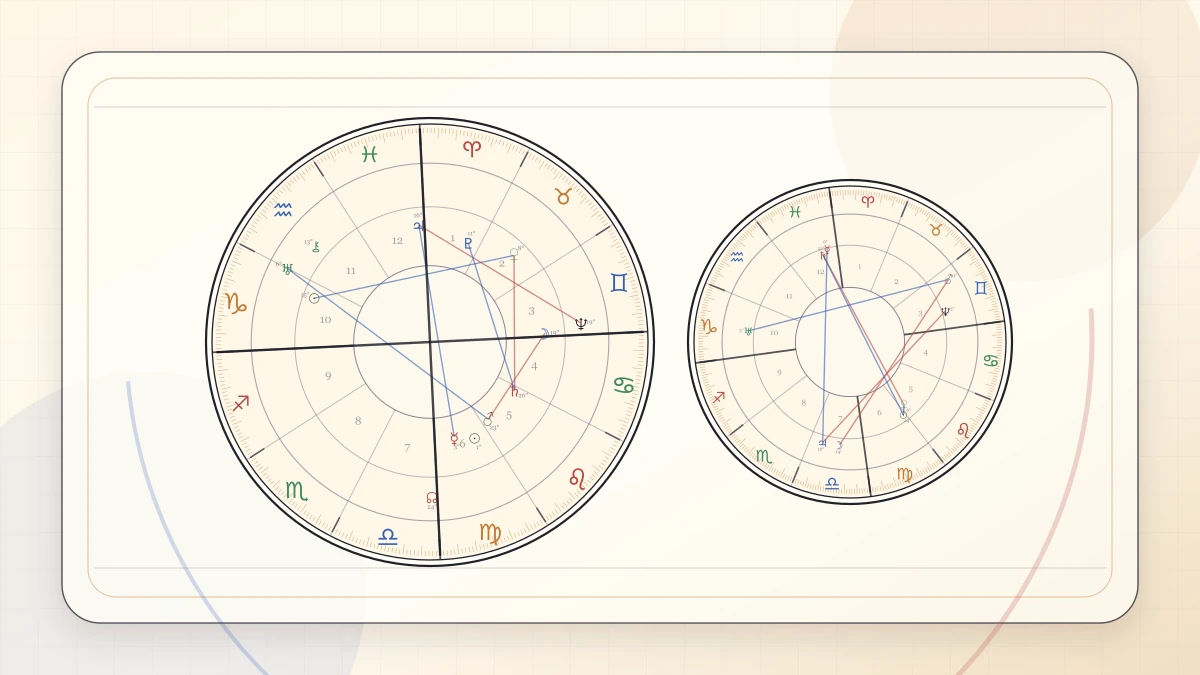
This chart is made up, in a made-up sky. Natal Mercury is at 22 degrees of Gemini, and transiting Neptune is at 20 degrees of Virgo. Gemini and Virgo are three signs apart, which is 90 degrees, so the square is exact when Neptune reaches 22 degrees of Virgo.
Neptune is 2 degrees short. At about 2.2 degrees a year, exactness is a little under a year away. A 2-degree orb ends at 24 degrees of Virgo, so the contact spans 20 to 24 Virgo, which is 4 degrees, or roughly 1.8 years of steady motion. A retrograde turn could add two more exact hits inside that window.
Mercury governs thinking and talk, so this person might spend about two years asking where a plan or a belief rests on something they have never checked.
A reflective method for a Neptune contact
The transit supplies a question. You supply the answer, in plain facts.
- Write down which natal planet or angle is touched, the angle (conjunction, square or opposition) and the orb.
- Note whether Neptune is direct or retrograde, and how many exact passes the contact may make.
- Write the touched point’s subject in one line: Mercury is thinking and talk, Venus is values and affection, the Midheaven is public direction.
- Make three lists for that area of life: what you have verified, what you are assuming, and what you do not know yet.
- Pick one assumption and check it concretely, by asking a direct question or reading the actual document.
- Revisit the lists around each exact pass and note what changed.
Questions readers ask about Neptune contacts
Do sextiles and trines from Neptune count? Some astrologers read them, with a smaller orb, as a gentler version of the same themes: imagination and sensitivity without the push to doubt. Squares and oppositions get most of the attention because friction is easier to notice, and that is the convention followed here.
Do I need an exact birth time? Rarely, for contacts to most planets, because Neptune moves only about 2 degrees a year. The natal Moon is an exception, since it moves about 13 degrees a day and its place is uncertain without a time. Contacts to the angles are different. The Ascendant moves about 1 degree every 4 minutes, so a 20-minute error shifts it about 5 degrees, which is more than two years of Neptune’s motion.
Is Neptune entering a new sign a personal event? It happens about every 14 years and is read as a generational shift. Whether it touches you personally depends on what it aspects in your own chart.
What this does and does not establish
A Neptune transit is not evidence of deception, addiction or any condition of mind or body, and doubt is no reason to accuse anyone.
Related calculators
Use the matching tool when you want a direct chart or timing result after reading the guide.
Current Transits Calculator
Exact current-sky snapshot for a selected city, built for repeat-use daily astrology readers.
Transit to Natal Calculator
Exact current-sky comparison against one verified natal chart for more personal practical transit guidance.
Retrograde Calendar
Exact retrograde-period page for year-based planning, editorial planning, and current-sky timing checks.
Calculation references
- Swiss Ephemeris: positions, angles and house-system conventions
Technical reference for calculation conventions. It does not certify an interpretation or mean every live tool uses this engine.
Related articles
Keep reading with nearby topics that deepen the same question from another angle.
Yearly Astrology Guide
A yearly astrology guide maps the cycles that run through any twelve months, from the monthly Sun and Moon to slow Saturn, and separates checkable dates from symbolic interpretation.
6 min read
Solar Return Chart Guide: How to Read the Year Without Overpredicting It
A solar return chart is cast for the moment the Sun returns to its exact birth position, once a year near your birthday, and read as a yearly theme for planning rather than a forecast of events.
6 min read
Uranus Transit Meaning
A Uranus transit is a slow contact, often lasting a year or more with up to three exact hits, that astrologers read as a push toward change, independence and fresh experiments.
6 min read
Pluto Transit Meaning
A Pluto transit is a slow contact lasting about one and a half to four years, which astrologers read as restructuring: power, depth and what remains when something is stripped back.
6 min read
Keep exploring
Use the category page and the main hubs when you want the next layer of context.
Previous article
Uranus Transit Meaning
Next article
Pluto Transit Meaning