
Planetary Transits
Pluto Transit Meaning
A Pluto transit is a slow contact lasting about one and a half to four years, which astrologers read as restructuring: power, depth and what remains when something is stripped back.
Table of contents
- Example or practical exercise
- What Pluto stands for: power, depth and endings
- Pluto’s uneven orbit compared with the other slow planets
- What Pluto does when it contacts a natal planet or angle
- Why a Pluto contact can last about one and a half to four years
- Why Pluto is called generational, and what is personal about it
- A constructed example: Pluto approaching the Ascendant
- A reflective method for a Pluto contact
- When a chart is not the right resource
- A second constructed example: the slow stretch of Pluto’s orbit
- Questions readers ask about Pluto contacts
- What this does and does not establish
Example or practical exercise
Transiting Pluto at 7 degrees of Cancer squares a natal Ascendant at 9 Libra over a window of about 2.7 years, prompting one boundary or responsibility to renegotiate in plain words.
What Pluto stands for: power, depth and endings
Pluto is the planet astrologers associate with the deepest layer of change: power, control, loss, and renewal after something has run its course. Modern astrologers treat it as the ruler of Scorpio, the sign of depth and of what is kept private. Astronomers classify Pluto as a dwarf planet, but astrologers have kept it as a chart point.
The word the tradition leans on is restructuring. Pluto is not the planet of sudden surprise, which is Uranus, or of dissolving certainty, which is Neptune. It concerns what remains when something is stripped back to its foundations, and who holds the authority to rebuild it.
Pluto’s uneven orbit compared with the other slow planets
Pluto’s orbit is very elongated, so its speed changes a great deal. It takes about 248 years to circle the zodiac, but the time it spends in one sign runs from about 12 years to about 31.
| Planet | Around the zodiac | Time in one sign |
|---|---|---|
| Saturn | About 29.5 years | About 2.5 years |
| Uranus | About 84 years | About 7 years |
| Neptune | About 165 years | About 14 years |
| Pluto | About 248 years | About 12 to 31 years |
What Pluto does when it contacts a natal planet or angle
Pluto contacts are counted like other slow transits: a conjunction at 0 degrees, a square at 90 or an opposition at 180, usually within about 1 to 3 degrees. Because Pluto’s orbit is so uneven, there is no reliable table of ages for these contacts. Only a transit calculation for your own chart dates them fairly.
Astrologers read the conjunction as the most concentrated, the square as pressure with friction, and the opposition as reflected through other people such as partners, rivals and authorities. The point touched sets the subject.
- Natal Sun: identity and authority, meaning who decides who you are.
- Natal Moon: deep feelings, attachments and what you need in order to feel secure.
- Natal Venus: values and the terms of closeness.
- Natal Mars: how you assert yourself and use force.
- Ascendant: how you meet the world and begin things.
- Midheaven: role, reputation and responsibility.
- IC: family, roots and what a home is built on.
Why a Pluto contact can last about one and a half to four years
Pluto’s pace runs from about 1 degree a year to about 2.5 degrees a year. Count 2 degrees either side of exact and the window is 4 degrees wide. At the fast end, 4 divided by 2.5 is about 1.6 years. At the slow end, 4 divided by 1 is 4 years.
Pluto is retrograde for several months of each year, so a contact can be exact three times: a forward pass, a backward pass and a final forward pass. The whole contact tends to read as one long chapter, not a single week.
Why Pluto is called generational, and what is personal about it
At 12 to 31 years in a sign, Pluto marks a whole cohort. People born across that span share the sign, and astrologers read it as the generation’s relationship to power, institutions and what must be reshaped. The sign says little about one person.
The personal part is the house Pluto occupies in your chart, the planets it touches by aspect and the timing of its transits to them. Two people with the same Pluto sign can have very different contacts.
A constructed example: Pluto approaching the Ascendant
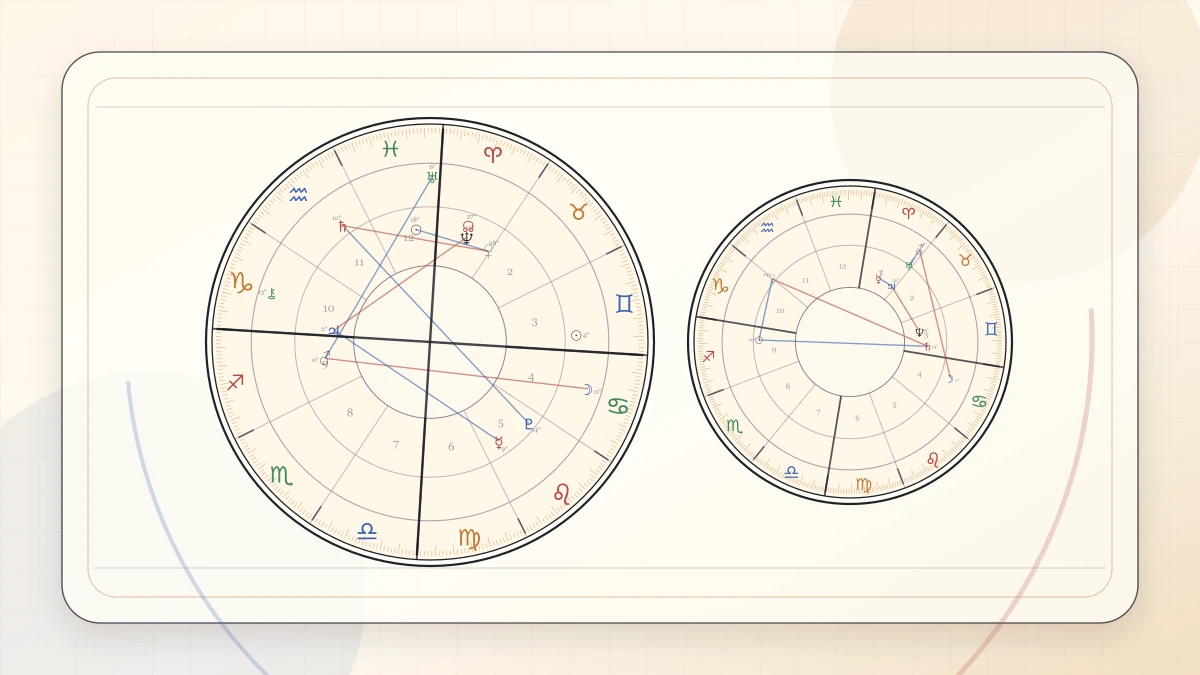
This chart is made up, in a made-up sky. The natal Ascendant is at 9 degrees of Libra, and transiting Pluto is at 7 degrees of Cancer. Libra and Cancer are three signs apart, so they are square, and the aspect is exact at 9 degrees of Cancer.
Pluto has 2 degrees to go. If it moves about 1.5 degrees a year, that is 2 divided by 1.5, roughly 16 months. The orb runs to 11 Cancer, so the window is 4 degrees, about 2.7 years at that pace, and retrograde can add repeats.
Birth time matters here. The Ascendant moves about 1 degree every 4 minutes, so a 2-degree orb equals about 8 minutes of birth time. If the recorded time is 20 minutes off, the Ascendant shifts about 5 degrees and the whole timing shifts with it. Contacts to the Sun or most other planets are far less sensitive to birth time; the Moon is the exception, since it moves about 13 degrees a day.
A reflective method for a Pluto contact
The tradition describes depth work, not catastrophe. A Pluto contact does not predict death, loss or harm, and many people notice nothing dramatic.
- Identify the point Pluto touches and whether it forms a conjunction, square or opposition.
- Write what that point governs in plain terms, such as how you present yourself and start things.
- List where you hold power, where you feel you lack it, and which arrangements were set long ago and never reviewed.
- Ask which arrangements still fit and which you keep out of habit.
- Choose one boundary or responsibility to renegotiate in real circumstances, in words rather than guesses.
- Review at each exact pass and note what changed.
When a chart is not the right resource
If a hard period is under way for real reasons, a trusted person or a qualified professional is a better resource than a transit. A Pluto contact can offer a vocabulary for reflection after the fact. It cannot explain or fix what is happening.
A second constructed example: the slow stretch of Pluto’s orbit
The first example used about 1.5 degrees a year. Here is a case at the slow end, about 1 degree a year, which makes a contact last longer. This chart is made up, in a made-up sky. Natal Venus is at 20 degrees of Capricorn, which is 270 plus 20, or 290. The opposite point is 290 minus 180, or 110, which is 20 degrees of Cancer. Transiting Pluto is at 18 degrees of Cancer, or 108, so it is 2 degrees from the opposition.
At 1 degree a year, exactness is about 2 years away. A 2-degree orb on each side gives a window from 18 to 22 Cancer, which is 4 degrees, so about 4 years of forward motion before any retrograde repeats. Venus concerns values and closeness, and an opposition is read as arriving through other people, so this person might ask what they expect from others in close relationships that they have never said aloud.
Questions readers ask about Pluto contacts
Does it matter that Pluto is a dwarf planet? Astronomers reclassified it in 2006, but astrologers use chart points for their symbolism and not their size, and Pluto has been used since its discovery in 1930. The classification does not change the arithmetic of a contact.
Can I look up the age at which Pluto touches my Sun? Not from a table, because Pluto’s speed varies too much. Use a transit tool for your own chart and read the dates it gives against your natal degrees.
What this does and does not establish
A Pluto contact does not predict death, loss or harm, and its timing to an angle shifts if the recorded birth time is off.
Related calculators
Use the matching tool when you want a direct chart or timing result after reading the guide.
Current Transits Calculator
Exact current-sky snapshot for a selected city, built for repeat-use daily astrology readers.
Transit to Natal Calculator
Exact current-sky comparison against one verified natal chart for more personal practical transit guidance.
Retrograde Calendar
Exact retrograde-period page for year-based planning, editorial planning, and current-sky timing checks.
Calculation references
- Swiss Ephemeris: positions, angles and house-system conventions
Technical reference for calculation conventions. It does not certify an interpretation or mean every live tool uses this engine.
Related articles
Keep reading with nearby topics that deepen the same question from another angle.
Yearly Astrology Guide
A yearly astrology guide maps the cycles that run through any twelve months, from the monthly Sun and Moon to slow Saturn, and separates checkable dates from symbolic interpretation.
6 min read
Solar Return Chart Guide: How to Read the Year Without Overpredicting It
A solar return chart is cast for the moment the Sun returns to its exact birth position, once a year near your birthday, and read as a yearly theme for planning rather than a forecast of events.
6 min read
Neptune Transit Meaning
A Neptune transit is a slow contact, often lasting about two years, that astrologers read as a time when certainty softens, ideals get tested and facts need extra checking.
6 min read
Mercury Retrograde Calendar Guide
A Mercury retrograde calendar lists the two stations, when Mercury appears to stop and reverse, and often shadow periods. Check its time zone and whether shadows are included before relying on it.
6 min read
Keep exploring
Use the category page and the main hubs when you want the next layer of context.
Previous article
Neptune Transit Meaning
Next article
Mercury Retrograde Calendar Guide