
Planetary Transits
How Planetary Transits Affect Your Birth Chart
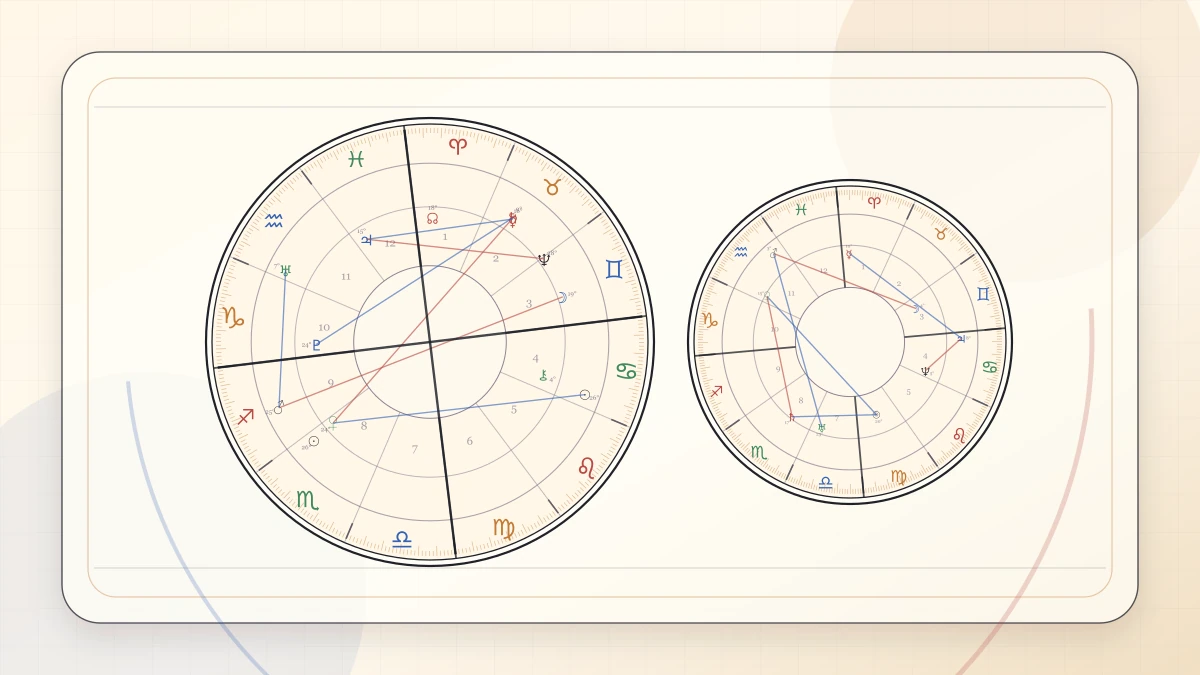
Transits do not change your birth chart. A planet in today's sky forms an angle to a fixed natal point, and astrologers read that pairing as a prompt for attention.
Table of contents
- Example or practical exercise
- What changes and what stays fixed when a planet transits
- Fast planets and slow planets: how long a contact lasts
- Which part of your chart a transit can touch
- Checking four contacts by arithmetic on a constructed chart
- What the arithmetic shows
- How to scan your own chart for transits
- Why the same transit reads differently for two people
- Common questions about transits and the birth chart
- A simple transit log to keep for a month
- What this does and does not establish
Example or practical exercise
For Sam, transiting Saturn at 12 Virgo is checked against four natal points; only the square to his Sun at 14 Gemini, 2 degrees from exact, is tight enough to count.
What changes and what stays fixed when a planet transits
Your birth chart is a snapshot: the positions of the Sun, Moon and planets at the moment you were born, frozen in the zodiac. It never moves. A transit is a planet’s position on some other day, laid over that snapshot. When astrologers say a transit “affects” the chart, they mean that a planet in the sky is now at a notable angle to a point in your chart, and the tradition attaches a theme to that pairing.
Nothing in the chart itself changes. The “effect” is interpretive: the question the contact raises about what is being tested, started or reconsidered. Treat it as a prompt for attention, not a mechanism.
Every transit reading therefore has three parts: the planet that is moving, the natal point it touches, and the angle between them. Leave any one out and you have a headline instead of a reading.
Fast planets and slow planets: how long a contact lasts
The same angle reads differently depending on how fast the moving planet travels, because speed sets how long a contact lasts and how often it returns. The figures below are rough averages.
| Planet | Rough pace | What a contact tends to feel like |
|---|---|---|
| Moon | about 13 degrees a day; a degree in a couple of hours | A passing mood or the tone of an afternoon |
| Sun | about 1 degree a day | A few days of emphasis on one theme |
| Mercury, Venus, Mars | a day to a few weeks per contact, depending on speed and retrograde | A short episode in talk, affection or drive |
| Jupiter | about a year per sign, so weeks per degree | A season in which one topic grows larger |
| Saturn | about two and a half years per sign, so weeks to a couple of months per degree | A long stretch of sorting out limits and commitments |
| Uranus, Neptune, Pluto | many months per degree | A slow background theme that many people barely notice |
Which part of your chart a transit can touch
Natal points carry different weight, and a transit reaches your chart in three distinct ways. Knowing which way you are looking at keeps a reading specific.
- An aspect to a natal planet: the most specific kind. Read the nature of the moving planet together with the nature of the planet it touches.
- An aspect to an angle, meaning the Ascendant, Descendant, Midheaven or Imum Coeli. This needs a trustworthy birth time, and it concerns how you meet the world, your public role, your close partnerships and your home base.
- A passage through a house: the background setting. While the planet stays in a house, the area of life that house names tends to come into focus. Jupiter spends about a year in a typical house and Saturn about two to three years, varying with the size of the house.
Checking four contacts by arithmetic on a constructed chart
Zodiac positions become a single number from 0 to 360, called longitude, when you add 30 for each sign passed since the start of Aries. Taurus begins at 30, Gemini at 60, Cancer at 90, Leo at 120, Virgo at 150, Libra at 180, Scorpio at 210, Sagittarius at 240, Capricorn at 270, Aquarius at 300 and Pisces at 330.
Take a constructed person, Sam, with natal Sun at 14 Gemini (74), Mercury at 8 Cancer (98), Venus at 21 Cancer (111) and Moon at 3 Libra (183). Transiting Saturn sits at 12 Virgo, which is 150 plus 12, or 162. Subtract and compare each gap with the set angles of 0, 60, 90, 120 and 180.
| Natal point | Longitude | Gap | Nearest set angle |
|---|---|---|---|
| Sun | 74 | 162 - 74 = 88 | Square (90), 2 degrees from exact |
| Mercury | 98 | 162 - 98 = 64 | Sextile (60), 4 degrees from exact |
| Venus | 111 | 162 - 111 = 51 | Sextile (60), 9 degrees off |
| Moon | 183 | 183 - 162 = 21 | None close enough |
What the arithmetic shows
With the usual orb of one to three degrees for a slow planet, only the Sun contact counts: Saturn is square Sam’s natal Sun, two degrees from exact. The Mercury sextile, at four degrees, would count only for an astrologer using a wide orb, and there is no single official figure.
Out of four possible pairings, one stands out. That filtering is most of the skill: deciding which angles are tight enough, slow enough and personal enough to deserve a sentence.
How to scan your own chart for transits
You can work by hand from a table of positions, or let the transit-to-natal calculator on this site do the subtraction. The steps are the same.
- Write each natal point as a longitude from 0 to 360.
- Choose the transiting planet and write down where it is on the day you are checking.
- Subtract, and if the answer is more than 180, take it away from 360.
- Compare the result with 0, 60, 90, 120 and 180, and keep gaps within about one to three degrees for slow planets and about one degree for fast ones.
- Note whether the planet is moving direct or retrograde, and whether the gap is shrinking or growing.
- Name the house the transiting planet is moving through.
- Write one open question for the contact, not a forecast.
Why the same transit reads differently for two people
Everyone shares the same sky on a given day, yet two people do not get the same reading. The difference lies in what the planet touches: which natal planet, which house that planet occupies, and which house the transiting planet is crossing.
Suppose Jupiter makes a trine, a 120 degree angle, to a natal Moon for two people. If one Moon sits in the fourth house, the theme leans toward home and family. If the other sits in the tenth, it leans toward public role. The transit is the same; the topic it lights up is not.
Common questions about transits and the birth chart
Do I need my birth time? For planet-to-planet contacts you can work with the date alone, but the Moon moves about 13 degrees a day, so without a time its natal place could be off by several degrees. Houses and angles cannot be read at all without a time.
Does the angle have to be exact? No. Exactness is the peak of a contact, not the whole of it.
What does retrograde do? A slow planet that turns retrograde can touch the same degree up to three times: forward, backward and forward again.
Will a transit cause something to happen? No. An exact angle does not establish that any event will occur in the life topic it names.
A simple transit log to keep for a month
Pick one slow transit and one fast one. Each week, write down the contact, the orb and what you noticed, before you decide what the transit means.
At the end of the month, reread your notes. You will see how often a tight angle passes with no visible effect, and how easy it is to remember the matches and forget the misses.
What this does and does not establish
An exact angle does not establish that any event will occur, and many tight contacts pass with no visible effect.
Related calculators
Use the matching tool when you want a direct chart or timing result after reading the guide.
Current Transits Calculator
Exact current-sky snapshot for a selected city, built for repeat-use daily astrology readers.
Transit to Natal Calculator
Exact current-sky comparison against one verified natal chart for more personal practical transit guidance.
Retrograde Calendar
Exact retrograde-period page for year-based planning, editorial planning, and current-sky timing checks.
Calculation references
- Swiss Ephemeris: positions, angles and house-system conventions
Technical reference for calculation conventions. It does not certify an interpretation or mean every live tool uses this engine.
Related articles
Keep reading with nearby topics that deepen the same question from another angle.
Yearly Astrology Guide
A yearly astrology guide maps the cycles that run through any twelve months, from the monthly Sun and Moon to slow Saturn, and separates checkable dates from symbolic interpretation.
6 min read
Solar Return Chart Guide: How to Read the Year Without Overpredicting It
A solar return chart is cast for the moment the Sun returns to its exact birth position, once a year near your birthday, and read as a yearly theme for planning rather than a forecast of events.
6 min read
Jupiter Transit Meaning
A Jupiter transit is Jupiter passing a sign, a house or a natal planet in your chart. Astrologers read it as a stretch of growth, learning and confidence that can also run past what you can manage.
6 min read
How to Read Current Transits Without Overreacting to Every Aspect
Choose your question first, list the slow-planet contacts within a tight orb, then add fast ones only for timing. A Saturn contact lasting months outweighs a Moon contact lasting hours.
6 min read
Keep exploring
Use the category page and the main hubs when you want the next layer of context.
Previous article
Jupiter Transit Meaning
Next article
How to Read Current Transits Without Overreacting to Every Aspect