
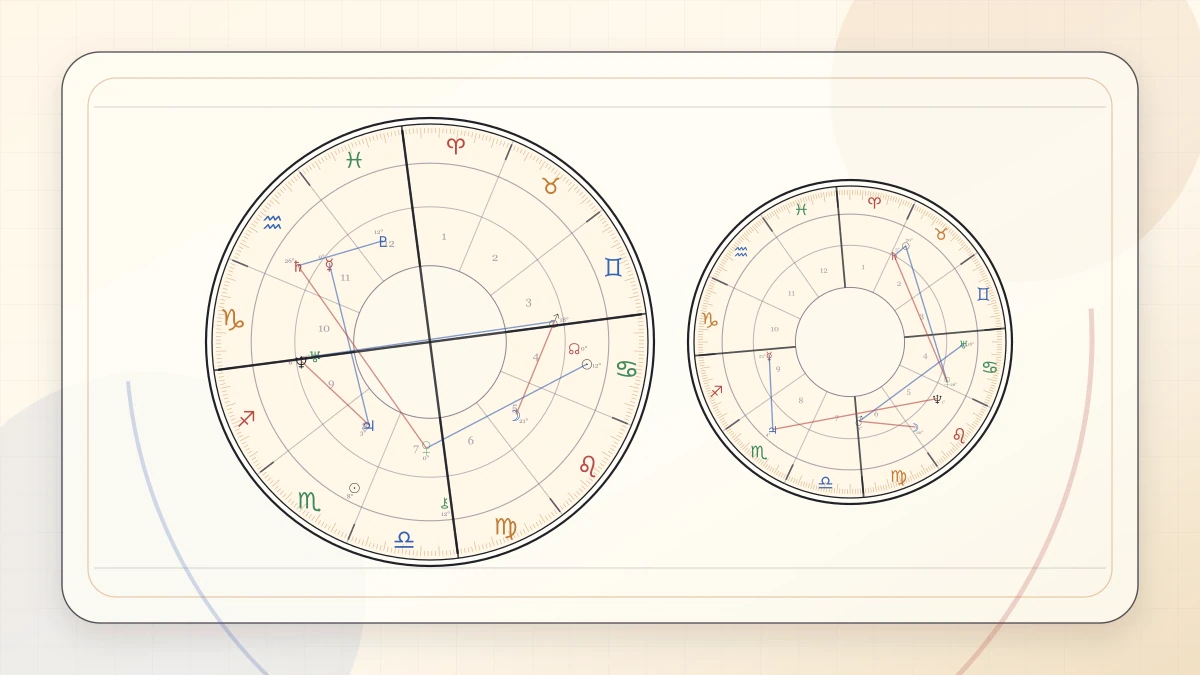
Planetary Transits
Jupiter Transit Meaning
A Jupiter transit is Jupiter passing a sign, a house or a natal planet in your chart. Astrologers read it as a stretch of growth, learning and confidence that can also run past what you can manage.
Table of contents
- Example or practical exercise
- What a Jupiter transit is
- Jupiter through the signs and what changes
- Where Jupiter lands in your houses
- How each kind of Jupiter contact is read
- Jupiter returns
- Jupiter’s contacts to your natal planets
- A constructed example: Jupiter trine a natal Sun
- Growth and over-extension: a practical routine
- Questions readers ask about Jupiter transits
- What this does and does not establish
Example or practical exercise
With Virgo rising and natal Sun at 14 degrees of Taurus, transiting Jupiter trines it at 14 Capricorn; a 3-degree orb gives a window of about ten weeks linking creative projects with study.
What a Jupiter transit is
A Jupiter transit is Jupiter’s current position in the sky as it passes a sign, a house of your chart or a planet in your birth chart. Jupiter takes about 12 years to go once around the zodiac, spends about a year in each sign and is retrograde for about four months of each year.
In the tradition Jupiter is the planet of growth, learning, generosity and confidence. Its transits are described as periods of expansion: more room, more contacts, more ideas. The catch, which the tradition also notes, is that expansion can run past what you can manage.
Jupiter through the signs and what changes
Because Jupiter stays about a year in one sign, its sign colors a whole year of public mood. Astrologers say the sign describes the style in which growth is sought. For example, a stay in an earth sign is read as growth through practical, tangible things, and a stay in an air sign as growth through ideas and conversation.
This is a general backdrop, shared by everyone. The personal part comes from the house Jupiter is crossing and the natal planets it contacts.
Jupiter rules Sagittarius and, in the traditional scheme, Pisces. When it is in one of its own signs, astrologers say its themes of belief, study and generosity are easy to express, but that does not make the year luckier or more eventful than any other. Treat all of this as a descriptive backdrop that gives you something to look at rather than a forecast of what the year holds.
Where Jupiter lands in your houses
A house is one of twelve areas of life in your chart, and the house Jupiter is crossing names the area where you are likely to want more for about a year. After its contacts to natal planets, that is the most personal layer of a Jupiter year, because the house depends on your birth time and place.
This page does not repeat a house-by-house list. The full reference, with what each house invites and where it can overshoot, is in our guide to Jupiter transits through the houses. Here the focus stays on what Jupiter’s contacts mean and how to weigh them.
How each kind of Jupiter contact is read
The angle between transiting Jupiter and a natal planet changes the tone of the reading. The table gives the usual modern description of each major aspect. Orbs for Jupiter transits are often kept to about 2 or 3 degrees, though astrologers differ.
| Aspect | Angle | How it is often read | What to watch |
|---|---|---|---|
| Conjunction | 0 degrees | The natal planet’s themes get the most room and attention | Mistaking a burst of enthusiasm for a long-term plan |
| Sextile | 60 degrees | A mild opening that usually needs a small step from you | Letting the opening pass because nothing pushes |
| Square | 90 degrees | Growth that rubs against old habits and asks for a change | Overcommitting just to settle the tension quickly |
| Trine | 120 degrees | An easy flow between the two themes | Comfort turning into coasting |
| Opposition | 180 degrees | Growth seen through other people or the opposite area of life | Promising more to others than you can give |
Jupiter returns
A Jupiter return is Jupiter coming back to the degree it held at your birth, about every 12 years. Ages, timing and a reflection routine are in our Jupiter return guide, so this page treats the return as one Jupiter contact among many.
Jupiter’s contacts to your natal planets
When Jupiter makes an aspect to a natal planet, the tradition says that planet’s themes get a boost of room and optimism. Jupiter conjunct the Sun is read as a stretch of confidence. Jupiter square the Moon is read as a stretch where feelings and appetites grow larger and need managing.
Jupiter moves about 30 degrees a year, or about 2.5 degrees a month, so a close contact within 3 degrees on each side typically lasts about two to three months, longer if Jupiter turns retrograde nearby.
A constructed example: Jupiter trine a natal Sun
This chart is made up. It has Virgo rising and the natal Sun at 14 degrees of Taurus. Counting whole-sign houses from Virgo, Taurus is the ninth house, linked to belief, study and long journeys, and Capricorn is the fifth, linked to creativity and play. On the 360-degree circle, 14 Taurus is 30 plus 14, or 44.
Suppose Jupiter enters Capricorn, at 270. A trine to the Sun needs Jupiter at 44 plus 240, or 284, which is 14 degrees of Capricorn. At about 2.5 degrees a month, those 14 degrees of travel take about five and a half months. With an orb of 3 degrees on each side, the window runs from 11 to 17 Capricorn, 6 degrees wide, or about 2.4 months, roughly ten weeks, if Jupiter does not turn retrograde inside it.
A reading would link a creative project or hobby with a wish to learn and see further, and the trine suggests the two fit together with little friction. The question to ask is whether that ease is producing anything you would still want after the window closes, or only a pleasant stretch of plans.
Growth and over-extension: a practical routine
The caution in the tradition is that Jupiter exaggerates. Opportunities look larger than they are, and it is easy to say yes to more than you can do. These steps keep expansion manageable.
- Write down every opportunity that shows up in the Jupiter window and keep them in one list.
- For each, note the time it asks for and what you would drop to make room.
- Pick one or two that you would choose even if no planet were involved.
- Review at the end of each month and cut back anything that has turned into an obligation.
Questions readers ask about Jupiter transits
Is a Jupiter transit always good? No. Traditional astrologers called Jupiter the greater benefic, a helpful planet, and that is the root of its lucky reputation. Many astrologers add that Jupiter enlarges whatever it touches, including excess and overconfidence, so a transit is a prompt to weigh the extra room and not a guarantee of luck.
What does it mean when Jupiter is retrograde? Jupiter appears to move backward for about four months a year. Astrologers read that as growth turning inward, a time to review, study and revisit plans before expanding them. The planet does not stop, and the reading is symbolic.
Will I notice a Jupiter transit at all? Many people notice nothing dramatic. The contacts are easy to calculate and harder to match to events, so a short written log of what you actually did shows whether the label fits.
What this does and does not establish
Jupiter enlarges whatever it touches, including excess, so a transit is a prompt to weigh extra room, not a promise of luck.
Related calculators
Use the matching tool when you want a direct chart or timing result after reading the guide.
Current Transits Calculator
Exact current-sky snapshot for a selected city, built for repeat-use daily astrology readers.
Transit to Natal Calculator
Exact current-sky comparison against one verified natal chart for more personal practical transit guidance.
Retrograde Calendar
Exact retrograde-period page for year-based planning, editorial planning, and current-sky timing checks.
Calculation references
- Swiss Ephemeris: positions, angles and house-system conventions
Technical reference for calculation conventions. It does not certify an interpretation or mean every live tool uses this engine.
Related articles
Keep reading with nearby topics that deepen the same question from another angle.
Yearly Astrology Guide
A yearly astrology guide maps the cycles that run through any twelve months, from the monthly Sun and Moon to slow Saturn, and separates checkable dates from symbolic interpretation.
6 min read
Solar Return Chart Guide: How to Read the Year Without Overpredicting It
A solar return chart is cast for the moment the Sun returns to its exact birth position, once a year near your birthday, and read as a yearly theme for planning rather than a forecast of events.
6 min read
Saturn Return Explained
A Saturn return is when Saturn comes back to the degree it held at your birth, about every 29.5 years. Astrologers read it as a checkpoint for responsibility and the structures you have built.
6 min read
How Planetary Transits Affect Your Birth Chart
Transits do not change your birth chart. A planet in today's sky forms an angle to a fixed natal point, and astrologers read that pairing as a prompt for attention.
6 min read
Keep exploring
Use the category page and the main hubs when you want the next layer of context.
Previous article
Saturn Return Explained
Next article
How Planetary Transits Affect Your Birth Chart