
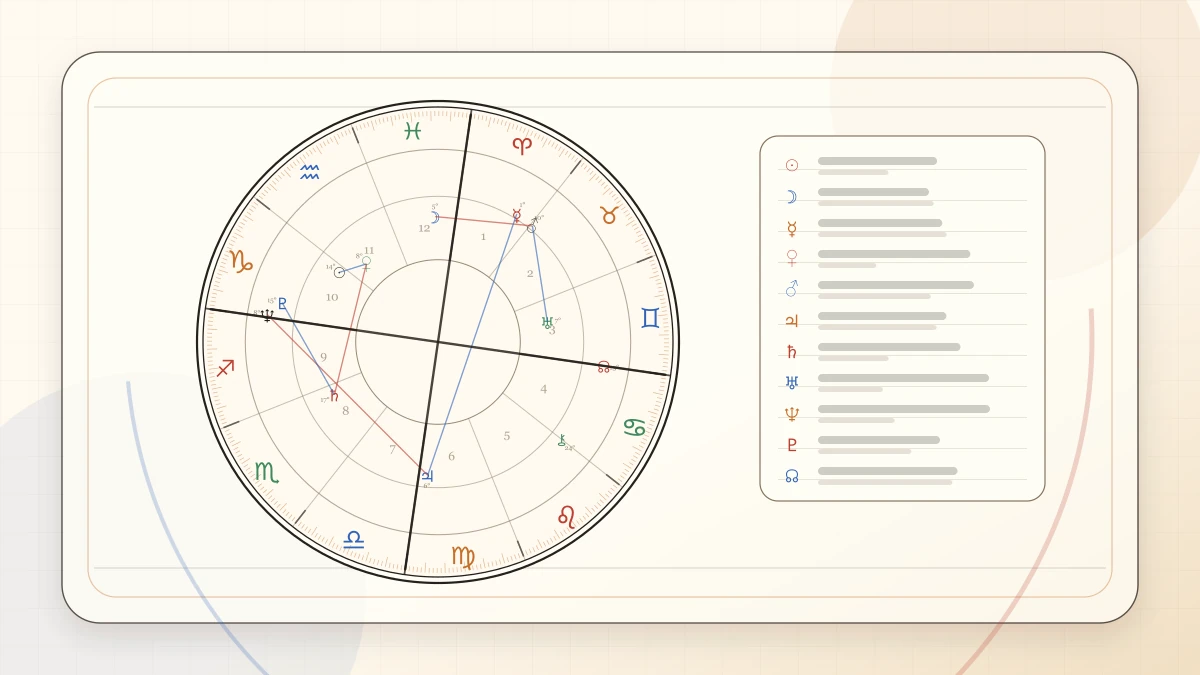
Birth Chart Basics
What a Dominant Planet Can Suggest in Your Chart
A dominant planet is the one a stated method ranks as most prominent, using points for angularity, dignity, rulership and aspects. It points to themes that repeat, not to a strength.
Table of contents
- Example or practical exercise
- What a “dominant planet” means, and what it does not
- Six defensible ways to find a dominant planet
- A simple scoring system with the rules stated
- Worked example: scoring a constructed chart
- How much the answer depends on the rules
- Scores are tools, not facts
- How to read the result
- What to do when two planets tie or the lead is small
- Common questions about dominant planets
- What this does and does not establish
Example or practical exercise
When a constructed Gemini-rising chart is scored, Mercury in Virgo earns 9 points as an angular chart ruler in its own sign, well ahead of Venus at 6 and Jupiter at 5.
What a “dominant planet” means, and what it does not
A dominant planet is the one an astrologer ranks as most prominent in a chart. It is not a measurement of the sky. It is a ranking produced by a method, and different methods can name different planets. Treat it as a way to start a conversation about which themes seem to repeat.
Six defensible ways to find a dominant planet
Astrologers use several tests, alone or combined.
- Angularity: planets in the first, fourth, seventh or tenth houses, or conjunct the angles, are traditionally considered prominent.
- Dignity: a planet in a sign it rules or is exalted in expresses with more ease in the traditional scheme.
- Chart ruler: the ruler of the Ascendant sign is often called the chart’s leading planet.
- Aspect count: a planet with many close aspects is tied into the rest of the chart.
- Element emphasis: a planet in the element that holds the most bodies draws extra weight.
- Rulers of the Sun, Moon and Ascendant signs: the planets that rule the Big Three are said to carry the main storyline.
A simple scoring system with the rules stated
Scoring combines the tests. The rules below are one choice among many and are used here only to show the arithmetic.
| Factor | Points | Rule |
|---|---|---|
| Angularity | +2 | Planet in the first, fourth, seventh or tenth house (whole-sign) |
| Dignity | +3 or +2 or −1 | Own sign +3, exaltation +2, detriment or fall −1; best one only |
| Chart ruler | +3 | Ruler of the Ascendant sign |
| Sun or Moon sign ruler | +2 each | Ruler of the sign holding the Sun, and of the sign holding the Moon |
| Aspects | +1 each | Each major aspect within a 5-degree orb |
Worked example: scoring a constructed chart
The chart is constructed, with the traditional seven planets, Gemini rising and whole-sign houses. Positions: Sun 14° Libra (194), Moon 3° Pisces (333), Mercury 22° Virgo (172), Venus 18° Libra (198), Mars 10° Capricorn (280), Jupiter 25° Cancer (115), Saturn 12° Sagittarius (252).
Close aspects: Sun and Venus conjunct (4 degrees); Sun and Mars square (280 − 194 = 86, a 4-degree orb); Sun and Saturn sextile (252 − 194 = 58, a 2-degree orb); Mercury and Jupiter sextile (172 − 115 = 57, a 3-degree orb). Element emphasis, the fifth test listed above, is not scored in this system. The element count is two bodies each in air, water and earth and one in fire, a tie, so it would not change the result.
| Planet | Sign and house | Angular | Dignity | Ruler role | Aspects | Total |
|---|---|---|---|---|---|---|
| Sun | Libra, 5 | 0 | −1 (fall) | 0 | 3 | 2 |
| Moon | Pisces, 10 | 2 | 0 | 0 | 0 | 2 |
| Mercury | Virgo, 4 | 2 | 3 (rules) | 3 (chart ruler) | 1 | 9 |
| Venus | Libra, 5 | 0 | 3 (rules) | 2 (Sun’s sign) | 1 | 6 |
| Mars | Capricorn, 8 | 0 | 2 (exalted) | 0 | 1 | 3 |
| Jupiter | Cancer, 2 | 0 | 2 (exalted) | 2 (Moon’s sign) | 1 | 5 |
| Saturn | Sagittarius, 7 | 2 | 0 | 0 | 1 | 3 |
How much the answer depends on the rules
Mercury leads with 9 of 30 points. The totals check: 9 + 6 + 5 + 3 + 3 + 2 + 2 = 30. But remove the chart-ruler bonus and Mercury drops to 6, tying with Venus. Count only aspects and the Sun leads with 3. Neither change alters the chart; both change the ranking.
That sensitivity is the point of the exercise. If one planet leads under every reasonable method, the finding is sturdy. If the leader changes with each rule, the chart has no clear dominant planet, and that is an honest result.
Scores are tools, not facts
The weights above are a convention, not a measurement. Nobody has shown that a planet with 9 points has more influence than one with 6, and no score is a percentage of anything. Use the number to decide where to look first, then read the planet by its sign, house and aspects like any other.
A second caution concerns false precision. A ranking built from whole-number points suggests exactness the chart does not have, since orbs, house systems and rulership choices are all open to dispute. Present a score as a rough ordering, never as a measurement.
How to read the result
Take the leading planet and ask what it stands for. In the example, Mercury suggests that thinking, talking, sorting and learning are recurring themes. Its sign (Virgo) points to precision and its house (the fourth) to home and roots as the setting. Ask where those themes already show up in your life, and where they do not.
Then check the runners-up. In the example, Venus at 6 and Jupiter at 5 add values and growth to the picture. The dominant planet is one voice among several, and a reading that mentions only one is incomplete.
Finally, write a plain sentence and test it. For the example chart: “Thinking, talking and sorting things out recur in this chart, with a careful style and a home base.” If friends who know the person recognize some of it, the ranking helped. If they do not, drop it and read the chart another way.
What to do when two planets tie or the lead is small
A gap of one or two points is within the noise of the method. If Mercury and Venus had each scored 6, the honest report would name both and describe how they work together. A lead of three points, as in the example, is modest and still depends on the rules.
Choose your method before you look at the results, and write it down. Picking the rules after seeing who wins turns a tool into a way of confirming what you already hoped.
Common questions about dominant planets
Is the Sun always the dominant planet? No. It is only dominant if the method says so, and in many charts it is not.
Can a chart have no dominant planet? Yes. A tie or a flat spread is a legitimate result.
Do outer planets count? Some astrologers add Uranus, Neptune and Pluto and use modern rulers; others keep to the seven traditional planets. Say which set you use.
Is a dominant planet a strength? Not necessarily. It describes where themes repeat, which can be a source of skill or of strain. Prominence is not the same as ease or success.
What this does and does not establish
Different scoring rules can name different planets, and a top score does not mean ease, talent or success with that planet's themes.
Related calculators
Use the matching tool when you want a direct chart or timing result after reading the guide.
Free Birth Chart Calculator
Create a birth chart from birth date, time, and place to review placements, houses, angles, and aspects.
Moon Sign Calculator
Exact Moon-sign verification from full birth-chart math for practical emotional and compatibility use cases.
Rising Sign Calculator
Exact Ascendant verification from full birth-chart math for practical house and Big 3 interpretation.
Calculation references
- Swiss Ephemeris: positions, angles and house-system conventions
Technical reference for calculation conventions. It does not certify an interpretation or mean every live tool uses this engine.
Related articles
Keep reading with nearby topics that deepen the same question from another angle.
The 12 Houses Explained
The twelve houses split a birth chart into twelve areas of life, measured from the horizon at your birthplace. A planet's sign shows how it behaves, and its house shows where that behavior appears.
6 min read
How to Read Current Transits Without Overreacting to Every Aspect
Choose your question first, list the slow-planet contacts within a tight orb, then add fast ones only for timing. A Saturn contact lasting months outweighs a Moon contact lasting hours.
6 min read
A Beginner's Guide to Chart Rulers: Following the Chain
Your chart ruler is the planet that rules your Rising sign. Follow it to the ruler of the sign it occupies, and onward, to trace a chain that ends at a planet in its own sign.
6 min read
How to Read and Test Chart Patterns Without Getting Lost
Test a chart pattern by declaring which bodies you count and which orb you allow, then measuring every leg in degrees. A pattern exists only if each required aspect passes.
6 min read
Keep exploring
Use the category page and the main hubs when you want the next layer of context.
Previous article
A Beginner's Guide to Chart Rulers: Following the Chain
Next article
How to Read and Test Chart Patterns Without Getting Lost