
Birth Chart Basics
Birth Chart Symbols Explained for Beginners
Chart symbols are shorthand glyphs for the ten planets, twelve signs and five main aspects, plus marks such as the retrograde R. Learn them in layers with a printed table beside the chart.
Table of contents
- Example or practical exercise
- What chart symbols are and where you meet them
- The ten planetary glyphs
- The twelve sign glyphs
- Aspect symbols and other marks on the chart
- What the retrograde mark does and does not say
- Reading one line of a position table, symbol by symbol
- A learning order that works
- What this does and does not establish
Example or practical exercise
A constructed table line reads Venus, 14, Libra, 20, retrograde, 5: Venus at 14 degrees 20 minutes of Libra, retrograde, in the fifth house, or about 194.33 degrees around the full wheel.
What chart symbols are and where you meet them
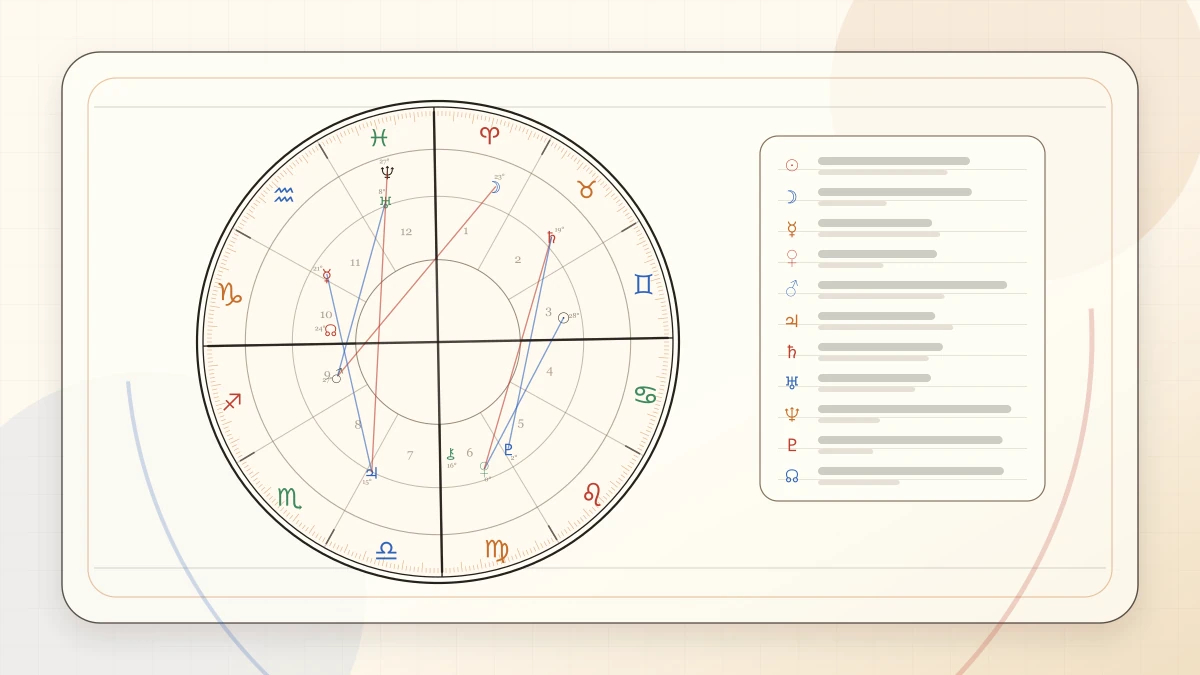
A birth chart is drawn in glyphs, small pictographs that stand for planets, signs, aspects and other points. They exist because a wheel with ten planets and twelve signs would otherwise be crowded with words. Each glyph is shorthand, and with a little practice the wheel starts to read like a sentence.
You meet glyphs in three places: around the wheel, in the table of positions beside it, and in the aspect grid. Glyph shapes vary a little between fonts and programs, so a symbol on your chart may look slightly different from one described here. Each table shows the glyph as your screen draws it in brackets, next to a description of its most common form.
The ten planetary glyphs
| Body | What the glyph looks like | A memory hook |
|---|---|---|
| Sun (☉︎) | A circle with a dot at its center | The disk of the Sun and its center |
| Moon (☽︎) | A crescent, open on one side | The crescent Moon |
| Mercury (☿︎) | A small circle with a crescent on top and a cross underneath | A winged cap above a cross |
| Venus (♀︎) | A circle sitting on top of a cross | A hand mirror |
| Mars (♂︎) | A circle with an arrow pointing up and to the right | A shield and spear |
| Jupiter (♃︎) | A curved stroke on the left joined to a cross, rather like a numeral 4 | A numeral 4 with a curved top |
| Saturn (♄︎) | A cross with a curved tail hanging from its lower end | A sickle or a lowercase h |
| Uranus (♅︎) | Usually an H shape with a small circle hanging beneath its crossbar | The H for its discoverer’s name |
| Neptune (♆︎) | A trident, a three-pronged fork standing on a short cross | The sea god’s trident |
| Pluto (♇︎) | Often a circle above a crescent above a cross; some fonts use a P and L joined together | Letters P and L |
The twelve sign glyphs
Most sign glyphs picture the animal or object behind the sign. The signs run in the table in zodiac order, starting from Aries.
| Sign | What the glyph looks like | The image behind it |
|---|---|---|
| Aries (♈︎) | A V shape with curled tips | A ram’s horns and nose |
| Taurus (♉︎) | A circle with an arc like a crescent resting on top | A bull’s head and horns |
| Gemini (♊︎) | Two upright strokes joined by a bar at the top and another at the bottom | Twins side by side |
| Cancer (♋︎) | Two small circles, each with a curved tail, one reversed, like a sideways 69 | A crab’s claws |
| Leo (♌︎) | A small circle with a looping tail curling away | A lion’s mane and tail |
| Virgo (♍︎) | An M-like shape whose last stroke curls into a loop | A maiden, often linked with wheat |
| Libra (♎︎) | A short horizontal line sitting above an arch | Scales over the horizon |
| Scorpio (♏︎) | An M-like shape ending in an arrow tip | A scorpion’s sting |
| Sagittarius (♐︎) | An arrow pointing up and to the right, crossed by a short bar | An archer’s arrow |
| Capricorn (♑︎) | A V-like stroke joined to a looping curl | A goat with a fish’s tail |
| Aquarius (♒︎) | Two parallel wavy or zigzag lines | Flowing water |
| Pisces (♓︎) | Two curved arcs facing away from each other, joined by a short line | Two fish tied together |
Aspect symbols and other marks on the chart
Aspects, the angles between planets, have their own symbols, and so do a few other points. Of these, the quincunx glyph varies the most between fonts.
| Mark | What it looks like | What it stands for |
|---|---|---|
| Conjunction (☌︎) | A small circle with a short line rising from it | 0 degrees, planets together |
| Sextile (⚹︎) | A six-pointed asterisk | 60 degrees |
| Square (□) | A small square | 90 degrees |
| Trine (△) | A small triangle pointing up | 120 degrees |
| Opposition (☍︎) | Two small circles joined by a line | 180 degrees |
| Quincunx (⚻︎) | A short vertical line with a small bar slanting off it | About 150 degrees |
| Retrograde (℞) | An R with a slash through its tail, or simply R or Rx | A planet appearing to move backward |
| Angles | Abbreviations: AC or ASC, DC or DSC, MC, IC | The four angles |
| North Node (☊︎) | A small horseshoe with a circle at each end | A calculated point of the Moon’s path |
What the retrograde mark does and does not say
The retrograde mark describes motion, not a separate planet. A planet marked this way appears, from Earth, to move backward through the zodiac for a while. It is an optical effect of the changing positions of Earth and that planet, like a car being passed on a highway seeming to slide back.
The Sun and Moon never carry the mark. Mercury is retrograde three or four times a year for about three weeks each time, Venus about every 19 months, and Mars about every 26 months. Astrologers read a retrograde planet as working more inwardly or slowly, and they disagree about how much weight to give it. The mark is a note on the planet’s motion, not a fault.
Reading one line of a position table, symbol by symbol
Take a constructed line: the glyph of a circle on a cross (♀︎), then 14, then the glyph of a line over an arch (♎︎), then 20, then an R with a slash (℞), then 5. Read it in order. The first glyph is Venus, the second is Libra, and the 20 is minutes of a degree. The R is the retrograde mark, and the final 5 is the house number.
In words: Venus is at 14 degrees 20 minutes of Libra, retrograde, in the fifth house. A minute is one sixtieth of a degree, so 14 degrees 20 minutes is about 14.33 degrees, and around the full wheel the position is 180 plus 14.33, or about 194.33. Check numbers like these in the table, not on the wheel, because glyphs on the wheel are often nudged aside to avoid overlap.
A learning order that works
Nobody has to memorize all of this at once. Keep a printed table beside the chart and learn in layers.
- Start with the Sun, Moon and Mercury through Saturn, the seven you will meet most often.
- Add Uranus, Neptune and Pluto, and learn the retrograde mark.
- Learn the signs in groups of four, one element at a time, tying each glyph to its image.
- Learn the five aspect marks by their shapes: circle, asterisk, square, triangle, two circles.
- Cover the labels on a chart you know and try to name every glyph. Check the table, then repeat a week later.
What this does and does not establish
Glyphs on the wheel are often nudged aside to avoid overlap, so take exact positions from the table, and remember the retrograde mark is not a fault.
Related calculators
Use the matching tool when you want a direct chart or timing result after reading the guide.
Free Birth Chart Calculator
Create a birth chart from birth date, time, and place to review placements, houses, angles, and aspects.
Rising Sign Calculator
Exact Ascendant verification from full birth-chart math for practical house and Big 3 interpretation.
12 Houses Calculator
Complete 12-house overview page for readers who want the full natal house framework before drilling into one exact placement.
Calculation references
- Swiss Ephemeris: positions, angles and house-system conventions
Technical reference for calculation conventions. It does not certify an interpretation or mean every live tool uses this engine.
Related articles
Keep reading with nearby topics that deepen the same question from another angle.
What the IC Means in Astrology
The IC, or Imum Coeli, is the chart point directly opposite the Midheaven, at the bottom of the wheel. Astrologers read its sign as your private foundation: home, roots and inner life.
6 min read
How to Read Your Birth Chart: A Beginner's Guide
Read your birth chart in five steps: find the Sun, Moon and Rising sign, count the elements, note crowded houses, locate the chart ruler, then read the two or three closest aspects.
6 min read
Sun, Moon, and Rising Signs Explained
Your Sun sign describes what you are aiming to be, your Moon sign what you need to feel settled, and your Rising sign how you meet the world and how it first meets you.
6 min read
How Birth Time Changes Your Chart
Birth time sets your Rising sign, Midheaven and house placements, because the Ascendant moves about one degree every four minutes. Most planet signs stay the same across the day.
6 min read
Keep exploring
Use the category page and the main hubs when you want the next layer of context.
Previous article
Monthly Moon Calendar Planning Guide
Next article
What the IC Means in Astrology