
Birth Chart Basics
What the IC Means in Astrology
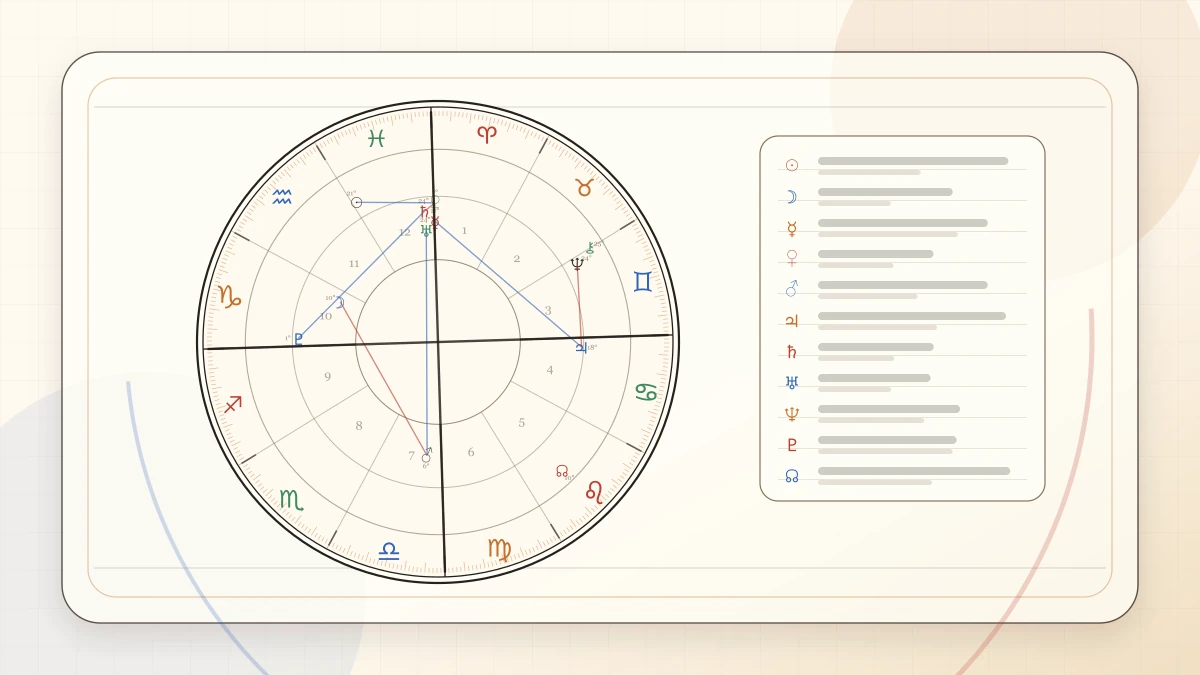
The IC, or Imum Coeli, is the chart point directly opposite the Midheaven, at the bottom of the wheel. Astrologers read its sign as your private foundation: home, roots and inner life.
Table of contents
- Example or practical exercise
- What the IC is and where it sits
- How the IC is found from the Midheaven
- The IC and the fourth house in different house systems
- What each sign on the IC tends to suggest
- Planets conjunct the IC
- A reflection exercise for your own IC
- Three common mix-ups about the IC
- What this does and does not establish
Example or practical exercise
A Midheaven at 8 degrees Leo puts the IC at 8 degrees Aquarius; with Scorpio rising in whole-sign houses that IC falls in the fourth house, but with Sagittarius rising it falls in the third.
What the IC is and where it sits
The IC, short for Imum Coeli (Latin for the bottom of the sky), is one of the four angles of a birth chart. It is the point on the zodiac directly opposite the Midheaven, which is the highest point of the chart. Picture the sky as a dome over your birthplace: the Midheaven is where the zodiac crosses the north-south line overhead, and the IC is where the zodiac crosses that same line beneath your feet.
It is not a planet or a star. It is a calculated degree of a sign, a point with no body behind it. In the tradition it stands for the foundation of the chart: home, family background, private life and the inner place a person returns to when nobody is watching. On the wheel it sits at the bottom, so a common picture is the roots beneath a tree.
Because the point depends on the exact time of birth, you cannot find an IC without one. If the time is a guess, the IC is a guess too.
How the IC is found from the Midheaven
Chart software finds the Midheaven from the birth time and the longitude of the birthplace, then places the IC exactly 180 degrees away. As a shortcut, the IC is always the opposite sign at the same degree: a Midheaven at 8 degrees of Leo gives an IC at 8 degrees of Aquarius. To check the arithmetic, treat the zodiac as a number line from 0 to 360.
- Write the Midheaven as a number. Aries starts at 0, Taurus at 30, Gemini at 60 and so on, so 8 degrees of Leo is 120 plus 8, or 128.
- Add 180. Here 128 plus 180 is 308.
- If the total is above 360, subtract 360. A Midheaven at 20 degrees of Scorpio is 230, and 230 plus 180 is 410, which becomes 50.
- Turn the number back into a sign by dividing by 30. The 308 is ten full signs (300) and 8 degrees, so it is 8 degrees of the eleventh sign, Aquarius. The 50 is one full sign and 20 degrees, so it is 20 degrees of Taurus.
The IC and the fourth house in different house systems
In Placidus and other quadrant house systems, the IC is the cusp of the fourth house, the exact degree where that house begins. In whole-sign houses the fourth house is simply the sign three places after the Rising sign, and the IC is a degree that may or may not land inside it. At most birthplaces it falls in the third, fourth or fifth house, and at very high latitudes it can reach a neighboring one.
Take a constructed IC of 8 degrees Aquarius. With Scorpio rising, whole-sign houses make Aquarius the fourth house, so the IC sits in it. With Sagittarius rising, the fourth house is Pisces, and the same IC falls in the third house. The point has not moved; only the house boundaries have.
Neither reading is a mistake. Choose one house system and say which. The IC’s sign, its ruler and any planets close to it stay the same in every system.
What each sign on the IC tends to suggest
The sign on the IC colors the style of your private base. The table gives the traditional theme for each sign and a question you can ask yourself. They are prompts for thought, not statements about your upbringing.
| Sign on the IC | Theme in the tradition | A question to ask |
|---|---|---|
| Aries | Self-reliance and a lively base | Where do I go to recharge my own energy? |
| Taurus | Stability, comfort, a physical home | What does a settled home look like to me? |
| Gemini | Talk, books, movement, curiosity | Is my base a place for conversation or for quiet? |
| Cancer | Belonging, family feeling, caretaking | Who counts as family to me? |
| Leo | Warmth, pride, a home that hosts | Where do I feel appreciated at home? |
| Virgo | Order, usefulness, routines | What helps my space work well? |
| Libra | Harmony, shared taste, avoiding conflict | How do I keep the peace without giving up my needs? |
| Scorpio | Privacy, intensity, guarded depths | What do I keep private, and why? |
| Sagittarius | Freedom, wide horizons, a home that changes places | Where do I feel free to roam and return? |
| Capricorn | Structure, duty, a serious foundation | What did I learn about responsibility early? |
| Aquarius | Independence, an unconventional household | What kind of home leaves room for my individuality? |
| Pisces | Sensitivity, imagination, a need for retreat | How do I protect my quiet time? |
Planets conjunct the IC
A planet within about 5 degrees of the IC, on either side, is said to be conjunct it. Some astrologers allow up to 8 degrees; there is no official limit. Traditionally such a planet is emphasized because it sits at a corner of the chart, and it is read as strongly tied to home and inner life.
- Sun: a sense of identity bound up with family, place or heritage.
- Moon: a strong need for a safe, familiar base, with moods that may follow the state of the home.
- Venus: a need for beauty, calm and affection in the living space.
- Mars: a need for room to move and act at home; the tradition also links it with a busy or lively household, a theme to consider rather than a fact about your family.
- Saturn: an early sense of duty or seriousness around home, and a slow, careful approach to building a base.
- Uranus, Neptune or Pluto: an unconventional, diffuse or intense home theme. The planet's sign is shared by everyone born in those years, so it is the contact with your own IC that makes the theme personal.
A reflection exercise for your own IC
This takes about twenty minutes and needs only paper. It is a journaling prompt, not an assessment of your family.
- Write down the sign on your IC, its ruling planet, and the house system you used.
- Without looking at the table, list three words for the home you grew up in and three words for the home you would like now.
- Read the table row for your IC sign. Mark every phrase that fits and every one that does not.
- If a planet sits near the IC, add one sentence about what that planet’s job is in your life.
- Look at where your two lists differ, and ask which differences come from choice and which from circumstance.
- Keep the page and reread it in a few months.
Three common mix-ups about the IC
First, the IC is not the same as the fourth house: one is a point, the other an area of the chart. Second, it is not the Moon, though the two share themes of home and belonging. Third, astrologers disagree about whether the IC and fourth house describe the mother, the father or both. Modern writers more often read the whole early home. Treat the IC as a question about what home means to you now, not as history.
What this does and does not establish
The IC is a question about what home means to you now, and it cannot reveal facts about your childhood, mother or father.
Related calculators
Use the matching tool when you want a direct chart or timing result after reading the guide.
Free Birth Chart Calculator
Create a birth chart from birth date, time, and place to review placements, houses, angles, and aspects.
Rising Sign Calculator
Exact Ascendant verification from full birth-chart math for practical house and Big 3 interpretation.
12 Houses Calculator
Complete 12-house overview page for readers who want the full natal house framework before drilling into one exact placement.
Calculation references
- Swiss Ephemeris: positions, angles and house-system conventions
Technical reference for calculation conventions. It does not certify an interpretation or mean every live tool uses this engine.
Related articles
Keep reading with nearby topics that deepen the same question from another angle.
Birth Chart Symbols Explained for Beginners
Chart symbols are shorthand glyphs for the ten planets, twelve signs and five main aspects, plus marks such as the retrograde R. Learn them in layers with a printed table beside the chart.
6 min read
What the Descendant Means in Astrology
The Descendant is the point where the zodiac meets the western horizon, exactly opposite your Ascendant. Astrologers read its sign as how you meet partners and other people one to one.
6 min read
How to Read Your Birth Chart: A Beginner's Guide
Read your birth chart in five steps: find the Sun, Moon and Rising sign, count the elements, note crowded houses, locate the chart ruler, then read the two or three closest aspects.
6 min read
Sun, Moon, and Rising Signs Explained
Your Sun sign describes what you are aiming to be, your Moon sign what you need to feel settled, and your Rising sign how you meet the world and how it first meets you.
6 min read
Keep exploring
Use the category page and the main hubs when you want the next layer of context.
Previous article
Birth Chart Symbols Explained for Beginners
Next article
What the Descendant Means in Astrology