
Birth Chart Basics
What the Descendant Means in Astrology
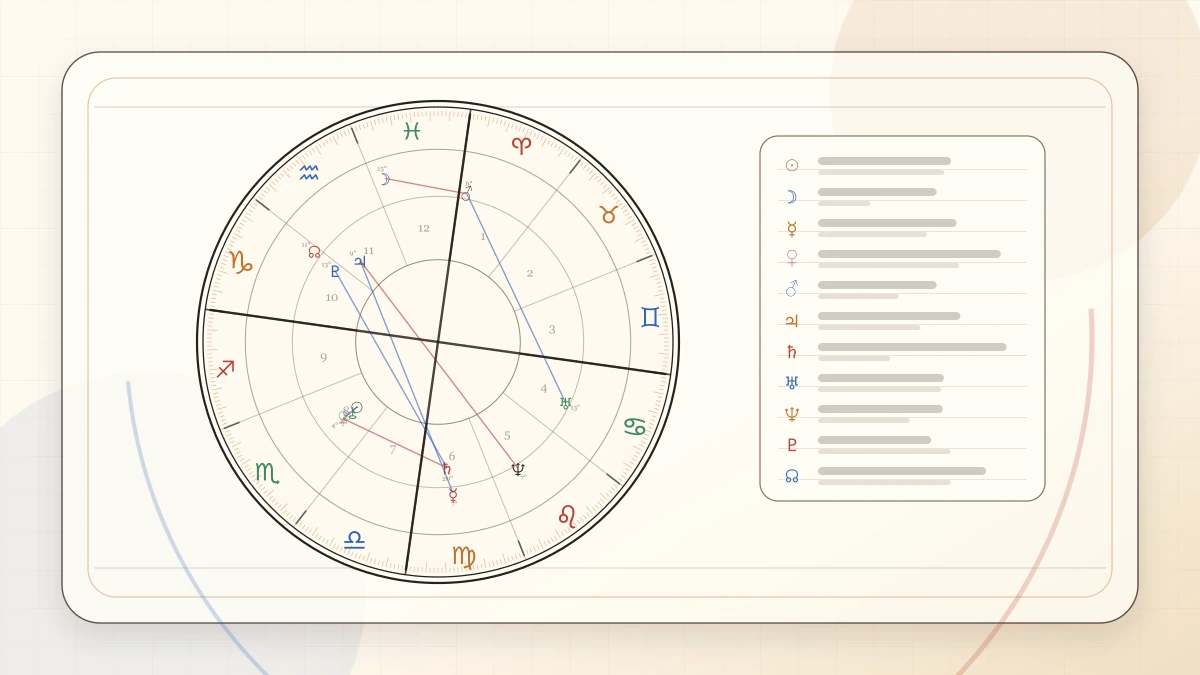
The Descendant is the point where the zodiac meets the western horizon, exactly opposite your Ascendant. Astrologers read its sign as how you meet partners and other people one to one.
Table of contents
- Example or practical exercise
- What the Descendant is
- Find your Descendant from your Rising sign
- Reading the Descendant as a mirror
- The Descendant and the seventh house in different systems
- Planets on the Descendant
- A constructed example: Sagittarius rising with Mercury near the Descendant
- Five steps to explore your own Descendant
- When the ruler of your Descendant sits in your first house
- Two quick questions about the Descendant
- What this does and does not establish
Example or practical exercise
A constructed Ascendant at 26 degrees Sagittarius puts the Descendant at 26 degrees Gemini, and Mercury at 23 Gemini sits 3 degrees from it while ruling the sign, so it is the first planet to read.
What the Descendant is
The Descendant is the point where the zodiac meets the western horizon, the place where the Sun and planets set. It is one of the four angles of a birth chart and always lies exactly opposite the Ascendant, the point rising in the east. If your Ascendant is 14 degrees of one sign, your Descendant is 14 degrees of the opposite sign.
In the tradition, the Ascendant is the self you bring to a situation and the Descendant is the other person standing across from you. That is why the point is tied to partnership: marriage, close friendship, working partners and anyone you deal with one to one. Astrologers read it as a statement about how you meet others, and as a mirror of qualities you notice or seek in them.
Like the other angles, it is a calculated point rather than a planet, and it needs an exact birth time.
Find your Descendant from your Rising sign
You do not need a separate calculation. Take your Rising sign and read across: the Descendant is the sign opposite it, six signs away, and the ruling planet of that sign is the one to look at next. The rulers shown are the traditional ones.
| Rising sign | Descendant sign | Traditional ruler of the Descendant |
|---|---|---|
| Aries | Libra | Venus |
| Taurus | Scorpio | Mars |
| Gemini | Sagittarius | Jupiter |
| Cancer | Capricorn | Saturn |
| Leo | Aquarius | Saturn |
| Virgo | Pisces | Jupiter |
| Libra | Aries | Mars |
| Scorpio | Taurus | Venus |
| Sagittarius | Gemini | Mercury |
| Capricorn | Cancer | Moon |
| Aquarius | Leo | Sun |
| Pisces | Virgo | Mercury |
Reading the Descendant as a mirror
A common way to read the point is as projection. We tend to notice in other people qualities we have not fully claimed in ourselves, so the Descendant sign is said to describe traits you look for, admire or find difficult in partners. A reserved, self-disciplined Capricorn Rising has Cancer on the Descendant, which is read as a pull toward warmth and open feeling in others.
This is one interpretive idea, not a rule about who you will meet or marry. It is also not a claim that you attract people of the Descendant sign; a partner’s Sun sign is a separate question. A more useful reading asks what you expect from partnership, and which of those expectations you could also supply for yourself.
Older tradition reads the seventh house a little more widely. It covers open opponents as well as partners, because both are people who face you directly. The Descendant is therefore about whoever sits across the table, whether the mood is friendly or not.
The Descendant and the seventh house in different systems
In Placidus and other quadrant systems, the Descendant is the cusp of the seventh house. Whole-sign houses are simpler here than for the Midheaven and IC: the first house is the whole Rising sign, so the seventh is the whole opposite sign, and the Descendant always lands inside it.
The difference shows up with nearby planets. In a quadrant system, a planet a few degrees before the Descendant falls in the sixth house, though it is often read with the seventh because it is close to the angle. In whole-sign houses the same planet, if it is in the Descendant’s sign, is already in the seventh. Say which method you use.
Planets on the Descendant
A planet within about 5 degrees of the Descendant, with some astrologers allowing up to 8, is described as setting, and its themes are read as arriving through other people.
- Sun: an identity that becomes clearer through relating to others.
- Moon: emotional needs that are met, or tested, through close company.
- Venus: a strong tie between affection and partnership, with harmony a priority.
- Mars: relationships that carry energy, competition or friction, or a habit of meeting others with a challenge.
- Jupiter: generosity and optimism in one-to-one bonds, with a risk of expecting a lot from them.
- Saturn: a serious, cautious approach to commitment, or a tendency to take on responsibility for others.
A constructed example: Sagittarius rising with Mercury near the Descendant
Take a constructed chart with the Ascendant at 26 degrees of Sagittarius. On the number line that is 240 plus 26, or 266. Subtract 180 and you get 86, which is 26 degrees of Gemini (60 plus 26). The Descendant is 26 degrees Gemini.
Now add Mercury at 23 degrees of Gemini, or 83. The distance from the Descendant is 86 minus 83, which is 3 degrees, well inside a 5 degree orb. Mercury also rules Gemini, so it is both the planet on the angle and the ruler of the Descendant sign. That makes it the first planet to read for relationships in this chart.
A reader might say this person tends to relate through conversation, questions and the exchange of ideas, and may look for partners who are good talkers, while the Sagittarius Rising approach is blunt and exploratory. The tension between a broad-view Sagittarius and a restless, fact-gathering Gemini is a theme to reflect on, not a prediction about any partner.
Five steps to explore your own Descendant
Use the table above and a chart from the birth chart calculator on this site.
- Find your Rising sign and write down the sign opposite it.
- Note the ruler of the Descendant sign, and where that planet sits in your chart by sign and house.
- List any planets within 5 degrees of the Descendant, on either side.
- Write three qualities you value, and three you find hard, in close partners. Compare them with the Descendant sign.
- Ask which of those qualities you could develop yourself and which you simply want in someone else.
When the ruler of your Descendant sits in your first house
This constructed chart has Aries rising, so Libra is on the Descendant and Venus is its traditional ruler. Suppose the Ascendant is at 20 degrees Aries and Venus is at 8 degrees Aries, 12 degrees before it. In whole-sign houses that puts Venus in the first house; in a quadrant system it falls in the twelfth, just before the Ascendant.
A reader might say the qualities this person looks for in others, such as harmony and courtesy, are already part of their own opening manner, so the partnership theme is partly about recognizing what is already theirs. That is a prompt for reflection, not a rule about partners.
Two quick questions about the Descendant
Does it change if my birth time is off? Yes, and in step with the Ascendant, at about 1 degree every 4 minutes on average (the rate varies with latitude and with the sign rising), so a small error can shift the sign if the degree is near a boundary.
Do two people with the same Descendant sign relate alike? No. The ruler’s sign and house, any planets near the point and the rest of the chart all differ, and so do the people.
What this does and does not establish
The Descendant does not predict who you will meet or marry, and it is not a claim that you attract people of that sign.
Related calculators
Use the matching tool when you want a direct chart or timing result after reading the guide.
Free Birth Chart Calculator
Create a birth chart from birth date, time, and place to review placements, houses, angles, and aspects.
Rising Sign Calculator
Exact Ascendant verification from full birth-chart math for practical house and Big 3 interpretation.
12 Houses Calculator
Complete 12-house overview page for readers who want the full natal house framework before drilling into one exact placement.
Calculation references
- Swiss Ephemeris: positions, angles and house-system conventions
Technical reference for calculation conventions. It does not certify an interpretation or mean every live tool uses this engine.
Related articles
Keep reading with nearby topics that deepen the same question from another angle.
What the IC Means in Astrology
The IC, or Imum Coeli, is the chart point directly opposite the Midheaven, at the bottom of the wheel. Astrologers read its sign as your private foundation: home, roots and inner life.
6 min read
Birth Chart Stellium Meaning
A stellium is a cluster of usually three or more planets in one sign or one house. It concentrates attention there, but the planets in it keep their separate jobs.
6 min read
How to Read Your Birth Chart: A Beginner's Guide
Read your birth chart in five steps: find the Sun, Moon and Rising sign, count the elements, note crowded houses, locate the chart ruler, then read the two or three closest aspects.
6 min read
Sun, Moon, and Rising Signs Explained
Your Sun sign describes what you are aiming to be, your Moon sign what you need to feel settled, and your Rising sign how you meet the world and how it first meets you.
6 min read
Keep exploring
Use the category page and the main hubs when you want the next layer of context.
Previous article
What the IC Means in Astrology
Next article
Birth Chart Stellium Meaning