
Birth Chart Basics
What Is Kundli?
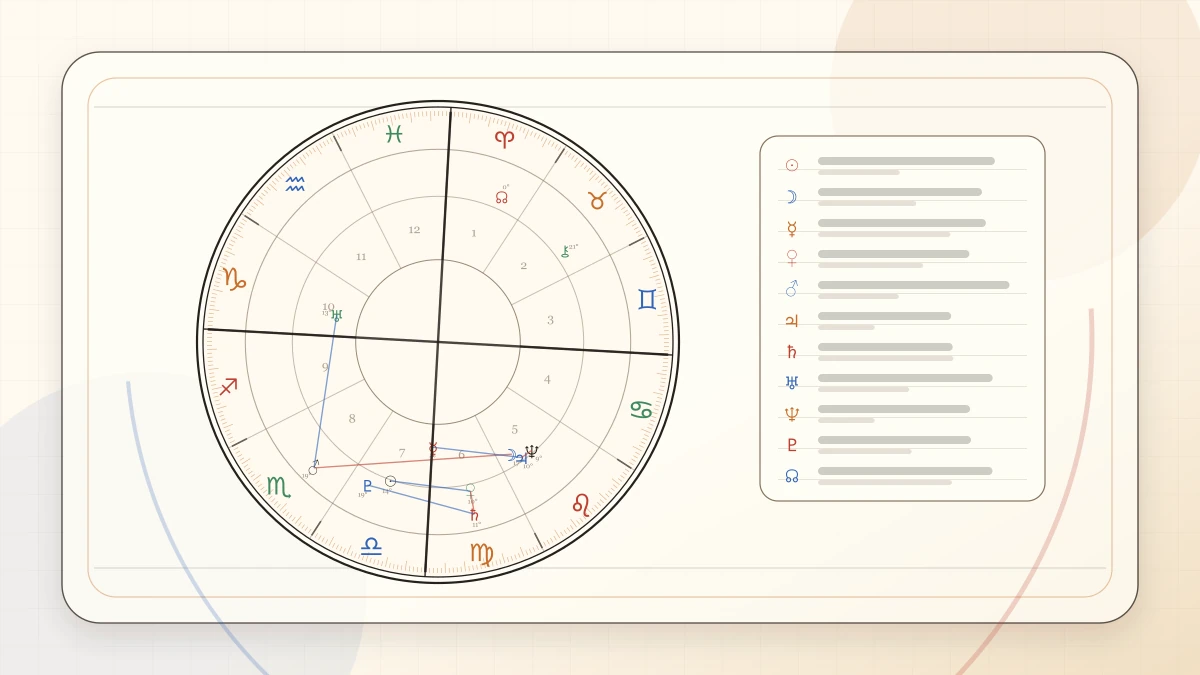
A Kundli is a Vedic birth chart calculated from your birth date, time and place, usually with the sidereal zodiac. It shows your Lagna, Moon sign, nakshatra, houses and planetary periods.
Table of contents
- Example or practical exercise
- What a Kundli is and why people make one
- The birth details a Kundli is calculated from
- Why a Kundli uses the sidereal zodiac
- The main parts of a Kundli, in plain terms
- North Indian and South Indian Kundli styles
- A constructed Kundli with a Leo Lagna, worked through
- What to read first in a new Kundli
- How the Kundli calculator on this site builds your chart
- Is a Kundli the same as a Western birth chart?
- Common Kundli questions, answered briefly
- What this does and does not establish
Example or practical exercise
Draw one chart in North Indian style, where the houses stay fixed, and again in South Indian style, where the signs stay fixed: the Lagna, Moon sign and nakshatra should match in both.
What a Kundli is and why people make one
A Kundli, also called a janam kundli or janampatri, is the birth chart of Jyotish, the astrological tradition of India. It maps where the Sun, Moon, planets and lunar nodes stood in the zodiac at the moment and place of your birth, arranged into twelve houses.
Families in India and across the diaspora have long made a Kundli soon after a birth and returned to it at milestones. Read as a structured record of the sky at birth, it gives anyone the tradition’s vocabulary for each placement.
A Kundli does not fix your future. This guide treats it as an interpretive map, read with judgment and context, rather than a forecast.
The birth details a Kundli is calculated from
Three facts go into every Kundli.
If the time is a guess, say so beside the chart: the planets’ signs may be right while the Lagna and houses are wrong.
- Date of birth places the Sun, the slower planets and, roughly, the Moon, which covers about 13 degrees a day.
- Time of birth sets the Lagna, the sign rising in the east, which changes about every two hours on average. A certificate or hospital record beats a family memory of “around dawn.”
- Place of birth supplies the latitude and longitude, and its time zone, including any daylight saving time that day, turns local clock time into one universal moment.
Why a Kundli uses the sidereal zodiac
Western astrology usually measures the signs from the March equinox point, the tropical zodiac; Jyotish measures them against the stars, the sidereal zodiac. Because the Earth’s axis slowly wobbles, the two drift apart by about 1 degree every 72 years and now sit about 24 degrees apart.
That gap is the ayanamsa; several versions exist, and Lahiri is the most common. As a result, many planets in a Kundli land one sign earlier than in a Western chart for the same moment.
The main parts of a Kundli, in plain terms
Most Kundli software and printed charts present the same core layers.
Rahu and Ketu, the Moon’s nodes, are points rather than bodies but count as grahas; the outer planets are usually left out.
| Term | What it is | Calculated from |
|---|---|---|
| Lagna | The sidereal Ascendant, the sign rising in the east | Exact birth time and place |
| Rashi | In everyday use, the Moon’s sidereal sign | The Moon’s position |
| Nakshatra | One of 27 lunar mansions, usually the Moon’s | The Moon’s exact degree |
| Grahas | Sun, Moon, Mars, Mercury, Jupiter, Venus, Saturn, Rahu and Ketu | Sidereal positions at birth |
| Bhavas | The twelve houses, or life areas | Counted from the Lagna sign |
| Dasha | A sequence of planetary periods, most often Vimshottari | The Moon’s nakshatra and progress through it |
| Navamsa (D9) | A divisional chart splitting each sign into nine | Each planet’s exact degree |
North Indian and South Indian Kundli styles
The same Kundli can be drawn two ways. The North Indian style is a square of diamonds and triangles with the houses fixed: house 1 is the top center diamond, and sign numbers (1 for Aries to 12 for Pisces) are written in. The South Indian style is a ring of twelve boxes with the signs fixed; the rising sign is marked, and the houses are counted from it.
Neither is more correct; regional habit usually decides. When two drawings look different, compare the Lagna and each planet’s sign, not the shape. Most Kundlis use whole-sign houses, where the entire rising sign is house 1, though some astrologers use other house methods for finer work.
A constructed Kundli with a Leo Lagna, worked through
Here is a made-up chart with three sidereal longitudes, degrees counted from 0 at the start of sidereal Aries. Dividing by 30 gives the sign; the remainder is the degree within it.
Leo becomes house 1. Counting on (Leo, Virgo, Libra, Scorpio, Sagittarius, Capricorn, Aquarius, Pisces, Aries, Taurus), Taurus lands tenth and Aquarius seventh.
The Moon at 52 degrees is in Rohini, the fourth nakshatra, spanning 40 degrees to 53 degrees 20 minutes. It is 12 degrees in, or 0.9 of the way (12 divided by 13.33). Rohini’s ruler is the Moon, with a 10-year Vimshottari period, so about one year remains at birth (0.1 times 10) before the 7-year Mars period.
Add back the 24-degree gap and the Sun’s 310 degrees becomes about 334 degrees tropical, 4 degrees of Pisces: a Western Pisces with a Kumbha Sun in the Kundli.
| Point | Sidereal longitude | Sign and degree | Whole-sign house |
|---|---|---|---|
| Lagna | 128° | Leo (Simha) 8° | 1st, by definition |
| Moon | 52° | Taurus (Vrishabha) 22° | 10th |
| Sun | 310° | Aquarius (Kumbha) 10° | 7th |
What to read first in a new Kundli
A full chart is a lot to take in at once; this order keeps the foundation first.
- Confirm the inputs and note how sure you are of the birth time.
- Find the Lagna and its ruler, the Lagna lord; every house is counted from this sign.
- Note the Rashi and the birth nakshatra with its pada.
- Look for houses holding several grahas, which mark themes the chart emphasizes.
- Check traditional dignity, such as own sign or exaltation, without calling any placement good or bad.
- Only then look at the current Dasha, as a theme for reflection rather than a schedule.
How the Kundli calculator on this site builds your chart
The Kundli calculator on this site converts your birth date, time and city to universal time and computes a sidereal chart with the Lahiri ayanamsa and whole-sign houses. Rahu and Ketu are mean nodes, exactly opposite each other, omitted rather than estimated for dates outside its node model’s range.
It shows your Lagna, Rashi and nakshatra with pada; each graha’s sign, degree, house and motion; and a North Indian (default) or South Indian chart. Signs carry English names, so Vrishabha appears as Taurus. It lists Vimshottari periods in 365.25-day years and reports Manglik and Kaal Sarp checks as rule outputs, not statements about your life or relationships. It does not draw a navamsa chart.
Is a Kundli the same as a Western birth chart?
This is usually the next question. Both map the sky at birth from the same details; they differ in zodiac (sidereal, not tropical), houses (usually whole-sign), bodies (nodes in, outer planets usually out) and drawing. Many placements move back one sign: two readings of one sky, not rival answers.
No birth time? You can still find the planets’ signs, and often the Rashi, but not a trustworthy Lagna. Some readers then use the Moon’s sign as house 1, a traditional technique called Chandra Lagna.
Common Kundli questions, answered briefly
What is Kundli matching? It compares two charts, traditionally starting from the Moon nakshatras. A matching score is a traditional reference, not a verdict on whether two people belong together.
Why do two websites give me different Kundlis? Usually a different ayanamsa, time zone or daylight saving assumption, or a typo in the birth time. Check those first.
Does a Kundli say what will happen to me? No. It records sky positions. Doshas are rule checks inside the tradition, not curses, and no chart needs a ritual, gemstone or payment to be “fixed.”
What this does and does not establish
A Kundli records sky positions; it cannot show that dosha labels or period readings predict what happens in your life.
Related calculators
Use the matching tool when you want a direct chart or timing result after reading the guide.
Kundli Calculator
Prepare a Kundli-style reference from birth date, time, and city while keeping exact Vedic calculation boundaries clear.
Rashi Calculator
Understand Rashi as the Vedic Moon sign and how it differs from simple Sun-sign astrology.
Lagna Calculator
Understand Lagna, why exact birth time matters, and how the Vedic Ascendant anchors houses.
Calculation references
- Swiss Ephemeris: positions, angles and house-system conventions
Technical reference for calculation conventions. It does not certify an interpretation or mean every live tool uses this engine.
Related articles
Keep reading with nearby topics that deepen the same question from another angle.
What Is Kundli?
A Kundli is a Vedic birth chart calculated from your birth date, time and place, usually with the sidereal zodiac. It shows your Lagna, Moon sign, nakshatra, houses and planetary periods.
6 min read
What Is Rashi?
Rashi means zodiac sign, and in Vedic astrology your Rashi usually means the sidereal sign the Moon occupied at your birth, which often differs from your Western Sun sign.
6 min read
What Is Nakshatra?
A nakshatra is one of 27 equal lunar mansions, each spanning 13 degrees 20 minutes of the sidereal zodiac. Your birth nakshatra is usually the one holding the Moon, and each has four padas.
6 min read
What Is Panchang?
A Panchang is a daily Vedic almanac built from five factors: weekday, Tithi, Nakshatra, Yoga and Karana. Its timings depend on local sunrise, so they change from city to city.
6 min read
Keep exploring
Use the category page and the main hubs when you want the next layer of context.
Previous article
Astrology Timing for Travel Planning: Check the Facts First
Next article
What Is Panchang?