
Birth Chart Basics
Day Chart vs Night Chart Explained
A day chart has the Sun above the horizon at birth and a night chart has it below. This is called sect, and it changes which planets traditional astrologers treat as most helpful.
Table of contents
- Example or practical exercise
- What makes a chart a day chart or a night chart
- How to tell which one you have
- Which planets belong to the day and which to the night
- In sect, out of sect, and the two planets of the sect
- A constructed pair: one Rising sign, a day Sun and a night Sun
- When the house count and the real horizon disagree
- How much weight modern astrologers give sect
- Try sect on your own chart in ten minutes
- What this does and does not establish
Example or practical exercise
Two constructed charts with 12 degrees Sagittarius rising differ only in the Sun: at 20 Leo it is above the horizon, a day chart favoring Jupiter, while at 20 Taurus it is below, a night chart favoring Venus.
What makes a chart a day chart or a night chart
Traditional astrology sorts every birth chart into one of two groups, called its sect. A day chart is one where the Sun was above the horizon at the moment of birth. A night chart is one where the Sun was below it. The idea is ancient, and in the traditional approach it changes how several planets are described.
Sect is about the Sun’s position relative to the horizon of the birthplace, not about the clock. Sunrise and sunset move through the year and shift with latitude, so the same clock time can fall in daylight in one season and after dark in another. Near the poles the Sun can stay above or below the horizon all day, which is a special case.
How to tell which one you have
You can answer this from a chart wheel in a minute. The birth chart calculator on this site shows the Sun’s sign, degree and house.
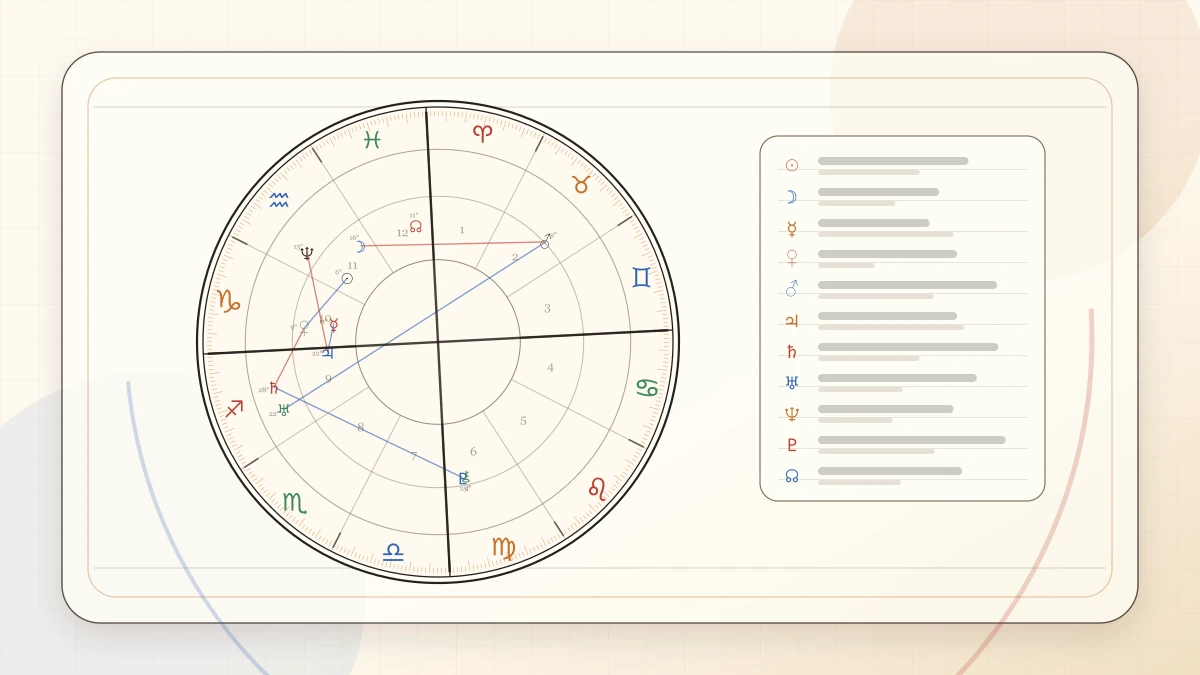
- Find the Sun on the wheel. The Ascendant (the zodiac degree rising in the east) and the Descendant (the point opposite it) split the chart into an upper and a lower half.
- On a standard wheel the Ascendant is on the left, and houses 7 to 12 fill the upper half. A Sun in houses 7 to 12 means a day chart.
- A Sun in houses 1 to 6, the lower half, means a night chart.
- If the Sun is within a few degrees of the Ascendant or Descendant, test the birth time. The Ascendant moves about 1 degree every 4 minutes, so a few minutes of doubt can move the Sun from one half to the other.
Which planets belong to the day and which to the night
The tradition gives each of the seven visible planets a side. The Sun, Jupiter and Saturn are the diurnal, or day, planets. The Moon, Venus and Mars are the nocturnal, or night, planets. Mercury changes sides: it counts as a day planet when it rises before the Sun and as a night planet when it rises after it.
Signs rise in zodiac order, so a Mercury behind the Sun in the zodiac, such as 10° Leo against a Sun at 20° Leo, rises first. Mercury stays within about 28° of the Sun, which makes the test quick. Count across sign lines, including the jump from Pisces to Aries: a Mercury at 28° Pisces is behind a Sun at 2° Aries.
| Planet | Side | In a day chart | In a night chart |
|---|---|---|---|
| Sun | Day | In sect | Out of sect |
| Jupiter | Day | In sect, the favorable planet of the sect | Out of sect |
| Saturn | Day | In sect, the difficult planet of the sect, read as milder | Out of sect |
| Moon | Night | Out of sect | In sect |
| Venus | Night | Out of sect | In sect, the favorable planet of the sect |
| Mars | Night | Out of sect | In sect, the difficult planet of the sect, read as milder |
| Mercury | Either | In sect if it rises before the Sun | In sect if it rises after the Sun |
In sect, out of sect, and the two planets of the sect
A planet is “in sect” when its side matches the chart: a day planet in a day chart, or a night planet in a night chart. Traditional astrologers read an in-sect planet as working more smoothly and comfortably. An out-of-sect planet is read as working with more effort, though that is a matter of degree and not a verdict.
Two planets get special roles. The favorable planet of the sect is Jupiter in a day chart and Venus in a night chart. The difficult planet of the sect is Saturn in a day chart and Mars in a night chart. The traditional idea is that each difficult planet is milder when it sits in its own sect, and that Mars in a day chart or Saturn in a night chart is the harder case.
A constructed pair: one Rising sign, a day Sun and a night Sun
Both charts here are constructed for teaching. Each has an Ascendant of 12° Sagittarius. Counting from 0° Aries, Sagittarius runs from 240° to 270°, so the Ascendant is at 240 + 12 = 252°. The Descendant is 180° away: 252 + 180 = 432, minus 360, gives 72°, which is 12° Gemini.
The lower half of the wheel runs from 252° through 0° to 72°. Chart A has the Sun at 20° Leo, which is 120 + 20 = 140°. That lies between 72° and 252°, so the Sun is above the horizon and the chart is a day chart. Chart B has the Sun at 20° Taurus, which is 30 + 20 = 50°. That falls in the lower half, so it is a night chart. Counting whole-sign houses from Sagittarius, the Sun is in the 9th house in A and the 6th in B.
Now the planets. In chart A, Jupiter is the favorable planet of the sect and Saturn the difficult planet in its own sect, read as milder; Venus and Mars are out of sect. A Mercury at 10° Leo is 10° behind the Sun, rises first and counts as a day planet, so it is in sect. In chart B the roles swap: Venus is favorable, Mars is the difficult planet in its own sect, and a Mercury at 28° Taurus is 8° ahead of the Sun, so it rises after it and is in sect as a night planet.
When the house count and the real horizon disagree
Whole-sign houses label entire signs, so a house number can disagree with the true horizon. Suppose the Ascendant is 28° Sagittarius (240 + 28 = 268°). The Descendant is then 268 + 180 − 360 = 88°, or 28° Gemini. A Sun at 10° Gemini (70°) is 18° short of it, so it is still below the horizon. Yet Gemini is the 7th sign counting from Sagittarius, so a whole-sign count calls it a 7th-house Sun and hints at a day chart.
Astrologers differ on which test to use. This guide follows the true horizon; say which one you used.
How much weight modern astrologers give sect
Sect is a traditional doctrine, and many modern astrologers use it little or not at all. A reading in a modern psychological style usually goes straight to signs, houses and aspects, and describes Jupiter, Saturn, Venus and Mars the same way in every chart.
Whether an in-sect Saturn really feels milder is not something a chart can show. Treat sect as a lens you can try on or leave, and as a tie-breaker, not a rating of a person or a life.
Try sect on your own chart in ten minutes
Pick a chart you know well, ideally your own with a reliable birth time.
- Decide day or night from the Sun’s true position, and note how close the Sun is to the horizon.
- Circle the favorable planet and the difficult planet of your sect, and note their signs and houses.
- Mark each of the seven planets as in sect or out of sect, using the table above.
- Ask where life feels easy and where it takes effort, and drop the idea if it fits poorly.
What this does and does not establish
Sect is a traditional idea that modern astrologers weigh very differently, so test it against your own life and drop it if it fits poorly.
Related calculators
Use the matching tool when you want a direct chart or timing result after reading the guide.
Free Birth Chart Calculator
Create a birth chart from birth date, time, and place to review placements, houses, angles, and aspects.
Rising Sign Calculator
Exact Ascendant verification from full birth-chart math for practical house and Big 3 interpretation.
12 Houses Calculator
Complete 12-house overview page for readers who want the full natal house framework before drilling into one exact placement.
Calculation references
- Swiss Ephemeris: positions, angles and house-system conventions
Technical reference for calculation conventions. It does not certify an interpretation or mean every live tool uses this engine.
Related articles
Keep reading with nearby topics that deepen the same question from another angle.
Chart Ruler by Rising Sign Explained
Your chart ruler is the traditional ruler of your Rising sign, such as Venus for Libra or Saturn for Capricorn. Read its sign, house and aspects to see where the chart's agenda is carried out.
6 min read
Mutual Reception Meaning in Astrology
Mutual reception happens when two planets each sit in a sign the other rules, such as Venus in Aries and Mars in Libra. Traditional astrologers read the exchange as a link between the two.
7 min read
How to Read Your Birth Chart: A Beginner's Guide
Read your birth chart in five steps: find the Sun, Moon and Rising sign, count the elements, note crowded houses, locate the chart ruler, then read the two or three closest aspects.
6 min read
Sun, Moon, and Rising Signs Explained
Your Sun sign describes what you are aiming to be, your Moon sign what you need to feel settled, and your Rising sign how you meet the world and how it first meets you.
6 min read
Keep exploring
Use the category page and the main hubs when you want the next layer of context.
Previous article
Chart Ruler by Rising Sign Explained
Next article
Mutual Reception Meaning in Astrology