
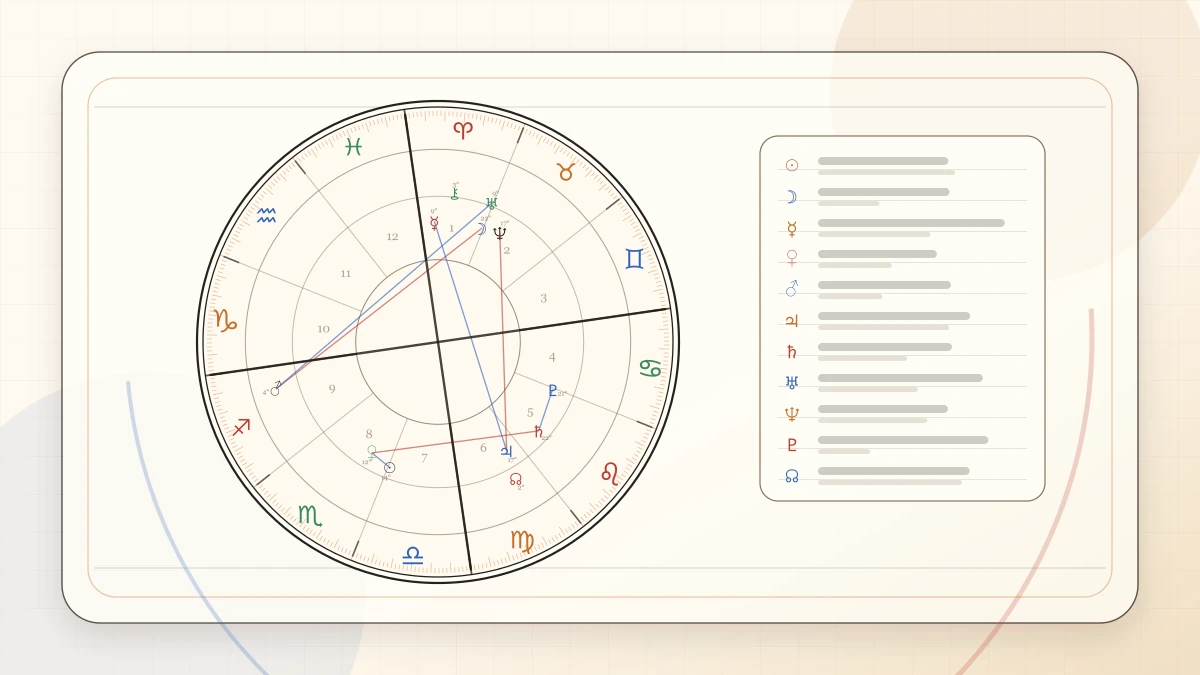
Birth Chart Basics
Chart Ruler by Rising Sign Explained
Your chart ruler is the traditional ruler of your Rising sign, such as Venus for Libra or Saturn for Capricorn. Read its sign, house and aspects to see where the chart's agenda is carried out.
Table of contents
- Example or practical exercise
- What a chart ruler is and why it gets its own reading
- The twelve Rising signs, their rulers and the houses they rule
- How to read the chart ruler by sign, house and aspect
- Constructed example: Libra Rising with Venus in Pisces
- Constructed example: Capricorn Rising with Saturn in Cancer
- When a modern ruler enters the picture
- Common slips with chart rulers
- A boundary case: when the Rising degree sits on a sign edge
- Questions readers ask about chart rulers
- What this does and does not establish
Example or practical exercise
In a constructed Libra-rising chart, Venus at 25 degrees Pisces sits exalted in the sixth house and trines Mars in Scorpio within 2 degrees, carrying the Libra agenda through daily routines and work habits.
What a chart ruler is and why it gets its own reading
The chart ruler is the planet that rules your Rising sign. The Ascendant stands for how a chart begins, so tradition treats this planet as a steward of the whole chart: where it sits shows where the Rising sign’s way of working gets applied.
Every Rising sign has a traditional ruler, and three have a modern one as well. This guide uses the traditional rulers and flags the modern ones where they differ.
The twelve Rising signs, their rulers and the houses they rule
The third column counts houses in whole-sign houses. A ruler of two signs rules the 1st house and one other. In a real chart the ruler can sit in any house, but one placed in a house it rules is read as at home.
| Rising sign | Chart ruler | Houses it rules | Detail to check |
|---|---|---|---|
| Aries | Mars | 1 and 8 | Which house receives Mars’s drive |
| Taurus | Venus | 1 and 6 | Venus stays within about 47° of the Sun |
| Gemini | Mercury | 1 and 4 | Mercury stays within about 28° of the Sun |
| Cancer | Moon | 1 | The Moon changes sign about every 2.3 days, so birth time matters |
| Leo | Sun | 1 | The Sun’s house is also the day or night test |
| Virgo | Mercury | 1 and 10 | Mercury stays within about 28° of the Sun |
| Libra | Venus | 1 and 8 | Venus stays within about 47° of the Sun |
| Scorpio | Mars (modern: Pluto) | 1 and 6 | State whether you read Mars or Pluto |
| Sagittarius | Jupiter | 1 and 4 | Jupiter spends about a year in each sign |
| Capricorn | Saturn | 1 and 2 | Saturn spends about 2.5 years in each sign |
| Aquarius | Saturn (modern: Uranus) | 1 and 12 | Uranus spends about 7 years in each sign |
| Pisces | Jupiter (modern: Neptune) | 1 and 10 | Neptune spends about 14 years in each sign |
How to read the chart ruler by sign, house and aspect
Think of the ruler as a guide to the chart. Its sign says how, its house says where and its aspects say what it works with.
- Find the ruler in the table and locate it on your chart.
- Read its sign as the style the Rising sign’s agenda takes in practice. Mars in Aries acts head-on, for example, while Mars in Cancer acts more cautiously and protectively.
- Read its house as the area of life where that agenda is most active.
- Note its tightest aspects, within about 6° to 8°, and what they link it to.
- Check whether it sits in a sign or house it rules, or in the sign opposite its own, which tradition reads as working against the grain.
- Finish with one sentence: the Rising sign sets the tone, and the ruler says where it lands.
Constructed example: Libra Rising with Venus in Pisces
This chart is constructed for teaching. The Ascendant is 14° Libra, so Libra is the 1st house, and the ruler is Venus. Place Venus at 25° Pisces, which is 330 + 25 = 355°. Counting whole-sign houses from Libra (Libra 1, Scorpio 2, Sagittarius 3, Capricorn 4, Aquarius 5, Pisces 6), Venus is in the 6th house.
Pisces is the sign where tradition says Venus is exalted, a position of honor. A tradition-minded sentence reads: affection and taste, the Libra Rising agenda, are carried through daily routines, work habits and everyday service. Add Mars at 27° Scorpio, which is 210 + 27 = 237°. The gap from Venus is 355 − 237 = 118°, a trine within 2°, linking the ruler to Mars in the 2nd house of values and resources.
Constructed example: Capricorn Rising with Saturn in Cancer
In this second constructed chart the Ascendant is 3° Capricorn, which is 270 + 3 = 273°. The ruler is Saturn. Put Saturn at 19° Cancer, which is 90 + 19 = 109°. Counting from Capricorn (Capricorn 1, Aquarius 2, Pisces 3, Aries 4, Taurus 5, Gemini 6, Cancer 7), Saturn is in the 7th house.
The Descendant is 273 − 180 = 93°, or 3° Cancer, so Saturn sits 109 − 93 = 16° past it. Saturn also stands in the sign opposite its own, Capricorn, which tradition reads as working against the grain. The reading is a theme, not a prediction: the Capricorn Rising agenda of discipline and responsibility gets worked out through other people, partnerships and agreements.
When a modern ruler enters the picture
For Scorpio, Aquarius and Pisces Rising, modern astrologers name Pluto, Uranus and Neptune. Pluto spends from about 12 to about 31 years in a sign, Uranus about 7 and Neptune about 14. Everyone born within a few years shares the sign of a modern ruler, so its house and aspects do most of the personalizing.
Pick one scheme and label it. Reading the other as a second layer is fine, but swapping rulers in the middle of a sentence confuses both.
Common slips with chart rulers
A few mistakes come up again and again. Check your own reading against them.
- Using your Sun sign’s ruler instead of your Rising sign’s ruler. They are two different questions.
- Forgetting that the Sun rules only Leo, so Leo is the only Rising sign whose chart ruler is the Sun.
- Trusting a rough birth time. The Ascendant moves about 1° every 4 minutes, so a time that is off can give the wrong Rising sign and therefore the wrong ruler.
- Treating the ruler’s house as a prediction instead of a place where a theme tends to concentrate.
A boundary case: when the Rising degree sits on a sign edge
Suppose a made-up chart has an Ascendant of 29 degrees 40 minutes of Libra. The Ascendant moves about 1 degree every 4 minutes, and it needs only 20 minutes of arc, a third of a degree, to reach Scorpio. A third of 4 minutes is about 80 seconds. A birth time off by a minute or two can move the Rising sign from Libra to Scorpio and the chart ruler from Venus to Mars.
The rate varies with latitude and with the sign rising, so treat 4 minutes per degree as an average. If your Ascendant is within about a degree of a sign edge, check the birth record, and read both possible rulers as separate questions until the time is settled. Do not pick the ruler that sounds nicer.
Questions readers ask about chart rulers
Can the chart ruler be retrograde? Yes, unless it is the Sun or Moon, which never are. The retrograde adds a note about manner, and the ruler’s sign, house and aspects still do most of the work.
What if the ruler sits in the Rising sign itself? Then it is in its own sign and in the 1st house, so the way you come across and the way you pursue things tend to match. Venus in Taurus with Taurus Rising is one example.
What this does and does not establish
When the Rising degree sits within about a degree of a sign edge, a minute or two of birth time can change the ruler entirely.
Related calculators
Use the matching tool when you want a direct chart or timing result after reading the guide.
Free Birth Chart Calculator
Create a birth chart from birth date, time, and place to review placements, houses, angles, and aspects.
Rising Sign Calculator
Exact Ascendant verification from full birth-chart math for practical house and Big 3 interpretation.
12 Houses Calculator
Complete 12-house overview page for readers who want the full natal house framework before drilling into one exact placement.
Calculation references
- Swiss Ephemeris: positions, angles and house-system conventions
Technical reference for calculation conventions. It does not certify an interpretation or mean every live tool uses this engine.
Related articles
Keep reading with nearby topics that deepen the same question from another angle.
How to Read Intercepted Signs in a Birth Chart
An intercepted sign lies wholly inside one house without touching any cusp, which happens only in unequal house systems such as Placidus. Its opposite sign is intercepted too, and two other signs repeat on cusps.
6 min read
Day Chart vs Night Chart Explained
A day chart has the Sun above the horizon at birth and a night chart has it below. This is called sect, and it changes which planets traditional astrologers treat as most helpful.
7 min read
How to Read Your Birth Chart: A Beginner's Guide
Read your birth chart in five steps: find the Sun, Moon and Rising sign, count the elements, note crowded houses, locate the chart ruler, then read the two or three closest aspects.
6 min read
Sun, Moon, and Rising Signs Explained
Your Sun sign describes what you are aiming to be, your Moon sign what you need to feel settled, and your Rising sign how you meet the world and how it first meets you.
6 min read
Keep exploring
Use the category page and the main hubs when you want the next layer of context.
Previous article
How to Read Intercepted Signs in a Birth Chart
Next article
Day Chart vs Night Chart Explained