
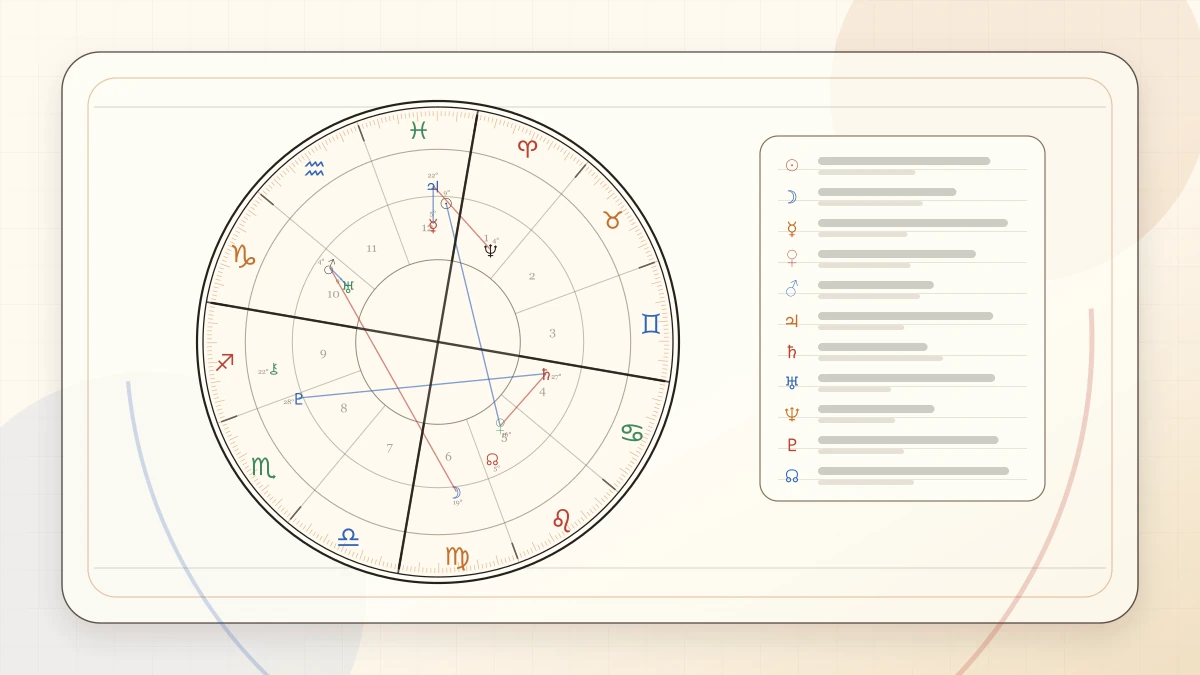
Birth Chart Basics
How to Find Your Dominant Element in a Birth Chart
Count the ten planets by the element of their signs, then recount giving two points each to the Sun, Moon and Ascendant. Compare the two totals to see which element leads.
Table of contents
- Example or practical exercise
- What a dominant element is and what it is not
- Which bodies and points to count
- Weighting the Sun, Moon and Ascendant
- Counting your own elements step by step
- A worked count on a constructed chart
- What an emphasized element and a missing element can suggest
- How to avoid overreading a tie or a narrow lead
- A second count where the choice of bodies changes the result
- Where traditions measure temperament differently
- What this does and does not establish
Example or practical exercise
In a constructed chart, air and earth tie at 3 in the plain count, but weighting puts air ahead 6 to 4; a birth more than about 12 minutes earlier would move the Ascendant into Virgo and flip the result.
What a dominant element is and what it is not
A dominant element is the element, fire, earth, air or water, that appears most often among the signs in your chart. The elements group the twelve signs in threes. Fire is Aries, Leo and Sagittarius; earth is Taurus, Virgo and Capricorn; air is Gemini, Libra and Aquarius; water is Cancer, Scorpio and Pisces. Counting them gives a quick picture of where a chart leans.
It is arithmetic first and interpretation second. The result depends entirely on rules you choose: which bodies to include and whether some count more. Two careful astrologers can name different winners for the same chart, so state your rules each time.
Which bodies and points to count
The core set is the ten bodies, the Sun, Moon, Mercury, Venus, Mars, Jupiter, Saturn, Uranus, Neptune and Pluto, each counted by the sign it occupies. Many astrologers also add the Ascendant, the most personal point in the chart. Count signs, not houses: a planet’s house does not change its element.
Uranus, Neptune and Pluto stay in a sign for years, so they push a whole generation toward the same elements. Some astrologers leave them out for that reason, and either choice is fine if stated. Leave the lunar nodes, Chiron and asteroids for a second pass, since each needs its own convention.
Weighting the Sun, Moon and Ascendant
A plain count gives every body one point. A weighted count gives the Sun, Moon and Ascendant two points each, on the reasoning that they carry more of the chart’s identity. There is no standard weight, and some astrologers use three or give extra to the chart ruler.
This guide uses two points for those three and one for every other body. With all ten bodies and the Ascendant, the total is 3 × 2 + 8 = 14 points.
Counting your own elements step by step
You need a chart with the sign of each body and, for the weighted version, the Rising sign.
- List each body and the Ascendant with its sign.
- Write the element beside each sign.
- Give one point per body, and two points to the Sun, Moon and Ascendant for the weighted version.
- Add up each element and check that the plain total is 10 and the weighted total is 14.
- Compare the two results and note where they differ.
- Check the Ascendant if it is within about 3° to 5° of a sign boundary, since 1° is about 4 minutes of birth time, and check the Moon and any other body within about 1° of one. A small birth-time error can move the Ascendant across a sign line, and the Moon, at about 13° a day, can cross one as well.
A worked count on a constructed chart
This chart is constructed for teaching. The Sun is at 25° Gemini, the Moon 12° Virgo, the Ascendant 3° Libra, Mercury 8° Cancer, Venus 20° Taurus, Mars 14° Aquarius, Jupiter 6° Leo, Saturn 17° Virgo, Uranus 15° Scorpio, Neptune 10° Sagittarius and Pluto 2° Libra.
| Element | Placements | Plain count (10 bodies) | Weighted count (14 points) |
|---|---|---|---|
| Fire | Jupiter in Leo, Neptune in Sagittarius | 2 | 2 |
| Earth | Moon in Virgo, Venus in Taurus, Saturn in Virgo | 3 | 4 |
| Air | Sun in Gemini, Mars in Aquarius, Pluto in Libra, Ascendant in Libra | 3 | 6 |
| Water | Mercury in Cancer, Uranus in Scorpio | 2 | 2 |
What an emphasized element and a missing element can suggest
Tradition describes each element in broad strokes. These are descriptions of themes, not abilities a person has or lacks.
- Fire emphasized: energy, enthusiasm and a drive to act. The edge is hurry.
- Earth emphasized: practicality, steadiness and attention to the tangible. The edge is resisting change.
- Air emphasized: ideas, conversation and perspective. The edge is staying in the head.
- Water emphasized: feeling, empathy and memory. The edge is being swamped by mood.
- A missing element, with no body in those signs, is read as a theme to approach more consciously. The Ascendant, houses and aspects can still carry that element’s themes.
How to avoid overreading a tie or a narrow lead
In the plain count above, air and earth tie at 3. A tie is not a result. The weighted count puts air at 6 against earth at 4, because the Sun and Ascendant are both air. A lead of 2 points on 14 is modest, so the honest summary is that air leads, earth follows, and fire and water are lighter.
Check how stable the count is. The Ascendant at 3° Libra is 3° past the sign boundary. At 1° every 4 minutes, a birth time more than about 12 minutes earlier would put it in Virgo, an earth sign. Then air drops to 4 and earth rises to 6, and the winner flips. When a count depends on a few minutes of birth time, report both versions and call it a lean. There is no official threshold for a clear lead, but a gap of three or more points is easier to defend than one.
A second count where the choice of bodies changes the result
This second chart is constructed for teaching. The Sun is at 4° Aries, the Moon 21° Sagittarius, the Ascendant 18° Cancer, Mercury 28° Pisces, Venus 9° Taurus, Mars 15° Virgo, Jupiter 2° Capricorn, Saturn 25° Virgo, Uranus 20° Pisces, Neptune 20° Aquarius and Pluto 1° Capricorn. Count it three ways.
Earth leads in the first two counts, then ties with fire in the third, because leaving out the outer planets removes Pluto in Capricorn, earth's fifth placement and a generational one that everyone born in those years shares. The honest summary is that earth and fire lead and water is a strong third through the Ascendant. Air is lightest on every count, which is a theme to notice and not a missing skill.
| Rule | Fire | Earth | Air | Water | Total |
|---|---|---|---|---|---|
| Plain, ten bodies | 2 | 5 | 1 | 2 | 10 |
| Weighted, ten bodies plus Ascendant | 4 | 5 | 1 | 4 | 14 |
| Weighted, without Uranus, Neptune and Pluto | 4 | 4 | 0 | 3 | 11 |
Where traditions measure temperament differently
Counting ten bodies is a modern habit. Some traditional methods judge temperament from a short list instead, such as the Rising sign, its ruler, the Moon and the season of birth, and they describe the result with the old four temperaments rather than a tally.
The two approaches answer slightly different questions, so name which one you are using. Neither has good evidence behind it as a measure of personality. Use the result as a prompt for reflection.
What this does and does not establish
An element count is arithmetic about symbols, so a narrow lead is only a lean and a missing element is not a missing ability.
Related calculators
Use the matching tool when you want a direct chart or timing result after reading the guide.
Free Birth Chart Calculator
Create a birth chart from birth date, time, and place to review placements, houses, angles, and aspects.
Rising Sign Calculator
Exact Ascendant verification from full birth-chart math for practical house and Big 3 interpretation.
12 Houses Calculator
Complete 12-house overview page for readers who want the full natal house framework before drilling into one exact placement.
Calculation references
- Swiss Ephemeris: positions, angles and house-system conventions
Technical reference for calculation conventions. It does not certify an interpretation or mean every live tool uses this engine.
Related articles
Keep reading with nearby topics that deepen the same question from another angle.
How to Read Retrograde Planets in the Houses
Start with the house topic, then add the retrograde as a note on style: the planet's themes in that area of life are handled more inwardly, privately or with repeated review.
6 min read
How to Read Your Birth Chart: A Beginner's Guide
Read your birth chart in five steps: find the Sun, Moon and Rising sign, count the elements, note crowded houses, locate the chart ruler, then read the two or three closest aspects.
6 min read
Sun, Moon, and Rising Signs Explained
Your Sun sign describes what you are aiming to be, your Moon sign what you need to feel settled, and your Rising sign how you meet the world and how it first meets you.
6 min read
How Birth Time Changes Your Chart
Birth time sets your Rising sign, Midheaven and house placements, because the Ascendant moves about one degree every four minutes. Most planet signs stay the same across the day.
6 min read
Keep exploring
Use the category page and the main hubs when you want the next layer of context.
Previous article
How to Read Retrograde Planets in the Houses
Next article
How Zodiac Signs Handle Conflict