
Birth Chart Basics
How to Read Retrograde Planets in the Houses
Start with the house topic, then add the retrograde as a note on style: the planet's themes in that area of life are handled more inwardly, privately or with repeated review.
Table of contents
- Example or practical exercise
- Start with the house, then add the retrograde
- House by house: what a retrograde planet may add
- How a retrograde reads in a house
- Three constructed examples, one for each house type
- How much weight to give a retrograde
- A five-step house routine for each retrograde planet
- When the ruler of a house is retrograde
- Questions readers ask about retrogrades in the houses
- What this does and does not establish
Example or practical exercise
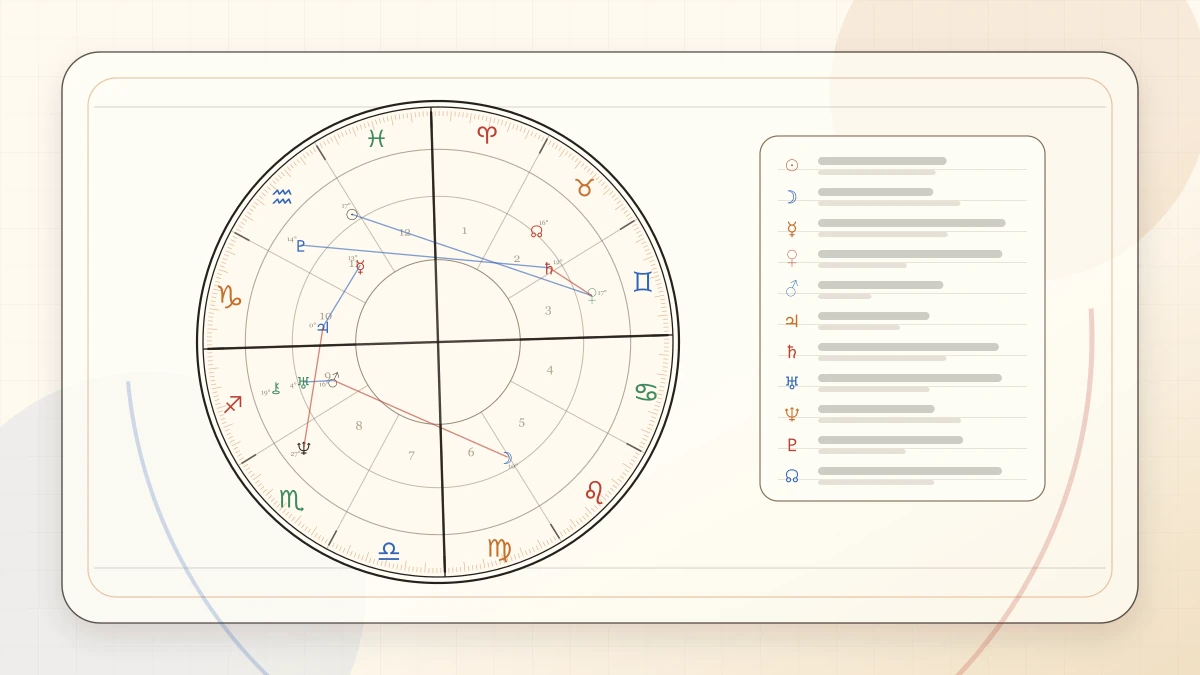
In a constructed Cancer-rising chart, Mercury retrograde at 20 degrees Pisces falls in the ninth house, suggesting ideas about belief and meaning mulled over through rereading and private study before they are spoken.
Start with the house, then add the retrograde
This guide answers one narrow question: once you have found a retrograde planet in your chart, what does the mark add to the house that planet sits in? The basics, what the R or Rx means, how often each planet goes retrograde and how different schools read it, are covered in our guide to what retrograde planets mean in a natal chart, so they are not repeated here.
The working rule for this page is simple. The house decides the topic and the retrograde adds a note about manner. A retrograde planet in the second house is still about money and what you value; the mark only suggests the topic is handled in a more reviewing, private or unhurried way. Many astrologers give that note little weight, so treat everything below as a question to test, not a finding.
House by house: what a retrograde planet may add
Each row gives the house topic and one common way a retrograde planet there is read, phrased so you can test it against your own experience. The planet’s own function still matters: a retrograde Mars in the sixth is about effort at work, a retrograde Venus there about how pleasant the working day feels.
| House | Topic | What the retrograde may add |
|---|---|---|
| 1st | Self-presentation and approach | A first impression that is considered rather than instant |
| 2nd | Money, possessions and values | Values rethought over time rather than inherited whole |
| 3rd | Daily talk, siblings, learning | Words drafted in the head before they are spoken |
| 4th | Home, family and roots | Family history revisited and reinterpreted in adult life |
| 5th | Play, romance and creativity | Creative work kept private until it feels ready |
| 6th | Routines, work tasks and health habits | Daily methods adjusted by trial, review and redoing |
| 7th | Close partnerships | Commitments weighed slowly, with a habit of reviewing them |
| 8th | Shared resources and intimacy | Trust built gradually and reconsidered in private |
| 9th | Belief, study and travel | Convictions worked out alone rather than taken from teachers |
| 10th | Career and public role | Ambitions measured against an inner standard first |
| 11th | Friends, groups and hopes | A small circle chosen carefully, and goals often revised |
| 12th | Rest, retreat and the inner life | A rich private reflective life, often unseen by others |
How a retrograde reads in a house
Keep the layers separate. The retrograde does not move the planet to another house or change its aspects. It adds a note about manner.
Think of tone of voice. The words, which are the planet, sign and house, stay the same, and the retrograde changes how they are delivered: quieter, slower or more considered.
- Read the planet as the function.
- Read the sign as the style.
- Read the house as the topic.
- Add the retrograde as a nuance of manner: more reflective, slower or reviewing.
- Check the aspects as you normally would. They are not changed by the retrograde.
Three constructed examples, one for each house type
All three charts are constructed for teaching and use whole-sign houses. Angular house: Taurus is Rising and Venus is retrograde at 12° Scorpio, which is 210 + 12 = 222°. Counting from Taurus (Taurus 1, Gemini 2, Cancer 3, Leo 4, Virgo 5, Libra 6, Scorpio 7), Venus is in the 7th house. A tradition-minded sentence reads: values and affection are weighed privately and intensely in close one-to-one relationships, with a habit of reviewing what is worth committing to.
Succedent house: Libra is Rising and Saturn is retrograde at 15° Taurus, which is 30 + 15 = 45°. Counting from Libra (Libra 1, Scorpio 2, Sagittarius 3, Capricorn 4, Aquarius 5, Pisces 6, Aries 7, Taurus 8), Saturn is in the 8th house. The sentence reads: caution about shared money and trust, with standards for what is fair worked out privately rather than borrowed. A direct Saturn in the same place would differ only in tone.
Cadent house: Cancer is Rising and Mercury is retrograde at 20° Pisces, which is 330 + 20 = 350°. Counting from Cancer (Cancer 1, Leo 2, Virgo 3, Libra 4, Scorpio 5, Sagittarius 6, Capricorn 7, Aquarius 8, Pisces 9), Mercury is in the 9th house. The sentence reads: ideas about belief and meaning are mulled over at length, perhaps through rereading and private study, before they are put into words.
How much weight to give a retrograde
The retrograde idea is interpretive. There is no way to test it as a rule, and astrologers disagree about how much it matters. Do not read a retrograde in a house as a predicted failure there. A natal retrograde and a retrograde happening in the sky now are separate matters.
A practical approach is to note the retrograde, write the question from the table in your notes, and compare it with your own history. If the inward style fits, it earns a place in your reading. If it does not, leave it out.
A five-step house routine for each retrograde planet
Once your retrograde planets are listed, this routine keeps the house in charge of the reading.
- Write each retrograde planet beside its house, and name the house system your chart uses.
- Describe the house topic in plain words before you think about the retrograde at all.
- Read that house’s row in the table above and turn it into one question about your own life.
- Look up the ruler of the sign on that house. If the ruler is also retrograde, note it, since the house then carries the theme twice.
- If two or more retrograde planets share a house, write one combined sentence for the house instead of separate ones.
When the ruler of a house is retrograde
A planet can color a house without sitting in it. Every house has a sign on its cusp, and the planet that rules that sign is the house ruler. Some astrologers carry the retrograde note to every house a planet rules. In a constructed Virgo Rising chart with whole-sign houses, a retrograde Mercury would then touch the 1st house (Virgo) and the 10th (Gemini, ten signs on) as well as the house it occupies.
Others apply the note only to the house the planet occupies. The first approach spreads the theme across several topics, and the second keeps it in one place. Choose one, label it in your notes and keep it for the whole chart.
Questions readers ask about retrogrades in the houses
Does a retrograde change which house a planet is in? No. The house depends on the planet’s position and your birth time and place, not on its direction. Only a change of house system can move a planet near a cusp into the neighboring house.
Is a house with a retrograde planet a problem area? No. The mark describes a style of handling the topic, not trouble with it, and many people handle that part of life with real skill.
Do the outer planets matter here? Uranus, Neptune and Pluto are retrograde for several months every year, so many people share the mark, and their house and aspects personalize them.
What this does and does not establish
A retrograde in a house is not a predicted failure there, and the idea cannot be tested as a rule, so keep it only if it fits.
Related calculators
Use the matching tool when you want a direct chart or timing result after reading the guide.
Free Birth Chart Calculator
Create a birth chart from birth date, time, and place to review placements, houses, angles, and aspects.
Rising Sign Calculator
Exact Ascendant verification from full birth-chart math for practical house and Big 3 interpretation.
12 Houses Calculator
Complete 12-house overview page for readers who want the full natal house framework before drilling into one exact placement.
Calculation references
- Swiss Ephemeris: positions, angles and house-system conventions
Technical reference for calculation conventions. It does not certify an interpretation or mean every live tool uses this engine.
Related articles
Keep reading with nearby topics that deepen the same question from another angle.
Mutual Reception Meaning in Astrology
Mutual reception happens when two planets each sit in a sign the other rules, such as Venus in Aries and Mars in Libra. Traditional astrologers read the exchange as a link between the two.
7 min read
How to Find Your Dominant Element in a Birth Chart
Count the ten planets by the element of their signs, then recount giving two points each to the Sun, Moon and Ascendant. Compare the two totals to see which element leads.
6 min read
How to Read Your Birth Chart: A Beginner's Guide
Read your birth chart in five steps: find the Sun, Moon and Rising sign, count the elements, note crowded houses, locate the chart ruler, then read the two or three closest aspects.
6 min read
Sun, Moon, and Rising Signs Explained
Your Sun sign describes what you are aiming to be, your Moon sign what you need to feel settled, and your Rising sign how you meet the world and how it first meets you.
6 min read
Keep exploring
Use the category page and the main hubs when you want the next layer of context.
Previous article
Mutual Reception Meaning in Astrology
Next article
How to Find Your Dominant Element in a Birth Chart