
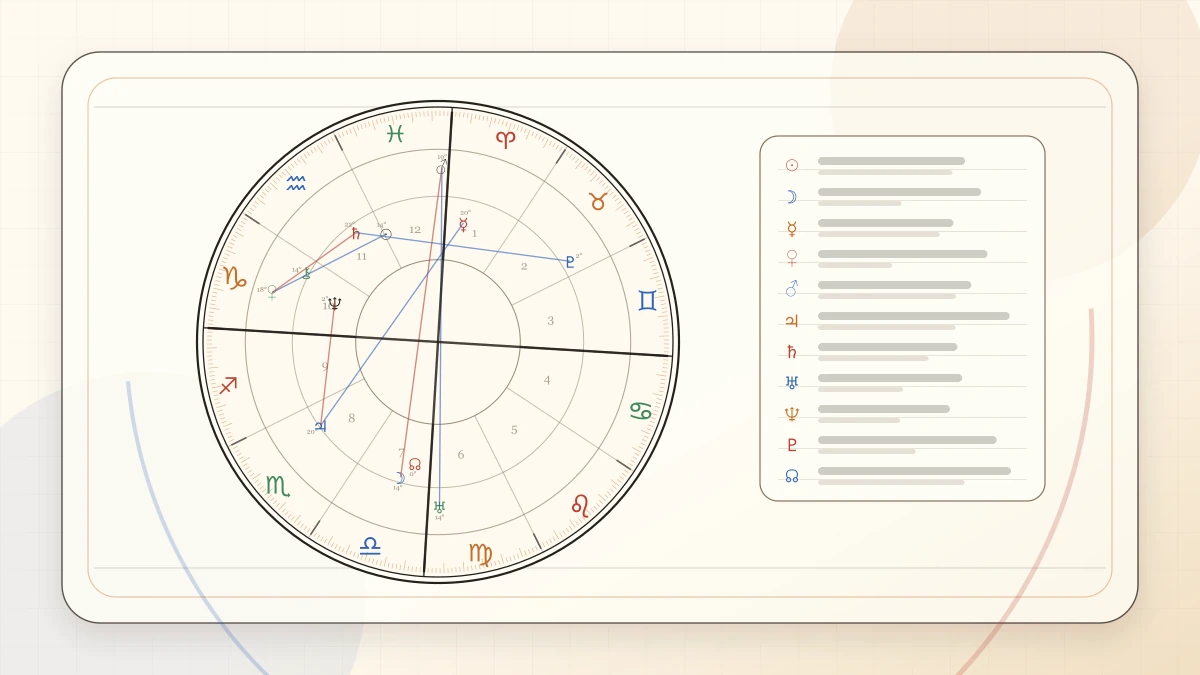
Birth Chart Basics
North Node and South Node: A Beginner's Guide
The lunar nodes are the two points where the Moon's orbit crosses the Sun's path, always opposite each other. Modern readers treat the South Node as familiar ground and the North Node as growth.
Table of contents
- Example or practical exercise
- What the lunar nodes are, in plain astronomy
- Mean node or true node, and how to find yours
- The six node axes by sign pair
- Familiar versus growing toward: a modern reading
- Which house your nodes fall in
- The nodal return and the ages it falls at
- A constructed chart: North Node in Taurus, 11th house
- Reading your own nodes in five steps
- What this does and does not establish
Example or practical exercise
In Dana's constructed Cancer-rising chart, the North Node at 14 degrees Taurus in the eleventh puts the South Node at 14 degrees Scorpio in the fifth, contrasting intense private involvement with steadier group goals.
What the lunar nodes are, in plain astronomy
The lunar nodes are two points, not two objects. The Moon’s orbit is tilted about 5 degrees from the ecliptic, the path the Sun appears to follow through the zodiac over a year, so the two paths cross in two places. Where the Moon crosses heading north is the North Node; where it crosses heading south is the South Node.
The two nodes are always exactly opposite, so a North Node at 10 degrees of one sign means a South Node at 10 degrees of the opposite sign. They move backward through the zodiac, circling it in about 18.6 years, which is about 1.5 years per sign. Eclipses happen near them, which is one reason astrologers watch them. Older European texts call them the Dragon’s Head and Tail, and Vedic astrology uses Rahu and Ketu with methods of its own; this guide describes the modern Western habit.
Mean node or true node, and how to find yours
Two calculations are in use. The mean node is a smoothed average that glides steadily backward. The true node follows the Moon’s actual, slightly uneven path and wobbles around the mean by a degree or two. Astrologers use one or the other, and neither is the official one.
For most people the two give the same sign and house, so the choice rarely changes a reading. It matters when a node sits near the edge of a sign, so note which one your chart uses. To find yours, enter your birth date, time and place in the birth chart calculator on this site. Without a birth time the sign is usually still dependable, since the node moves only about 1.6 degrees a month, but the house is not.
The six node axes by sign pair
Twelve signs make six axes. Each pair is listed both ways, because the same two signs read differently depending on which end holds the North Node. The wording is modern interpretive shorthand, not a rule.
| North Node in | South Node in | Familiar side (South Node) | Growing toward (North Node) |
|---|---|---|---|
| Aries | Libra | Weighing others, keeping the peace | Acting on your own preference, starting things |
| Libra | Aries | Self-reliance, going first | Cooperation, listening, shared decisions |
| Taurus | Scorpio | Intensity, merging, high stakes | Steadiness, simple pleasures, building slowly |
| Scorpio | Taurus | Comfort, routine, holding what is secure | Depth, honesty about feelings, shared risk |
| Gemini | Sagittarius | Big-picture belief, certainty | Curiosity, asking questions, nearby connection |
| Sagittarius | Gemini | Gathering facts, staying flexible | Conviction, meaning, wider horizons |
| Cancer | Capricorn | Duty, control, self-reliance | Tending feelings, home, needing others |
| Capricorn | Cancer | Caretaking, staying in the safe nest | Structure, responsibility, public effort |
| Leo | Aquarius | Staying with the group, detachment | Creative self-expression, being seen |
| Aquarius | Leo | Seeking the spotlight and approval | Shared goals, friendships, serving a group |
| Virgo | Pisces | Drifting, imagining, going with the flow | Practical routines, skill, discernment |
| Pisces | Virgo | Analyzing, fixing, perfecting | Trust, imagination, tolerating imperfection |
Familiar versus growing toward: a modern reading
The common modern reading treats the South Node as what feels familiar, easy or automatic, and the North Node as what feels less familiar but worth growing toward. This is a twentieth-century idea built on top of the astronomy, not a tradition from antiquity. Many authors who teach it connect the nodes to past lives or karma; this guide does not, and treats the idea only as a reflection tool, with no claim about past lives, debts or destiny.
The useful part is the tension. A South Node trait is not a flaw to drop, since familiar skills carry real weight; the question is whether leaning on them alone leaves something out. The North Node is not a goal to achieve or a grade on your life. It is a direction to be curious about, and the reading expects it to feel awkward at first.
Which house your nodes fall in
The house adds the setting. Whether you use whole-sign houses or a quadrant system such as Placidus, the nodes land in opposite houses, because the points themselves are opposite. Whichever end holds the North Node is the side the reading invites you to explore.
- Houses 1 and 7: self-direction and partnership.
- Houses 2 and 8: what you own and earn, and what you share.
- Houses 3 and 9: everyday learning and wider belief.
- Houses 4 and 10: private roots and public role.
- Houses 5 and 11: creative play and groups of friends.
- Houses 6 and 12: daily routines, and rest, retreat and imagination.
The nodal return and the ages it falls at
The nodes return to the degree they held at your birth about every 18.6 years, which astrologers call the nodal return. Halfway through each cycle, about 9.3 years in, the nodes are swapped: the North Node sits on your natal South Node and the reverse. The ages are approximate, since the mean and true nodes can differ by a month or so.
| Point in the cycle | Arithmetic | Approximate age |
|---|---|---|
| First half return (nodes swapped) | 18.6 divided by 2 = 9.3 | about 9 |
| First nodal return | 18.6 | about 18 to 19 |
| Second half return | 18.6 times 1.5 = 27.9 | about 28 |
| Second nodal return | 18.6 times 2 = 37.2 | about 37 |
| Third half return | 18.6 times 2.5 = 46.5 | about 46 to 47 |
| Third nodal return | 18.6 times 3 = 55.8 | about 56 |
| Fourth half return | 18.6 times 3.5 = 65.1 | about 65 |
| Fourth nodal return | 18.6 times 4 = 74.4 | about 74 |
A constructed chart: North Node in Taurus, 11th house
Dana is a constructed person with a Cancer Rising sign and whole-sign houses. Her North Node is at 14 degrees of Taurus. To find the South Node, add 180 degrees. Taurus begins at 30 degrees on the full circle, so 14 degrees of Taurus is 44; 44 plus 180 is 224, which is 14 degrees into Scorpio, since Scorpio begins at 210.
Counting from Cancer as the 1st house, Taurus is the 11th and Scorpio the 5th. A modern reading would call intense, private, all-or-nothing involvement in creative or romantic life the familiar side, and the North Node would ask about steadier shared goals with friends and groups. The reading is a question, not a verdict.
Her first half return falls at about 9.3 years: at about 19.35 degrees a year, the node travels about 180 degrees backward (9.3 times 19.35), from 14 degrees of Taurus to 14 degrees of Scorpio.
Reading your own nodes in five steps
Treat the nodes as a prompt for reflection and nothing more.
- Write down the sign, degree and house of each node, and whether your chart uses the mean or true node.
- Check the arithmetic: the South Node should sit exactly 180 degrees from the North Node.
- Under the South Node, list two or three habits or skills that come easily in that sign and house.
- Under the North Node, choose one small action that stretches you toward the other end, such as asking a question where you usually answer.
- Note any planet within about 3 degrees of either node, since its themes join the axis, and look again in a few months to see what, if anything, shifted.
What this does and does not establish
The nodes offer a prompt for reflection rather than a verdict, and charts using the mean node or the true node may differ slightly.
Related calculators
Use the matching tool when you want a direct chart or timing result after reading the guide.
Free Birth Chart Calculator
Create a birth chart from birth date, time, and place to review placements, houses, angles, and aspects.
Moon Sign Calculator
Exact Moon-sign verification from full birth-chart math for practical emotional and compatibility use cases.
Rising Sign Calculator
Exact Ascendant verification from full birth-chart math for practical house and Big 3 interpretation.
Calculation references
- Swiss Ephemeris: positions, angles and house-system conventions
Technical reference for calculation conventions. It does not certify an interpretation or mean every live tool uses this engine.
Related articles
Keep reading with nearby topics that deepen the same question from another angle.
The 12 Houses Explained
The twelve houses split a birth chart into twelve areas of life, measured from the horizon at your birthplace. A planet's sign shows how it behaves, and its house shows where that behavior appears.
6 min read
How to Read Current Transits Without Overreacting to Every Aspect
Choose your question first, list the slow-planet contacts within a tight orb, then add fast ones only for timing. A Saturn contact lasting months outweighs a Moon contact lasting hours.
6 min read
How to Read Houses and Signs Together
A house is the area of life and a sign is the style. Read the sign on each house cusp, then follow its ruler to see where that area's story continues.
5 min read
What Retrograde Planets Mean in a Natal Chart
A natal retrograde means a planet appeared to move backward through the zodiac, as seen from Earth, when you were born. Modern readers describe its themes as worked on inwardly or revisited.
6 min read
Keep exploring
Use the category page and the main hubs when you want the next layer of context.
Previous article
How to Read Houses and Signs Together
Next article
What Retrograde Planets Mean in a Natal Chart