
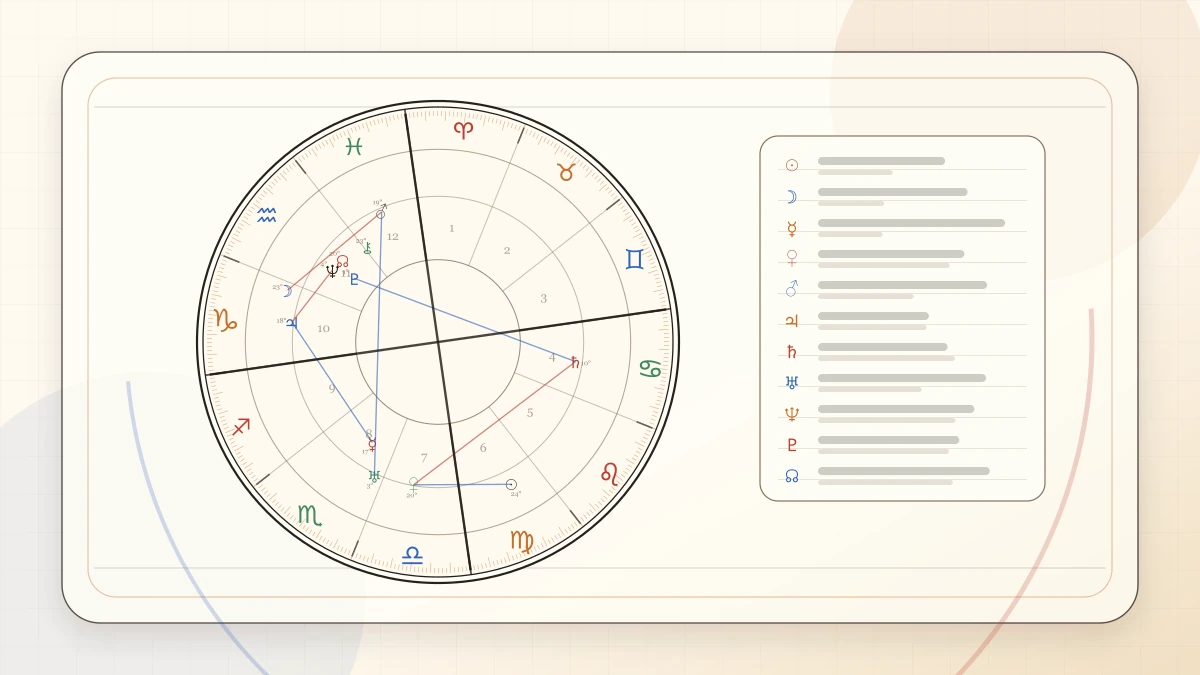
Birth Chart Basics
What Your Rising Sign Says About Your First Impression
Your Rising sign describes your manner when you meet someone new: how you enter a room, start a conversation and approach a fresh situation. It also sets the layout of the houses.
Table of contents
- Example or practical exercise
- What the Rising sign is
- Why it is linked with first impressions
- The twelve Rising signs
- It sets the whole chart, not just one label
- How accurate does the birth time need to be?
- Reading a Rising sign on a constructed chart
- Rising sign and Sun sign: which is “really” you?
- How to find your Rising sign step by step
- Questions readers ask about the Rising sign
- What this does and does not establish
Example or practical exercise
In a constructed chart with Virgo rising and an Aries Sun, the person comes across as careful and observant, with Mercury, the chart ruler, in Taurus in the ninth house, yet grows direct once introductions are over.
What the Rising sign is
The Rising sign, also called the Ascendant, is the sign of the zodiac that was coming up over the eastern horizon at the moment and place you were born. It is an astronomical fact about the horizon, not a planet.
Because the Earth turns once in twenty-four hours, the whole zodiac rises and sets every day. A new sign comes over the horizon roughly every two hours. Two babies born in the same hospital on the same day, six hours apart, share a Sun sign and almost certainly have different Rising signs.
Why it is linked with first impressions
The Ascendant marks the start of the first house, which astrologers have long associated with the body, appearance and the way a person begins things. From there comes the modern description: the Rising sign is the manner you lead with before anyone knows you well.
A helpful comparison is a front door. The Sun and Moon describe the rooms inside the house. The Rising sign is what visitors see from the street and how they are greeted. It is real, and it is also only the entrance.
The twelve Rising signs
One line each on how the sign tends to arrive. These describe a manner, so expect them to fit how strangers describe you better than how family does.
- Aries rising: direct, quick, physically energetic; gets straight to the point.
- Taurus rising: calm, unhurried, steady; takes time to warm up and then stays.
- Gemini rising: talkative, curious, quick to joke; asks a lot of questions.
- Cancer rising: gentle, watchful, protective; reads the room before speaking.
- Leo rising: warm, confident, noticeable; enjoys an audience.
- Virgo rising: neat, modest, observant; notices what needs fixing.
- Libra rising: charming, polite, agreeable; works to put others at ease.
- Scorpio rising: reserved, intense, private; watches more than it reveals.
- Sagittarius rising: friendly, frank, restless; open with opinions.
- Capricorn rising: serious, composed, capable; seems older than its years.
- Aquarius rising: friendly but detached, original; treats everyone the same.
- Pisces rising: soft, dreamy, adaptable; takes on the mood of the company.
It sets the whole chart, not just one label
The Rising sign does more than describe manner. It fixes where the twelve houses fall, so it decides which area of life each planet belongs to. Change the Rising sign and every planet may change house.
It also names the chart ruler: the planet that rules the Rising sign. Astrologers treat that planet as a guide to the whole chart. Its sign shows the style you bring to life, and its house shows where your attention keeps returning.
| Rising sign | Traditional ruler | Modern ruler, where different |
|---|---|---|
| Aries | Mars | No separate modern ruler |
| Taurus | Venus | No separate modern ruler |
| Gemini | Mercury | No separate modern ruler |
| Cancer | Moon | No separate modern ruler |
| Leo | Sun | No separate modern ruler |
| Virgo | Mercury | No separate modern ruler |
| Libra | Venus | No separate modern ruler |
| Scorpio | Mars | Pluto |
| Sagittarius | Jupiter | No separate modern ruler |
| Capricorn | Saturn | No separate modern ruler |
| Aquarius | Saturn | Uranus |
| Pisces | Jupiter | Neptune |
How accurate does the birth time need to be?
The Ascendant moves about one degree every four minutes. Each sign is thirty degrees wide, so a birth time that is correct to within a few minutes will almost always give the right sign.
The risk is at the edges. If your calculated Ascendant is in the first or last three degrees of a sign, a birth time that is ten or fifteen minutes out could put it in the neighboring sign. In that case read both descriptions and be cautious about anything that depends on the houses.
Birth times are often rounded to the nearest quarter or half hour, and some records are written down later from memory. A time ending in :00 or :30 deserves a little suspicion.
Reading a Rising sign on a constructed chart
Take a constructed chart with Virgo rising and the Sun in Aries. Virgo rising arrives as careful and observant: this person listens first, notices details and offers practical help. Mercury rules Virgo, so it is the chart ruler, and wherever Mercury sits shows where this person's attention keeps going. Suppose Mercury is in Taurus, the sign after the Aries Sun, since Mercury never strays more than about 28 degrees from the Sun. With whole-sign houses that puts it in the ninth house, so study, beliefs and wider horizons sit at the center of the chart.
The Aries Sun adds a different note. Underneath the tidy first impression is someone who wants to act and to lead. Friends may be surprised by how direct this person becomes once the introductions are over. Neither the Rising sign nor the Sun is a mask. They are two layers, and the reading is to name what each one does.
Rising sign and Sun sign: which is “really” you?
Both. They describe different layers. The Rising sign is how you start: your default approach to a new person, place or task. The Sun sign is what you are working toward once you are past the introduction.
This is why people sometimes say they do not feel like their Sun sign. Others may be responding to the Rising sign, and the person may have grown up being described by it. Reading the two together usually removes the puzzle: for example, a shy-seeming Cancer rising with an outspoken Sagittarius Sun is quiet at the door and frank at the table.
How to find your Rising sign step by step
You cannot work out a Rising sign from a birth date alone, so the search starts with a time and a place.
- Find the birth time and birthplace. Use a recorded time if you have one.
- Enter the date, the time and the place into a birth chart calculator. The place supplies the latitude and the time zone.
- Read the sign and degree of the Ascendant.
- Note which house system the calculator used, because it affects the houses and not the Rising sign itself.
- Read the sign description and then the chart ruler's sign and house as a first look.
Questions readers ask about the Rising sign
Do twins share a Rising sign? Often, but not always. The Ascendant moves about one degree every four minutes, so twins born minutes apart usually share a sign, and a longer gap can put the second twin in the next sign if the first was near a boundary.
Can people tell my Rising sign by how I look? No. The idea that a sign produces a certain face or build is a loose tradition with no good evidence behind it, and it is better treated as a game than as a method.
Does it change as I get older? No. The chart is fixed for the moment of birth. What can change is how much of it you recognize.
What this does and does not establish
A Rising sign cannot tell anyone how you look, and it is not a mask hiding a truer self.
Related calculators
Use the matching tool when you want a direct chart or timing result after reading the guide.
Free Birth Chart Calculator
Create a birth chart from birth date, time, and place to review placements, houses, angles, and aspects.
Moon Sign Calculator
Exact Moon-sign verification from full birth-chart math for practical emotional and compatibility use cases.
Rising Sign Calculator
Exact Ascendant verification from full birth-chart math for practical house and Big 3 interpretation.
Calculation references
- Swiss Ephemeris: positions, angles and house-system conventions
Technical reference for calculation conventions. It does not certify an interpretation or mean every live tool uses this engine.
Related articles
Keep reading with nearby topics that deepen the same question from another angle.
The 12 Houses Explained
The twelve houses split a birth chart into twelve areas of life, measured from the horizon at your birthplace. A planet's sign shows how it behaves, and its house shows where that behavior appears.
6 min read
How to Read Current Transits Without Overreacting to Every Aspect
Choose your question first, list the slow-planet contacts within a tight orb, then add fast ones only for timing. A Saturn contact lasting months outweighs a Moon contact lasting hours.
6 min read
Sun, Moon, and Rising Signs Explained
Your Sun sign describes what you are aiming to be, your Moon sign what you need to feel settled, and your Rising sign how you meet the world and how it first meets you.
6 min read
Moon Sign Meaning in Love, Emotions, and Daily Life
Your Moon sign describes what you need to feel safe: your moods, instincts, habits and the kind of comfort that settles you, which shows most clearly at home and in close relationships.
6 min read
Keep exploring
Use the category page and the main hubs when you want the next layer of context.
Previous article
Sun, Moon, and Rising Signs Explained
Next article
Moon Sign Meaning in Love, Emotions, and Daily Life